

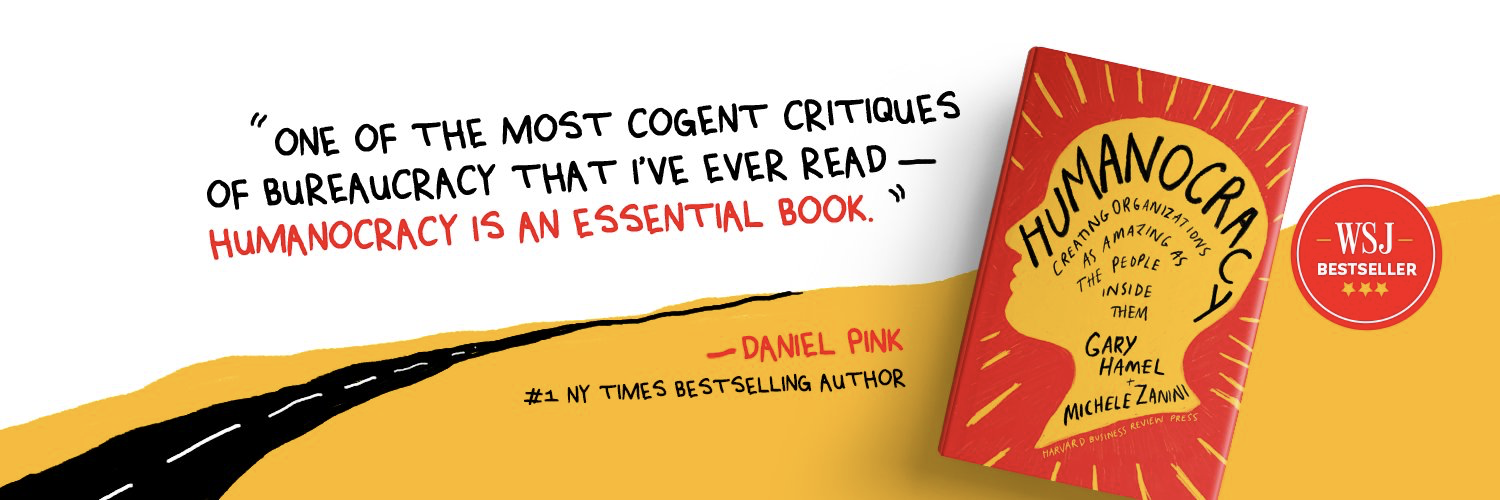

The Wall Street Journal recently ranked Gary Hamel as the world’s most influential business thinker, and Fortune magazine has called him “the world’s leading expert on business strategy.”
Hamel’s landmark books, which have been translated into more than 20 languages, include Competing for the Future, Leading the Revolution and The Future of Management (selected by Amazon.com as the best business book of the year). His latest book, What Matters Now, was published in 2012.
Over the past twenty years, Hamel has authored 17 articles for the Harvard Business Review and is the most reprinted author in the Review’s history. He has also written for the Wall Street Journal, Fortune, The Financial Times and many other leading publications around the world. He writes an occasional blog for the Wall Street Journal.
Since 1983, Hamel has been on the faculty of the London Business School, where he is currently Visiting Professor of Strategic and International Management.
As a consultant and management educator, Hamel has worked for companies as diverse as General Electric, Time Warner, Nestle, Shell, Best Buy, Procter & Gamble, 3M, IBM, and Microsoft. His pioneering concepts such as “strategic intent,” “core competence,” “industry revolution,” and “management innovation” have changed the practice of management in companies around the world.
Hamel speaks frequently at the world’s most prestigious management conferences, and is a regular contributor to CNBC, CNN, and other major media outlets. He has also advised government leaders on matters of innovation policy, entrepreneurship and industrial competitiveness.
Currently, Hamel is leading a pioneering effort to reinvent management by harnessing the power of open innovation. The Management Innovation Exchange (MIX) is an online community where the world’s most progressive business leaders share their ideas on how to build organizations that are fit for the future and fit for human beings. The MIX is supported by a network of strategic partners, which includes McKinsey & Company, the Harvard Business Review and others.
Hamel is a Fellow of the World Economic Forum and the Strategic Management Society. He lives in Northern California.




Stories, Hacks, & Barriers
Meet the other Mavericks












Vineet Nayar
Former CEO, HCL Technologies Founder, Sampark Foundation & Author, "Employees First, Customers Second" at HCL Technologies
Andrew McAfee
Principal Research Scientist, Center for Digital Business, MIT Author, Enterprise 2.0 at Center for Digital Business, MIT

Bob Sutton
Stanford University



Bill Taylor
Author, Practically Radical

Ivy Ross
Gap Inc.
Tony Schwartz
The Energy Project
Daniel Pink
Author, To Sell is Human



Greg Sutherland
Executive General Manager of Group Strategy and Innovation at National Australia Bank (NAB)