


Keep reading... Let us be your guinea pig! Our organisation Atlassian is conducting an open review of our new performance review model for everyone to see.

So, what was the problem? In short, twice a year the model did exactly the opposite to what we wanted to accomplish. Instead of an inspiring discussion about how to enhance people's performance, the reviews caused disruptions, anxiety and de-motivated team members and managers. Also, even though our model was extremely lean and simple, the time investment was significant.
If you ask your managers and staff to invest time and money in a process, it'd better be worth it. And in our opinion it wasn't - well, not in its traditional format.
First, we analysed the traditional performance review model in detail. We asked what made people perform better and what parts of the reviews worked well. We talked at length with other tech companies about their experiences and asked if the negative aspects of reviews, mainly related to de-motivation and the high levels of anxiety, tend to disappear after a while (they don't).
The triggers for this experiment was that we found nothing out there to copy (that would have been much better and easier). Sure, there are books and blogs dwelling on the negatives of performance reviews, but their solutions are too impractical to implement often ignoring the need for solid performance feedback. Also, there are systems that have a new approach to performance reviews, but no HR system supported our approach. We needed to start from scratch.
1. Rip apart the traditional performance review
We've replaced the traditional performance review structure with a more lightweight, continuous model.
-
- We incorporated the constructive aspects of reviews in the existing one-on-one meetings. Atlassian managers already have weekly one-on-ones with their team members. Now, every month, one of these meetings is dedicated to a discussion on how the person can enhance their own performance and play to their strengths.
- Removed the unconstructive focus on ratings and get rid of the distributed curve.
Instead, we gave everyone a salary bump. Similar to Netflix's approach, we prefer to pay top market salaries rather than bonuses. However, we continued to pay an organisational bonus like before, so people will share in the company's success. Also, we've recently given every staffmember stock options so people will benefit from the company's growth/increased value over time
3. Create bite sized chunks
The thing with our traditional review was that, despite good intentions, it focused mainly on two sections: the manager rating and the employee's weaknesses. This makes total sense as the first thing a person will be curious about is their rating (which also affects their bonus). Even if a person receives a "good" rating, most of the time will be consumed by justifying why the person didn't get an "outstanding" rating. We wanted to introduce a lightweight and continuous model of conversations designed to remind people to - every now and then - talk about topics other than daily operational stuff. We changed the following:
- All sections should receive equal attention. We think that the 360 review feedback can better be discussed in a separate conversation. Same goes for performance ratings, strengths, weaknesses and career development, etc.
- We split the sections into separate conversations with their own coaching topics. Every month we allocate one of our weekly 1:1s to a coaching topic.
- We created conversation guides to help everyone stay on topic, and to supply tips and tricks on how to facilitate the conversations.

3. Performance still evaluated - with some crucial changes
We think it's important not to shy away from giving honest performance feedback. Some 'anti-performance review' books suggested skipping that altogether, but we think it's a invaluable element in every manager/employee relation. In two of our monthly conversations, managers will still check in with their reports to evaluate performance. However, we make a few crucial changes:
- No 'exact rating'
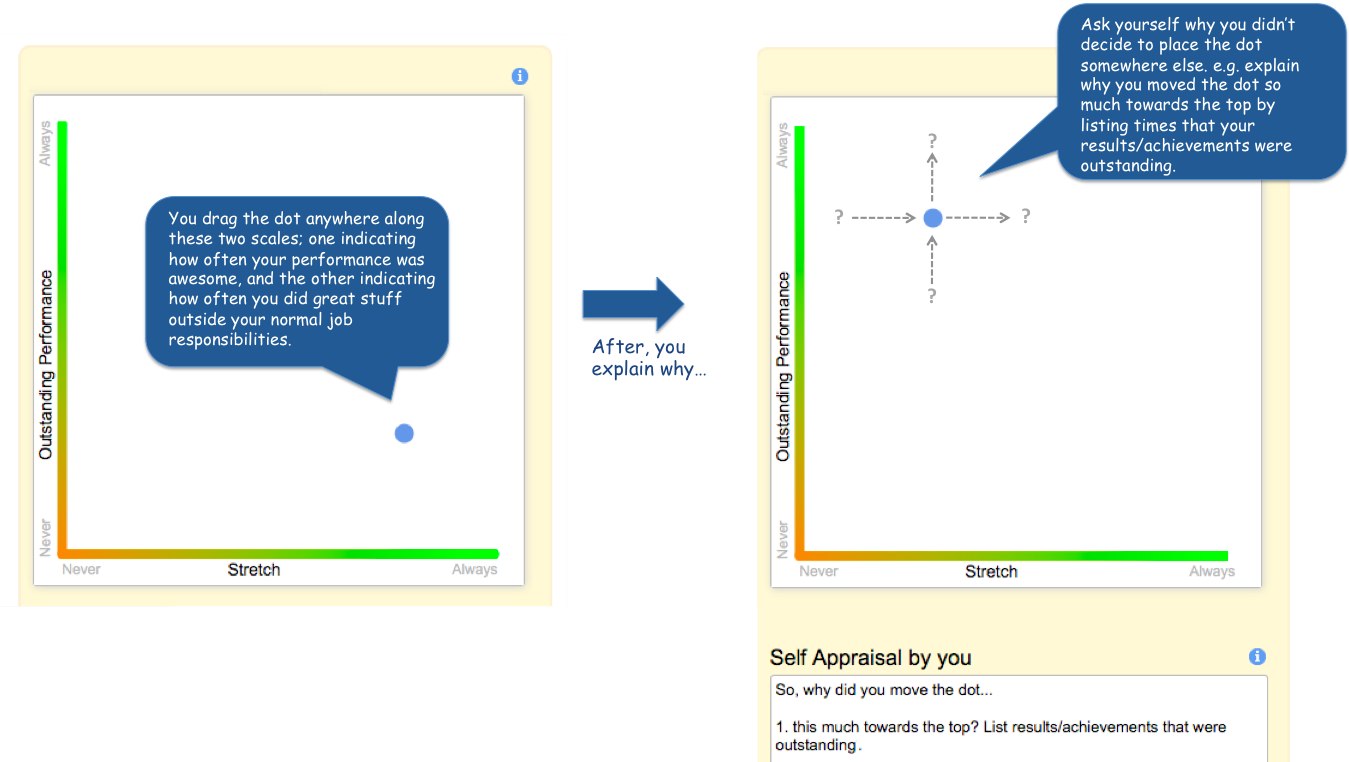
We prefer people not to concentrate on the exact rating definitions, but rather on having a good and honest conversation on how they have gone in the past 6 months. However, there will be no rating on a numerical scale. Instead, during in the check-in the manager indicates roughly how often their report has demonstrated exceptional performance.
- Two Axis
In addition to an evaluation of performance/achievements, we've added the scale on 'how often you have stretched yourself'. Put simply, the reason for using both scales is to acknowledge both effort and results. Two people can both deliver similar results, yet one of them has solely focussed on their normal work responsibilities whilst the other person has really injected extra energy in improving things outside their normal job (e.g. themselves, their team, etc) which has made a real difference to Atlassian. Feedback from Atlassian managers was that they wanted to acknowledge this.
- Focus on frequency of behaviours
The scale from 'never to always' helped people focus the conversation on how to improve the frequency of certain behavious, rather then focussing on a number. Recently, I shared this idea with the cool team of Sonar6 who translated this in a blogpost in their usual colorful way. Both staffmember and manager will decide on the person's position on two scales. When the a certain position on the axis is chosen, the logical subsequent question is: "why didn't you position this person more to the left or right, higher or lower?" This approach also encourages a better coaching style review conversation.

- Lack of best practice: there was not literature or best practice out there (or we couldn't find it) Lots of books focus on the negatives of performance reviews but they offer solutions that are too much focussed on just coaching, in not enough on the alternatives to the actual performance conversation. They also didn't offer much guidance on how to structure the coaching conversations themselves. We ended up merging different ideas including suggestions from the HR industry, strengths based coaching, motivational theories, and different rating evaluation scales.
- Systems: To my knowledge, there is no HR system that offers an integrated approach including regular 1:1s, coaching 1:1s and performance review check-ins. There are the heavy and traditional performance review tools like Successfactors and SumTotal. Conversely, there are some cool continuous feedback tools like Rypple - who I understand are designing a more integrated solution for Facebook. We finally found an awesome start-up who has created a really smart solution - called Small-Improvements. Small Improvements features all sorts of goodies in a nice lightweight app, can facilitate our performance check-in process and capture continuous feedback/coaching.
- Coaching conversations: The managers (some very new to the role) had little to no experience in how to handle a coaching conversation. We ended up engaging an executive coach who trained our managers in how to have a good coaching 1:1s.
- Team sizes: One of the first problems we highlighted was when a small group of managers said they wouldn't have enough time to discuss these topics once a month. And that highlighted a larger problem. Some teams were plainly too large for one manager to handle. This meant that, whilst the team was productive and well oiled, some people rarely met with their direct manager to discuss non-operational topics. That was one of the reasons we decided to form smaller, more agile teams and introduce a group of new team leads.
- People love numbers. They are objective and easy to analyse. So, when we decided to take out performance ratings many people felt uneasy. Truth is that people generally understand that, if their performance is indicated to be closer to the bottom-left corner of our performance/stretch axis, they have to step it up. You don't need a rating or a number for that! Also, we noticed that salary reviews and talent management didn't need an exact performance rating - as a matter of fact, we've never had a direct relation between salary and people's ratings. Other factors such as market salary movements, internal and external salary benchmark data, years in the job and skill-set all help determine salary growth. Few organisations would calculate their salary reviews in a simple formula.
- More focus on people's strenghts: instead of only operational 1:1s, every staffmember (100%) has now had discussions about their likes and dislikes of their current work. Coaching conversations uptake has been awesome. Within weeks of launching this new approach, all staffmembers have had converations about their strengths and how to dedicate more of their time on things they love.
- Motivation & recognision model changed. Instead of performance incentives that don't work, our model has shifted to encourage desired behaviours through better coaching. Also, a Kudos model where every staff member can recognise great performance of co-workers without their manager's approval has been implemented to supplement this new performance model. This peer feedback model has been extremely popular. since launching this, already 150 peer-kudos gifts have been handed out. 75% of staff who displayed outstanding performance were recognised by peers outside any formal process
- Engagement: Atlassian has been awkowledged as an Employer of choice internally and externally. Independent and internal staff engagement surveys showed extraordinary high engagement scores of 87% and 83% respectively. Last year, we've won several Best Employer awards, including Best US medium sized companies to work for, and a Highly commended award in Australia for HR Leader's Employer of the Decade.
- Challenge HR best practice - if the whole organisation hates something, yet you invest huge amounts of time and money (through bonuses) in performance reviews, something is wrong, best practice or not. It is HR's job to fix these things!
- Don't be stopped by the lack of HR systems - It's very difficult to change your model when HR systems can't support your ideas (and we can't go back to pen & paper). Big HR system providers will encourage you to keep with the current model and present traditional reviews as best practice in magazines and at conferences. Keep charging ahead - there are solutions out there developed by new start-ups.
- Make bold decisions - Performance bonuses are ingrained in our compensation model and staff ratings are the starting point of our talent management programs. It's hard to change these things. be courageous.
- Dan Pink's TED talk
- Markus Buckingham's books
- Atlassian's Talent blogs




Performance management is one of the biggest issues that HR professionals face every day. Thankyou for sharing this concise and informative article with everyone, it can be helpful for any HR professional in many ways.
Our company www.coggno.com offers many training and courses to make the life of any HR professional easy! For performance management also we have lots of courses to offer.
You can check out one of them here: http://goo.gl/JXx2Wc
- Log in to post comments
I like to keep performance management simple:
1) Communicate Expectations
2) Coach for Success
3) Recognize Results
Do this as often as possible (even daily!) and annual performance reviews will be painless.
Our company, www.HumanResources.Pro, developed our own performance management SaaS for this:
Perfecting Employee Performance (PEP). It’s cloud-based, intuitive, and the PEPTalk feature facilitates those frequent conversations. See what I’m talking about at www.pephr.com
- Log in to post comments
Hi Joris,
First off, it's great to see someone taking this view and being bold enough to experiment a little. I'd love to hear what your employees thought of being guinea pigs, hopefully they saw the good in what you were doing and you got a good level of buy-in.
Couldn't agree more with the "big bang" approach not working. You guys doing reviews every 6 months is relatively unusual as most companies I deal with have annual reviews. The main reason for this is that it's such a pain to run the process, so they can't stomach it being any more frequent. It's a pain for many reasons, most of which you picked up on here.
Personally, I don't think you can divorce performance management from the operational environment, but many companies do try and do this. People should be reviewed against what they are there to do, which is operational delivery. I believe that if you tie the two together, then you you get performance data 'for free'. This, of course, does mean that you need more frequent reviews. The process and tools to support this need to be light, and preferably built into the day-to-day operation of the company so it's not "another thing you need to do that ancillary to the day job". People development can still be tied to operational delivery (after all, why else do you do it?) plus if the development itself is connected with a 'real' deliverable, then it's far more likely to be achieved.
I think that people need to understand what the performance review process is there to do and how they would benefit from it. By benefit, I mean more than just arguing a good rating to get a good bonus!
I like the idea of 'chunking' sections, I should give that more thought for our own system.
Anyway, I'm subscribed now and look forward to reading more.
Rob Wheatley
Cogendo
http://www.cogendo.com
- Log in to post comments
Joris,
We are in the process of revamping our performance review process and this blog is exactly the direction I was thinking. Would love to hear if you have any updates since October on what's working and what's not. The primary issue I have with the traditional approach is we live in a world of just in time and by the time you sit down for a review the feedback is really stale - you've already moved way past it. I believe continuous feedback is critical and love the idea of taking one status a month to do coaching. As you point out key is making sure your managers know how to coach. Do you have any recommendations on a favorite course or book on coaching? Personally I love Crucial Conversations but that ensures folks have the right conversations at the right time, not the same as coaching. Also curious if you have found a favorite tool for peer feedback or perhaps you are developing one. Higher Grounds but they are still in early beta by invite only. I am also thinking of integrating this process with 4DX wigs. Anyone out their done this?
- Log in to post comments

Nice story. I think people struggle with performance reviews because, for better or worse, they seek the predictability and seeming simplicity of a number ("my assessment score") that quantifies their performance in a largely unpredictable environment. The engagement around conventional approaches to performance assessment becomes tedious because both parties introduce the various elements of unpredictability that support their respective points of view.
Are we being objectively subjective or subjectively objective about the person's performance? The mind reels.
I don't know what Atlassian does. However, the engagement model cited here would seem to serve as a good basis for a product -- or offering -- for other firms trying to navigage new channels carved by the Digital Age.
- Log in to post comments
Thanks for sharing these great tips. I especially enjoyed the thought about restarting the day at 2pm and reassessing your priorities; great tips!
- Log in to post comments
I really like what Atlassian is doing. I haven't been an avid follower...till now. How has Atlassian articulated the value proposition for folks who love their craft and want to remain in their craft without crossing over to the management/leadership career path?
- Log in to post comments
Great info
I've struggled with this for 10 years in 3 different companies
I like to tool, the support framework and the overall approach
- Log in to post comments

- Log in to post comments

Joris, thank you for sharing this detailed account. I recall Dan Pink mentioning Atlassian's practices in Drive and wish more corporations would do away with the traditional ways of evaluating and rewarding people. I believe most current practices feed on people's fear and insecurities, rather than champion their strengths. Plus transparency has become such a buzz word. Most management teams say they believe in it but hardly practice it. When CEOs model "yup, I f**ked" up" then we can start to feel the shoulders of those who follow under them, practice what has been modeled.
So question for you, like Zappos has created a college to educate other firms on how to live the Zappos way, has/is Atlassian doing something similar? I believe more of us that create the new reality and teach it the faster we will have the change we desire. (yeah I think Gandhi said that)
Bobby Bakshi
Chief Inspiration Officer
www.resonantinsights.com
- Log in to post comments
Joris, thank you for sharing this detailed account. I recall Dan Pink mentioning Atlassian's practices in Drive and wish more corporations would do away with the traditional ways of evaluating and rewarding people. I believe most current practices feed on people's fear and insecurities, rather than champion their strengths. Plus transparency has become such a buzz word. Most management teams say they believe in it but hardly practice it. When CEOs model "yup, I f**ked" up" then we can start to feel the shoulders of those who follow under them, practice what has been modeled.
So question for you, like Zappos has created a college to educate other firms on how to live the Zappos way, has/is Atlassian doing something similar? I believe more of us that create the new reality and teach it the faster we will have the change we desire. (yeah I think Gandhi said that)
Bobby Bakshi
Chief Inspiration Officer
www.resonantinsights.com
- Log in to post comments

Hello Joris,
I wanted to comment on your challenge #2 ... "no HR systems". We are another one of those "new start-ups" with a new model for tracking and managing performance. Unlike the traditional heavy-weight performance review systems, our solution is actually designed to support performance improvement and effective on-going communication between managers and employees.
4 Spires (www.4spires.com) offers a solution based on the concept of negotiated commitments. Managers make requests, not assignments. The software guides the employee to make an explicit response, i.e. agree to deliver on the request, decline, or make a counter-offer. Presenting the performer with the opportunity to negotiate their delivery commitment clarifies ownership and assures accountability, not to mention increases the likelihood that the delivery will be made on time. The weekly one-on-one meetings is an opportunity to review the software's dashboard reports that keep track of all commitment conversations in play plus completed conversations. The software adds further value by providing deep visibility into execution details, capturing performance metrics over time, and exposing patterns of behavior. This never-before-seen granularity around the week-by-week, month-by-month deliveries makes for really effective coaching.
Commitment based management has been described as the most important new management practice to emerge in the last several decades. This simple, but profound innovation in work management, first introduced by Fernando Flores and Terry Winograd in the 1980's, has been profiled in the Harvard Business Review, MIT Sloan Management Review, and the Wall Street Journal. These changes in management practice will disrupt current top-down/command-and-control work norms and increase trust. Let me know if you'd like to learn more.
- Log in to post comments
I am trying to get buy in at our new company to try soemthing along these lines after having a truly horrible rating system dumped on me a couple of weeks back.
I hope my colleagues and I are able to change the traditional thinking (about which most are instinctively aware is not going to work for us) - just need to find an appropriate alternative, something like this!
Thanks for sharing Joris, something which in itself is inspirational.
@Steve - good points! The issue I thnk we will have is going to be with splitting the org. into manageable yet functional teams; then with the team leaders being upskilled to deliver a coach based continuous feedback process that aims ultimately at performance enhancement, not salary or bonus distribution.
Excitingly challenging times!
- Log in to post comments
This is definitely one of the more innovative and balanced discussions of the performance review problem I've seen in recent years. Great stuff!
A few things that leapt out to me:
1. Existing performance review technology can be used to support this sort of process, albeit not exactly as described but close enough to capture the main concepts. But few companies configure the systems this way. In other words, the way existing performance management systems are typically used is not the way they probably should be used (full disclosure, I work for one of those "traditional performance review" companies).
2. Tying performance evaluation processes too closely pay decisions is a typical downfall of the standard performance process. The process becomes about justifying salary decisions rather than increasing productivity. But the extreme solution used at Atlassian of totally decoupling performance from pay is probably not feasible in most companies given the size and nature of their workforces and constraints of their financial operating budgets. But the Atlassian approach definitely calls out the direction companies should take if the objective of these systems truly is to drive higher levels of performance.
3. The emphasis on training managers on how to give feedback is a major point. Very few managers, let alone people, are good or comfortable giving critical feedback that increases people's awareness of what they need to do to be more successful while also building confidence in their ability to do it.
Great stuff. Thanks for sharing.
- Log in to post comments

Great ideas here- I've struggled with running performance reviews in 3 different organizations now and can relate to all aspects of this story. I like the idea of having employees rate themselves on their stretch- interesting to compare this to how managers rate them on potential. Rypple's coaching tool and Sonar performance reviews are great pieces of software, but no one has perfected the whole process and it takes a coaching culture to make a lot of this work. I am a big fan of the templated monthly discussions- something I have thought about but never actually been able to implement! Having used Confluence and JIRA in the past- I am really glad to see enlightened 'talent' work coming from Atlassian and no surprise as this is a great company.
- Log in to post comments

Joris awesome idea! I am so glad to be working at Atlassian and actually using this new approach! What a wonderful idea - complete paradigm shift. So many organisations I have worked for in the past could gain from it. Wonder why they try so hard to categorise so many different individuals into the stock standard 1,2,3,4 and 5 ratings. Now you have offered everyone this great big range - to move the dot - to fit different individual with different strengths. So many more options and much more open.....just leads to more open conversations. Perfect for our "open and honest - no bullshit" company.
Shubhra
- Log in to post comments
Big fan of Dan Pink's "Drive" - awesome to see it put into action at Atlassian. The old carrot-and-stick paradigm doesn't work for an organization that wants to maintain a culture of innovation and creativity.
Great read, Joris.
- Log in to post comments
Great read! Awesome to see creativity and 'out-of-the-box' thinking extend beyond product develop in an organization. Truly great companies, like Atlassian, seem to understand the importance of excelling in multiple areas simultaneously - culture and employee motivation yields better products, which then equates to high customer satisfaction and revenue. Good stuff Joris - it all starts with employee management and retention!
- Log in to post comments
Very insightful, Joris - interesting to note the positive results of the peer-recognition policy you implemented.
- Log in to post comments
Joris, awesome post. It's amazing to see how Atlassian has maintained its "startup" culture even as it's grown into a large, global organization. Really impressive!
- Log in to post comments
Great article Joris, awesome to see how Atlassian continuing to push for performance and creativity in its approach.
- Log in to post comments
Great blog post. It amazing how far you've gotten. As you know, we did something similar a couple years ago at Mozilla and it was very successful. We worked closely w/ Rypple to develop an application for managing 1:1s and feedback. Seems like it's exactly what you're looking for. You should check it out again.
Dan Portillo
- Log in to post comments

Yes - Joris I hear you deeply and could not agree more. Here is how I handle evaluations in Master level courses with MBA leaders. I align the task directions with the assessment criteria, so these two are exactly the same. Then I negotiate the criteria with the leaders. They love that because it gets all of us on the same page. Then when they are evaluated they are happy 100% of the time -- because they had a voice in the process.
At the Mita Brain Center - we have very deliberately exchanged the traditional culture that is accustomed to CRITIQUING FOR MISTAKES - into a culture of TARGETING IMPROVEMENTS together. Approaches are very different in the latter:-)
- Log in to post comments

@Ellen - Ratings help managers to be honest. However, the problem we found is that - even though organisations try to define and calibrate performance ratings - every manager will have a slightly different interpretation. And that leads to performance review discussion focusing more on the rating definition and on justifying of a certain rating (causing anxiety), rather than on discussing how to improve the frequency of a person's good behaviors/attitudes.
- Log in to post comments

Joris, I agree with Ellen - this is a bold experiment aimed at swapping quantification for something closer to actionable truth. As a University of Chicago graduate, I never thought I'd say that with pride!
Thanks for the contribution!
Jeremy
- Log in to post comments
Great stuff! Thanks for this motivational idea - Joris, what a keen topic for this time in history. I loved your emphasis to focus more on people's strengths! There are all kinds of reasons in research why this will work better for all leaders and for the field, to bring about the growth many leaders crave. I am especially interested in this topic -- and even published a book in 1999 on the topic with Pearson Pub.
Would you agree that the "love for numbers" comes from a bit of flawed thinking that numbers take out the messiness of ideas and make sharper delineations between facts? Of course, the opposite is often true, in that numbers simply give appearance of clarity - whereas the points you raised here show performance can be assessed in far more intelligence-fair ways. Thanks for your input.
- Log in to post comments
You need to register in order to submit a comment.