


Barrier:
Ongoing feedback: why do we ignore something we want so badly?
While so many of us acknowledge how critical ongoing feedback is to engaging and developing top contributors, very few actually do something about it. What's up?
Thanks to iPhones, BlackBerries, Facebook, Twitter and their contemporaries, we get so much real-time input in our daily lives. We're bringing this addiction to real-time to work. Yearly reviews don't cut it: we want to know how we're doing, what others think of us and what can we do to improve - and we want to know now! We're not afraid to ask for it, and we're not afraid to leave our jobs if we don't get it.
- Better team performance
- More engaged team
- Faster learning and development
- Better collaboration
- Improved focus and alignment
Many leaders recognize the importance of feedback, but very few seem to do anything about it.
So why doesn't more feedback happen? What's holding us back?
We're busy, feedback can be difficult to give and take, and many leaders don't have easy ways to share and track feedback. We're jaded by performance appraisals - heavy-weight processes designed for evaluation, pay, promotion and succession, fighting a fruitless battle to retrofit themselves for engagement, coaching, learning and development. Appraisals don't work for ongoing feedback because they're not designed for it. They're:
- Infrequent. Feedback isn't immediately useful, or delivered when it actually matters.
- Impersonal. The process is formal, rigid, top-down, stressful and even scary.
- Patchy. Tons of relevant, helpful feedback is forgotten because we don’t prepare for reviews until review time.
- Not actionable. Too much feedback is delivered at once (during the review) to be acted upon effectively.
- Misaligned. The focus is on pay, promotion and succession as opposed to learning, development and engagement.
- Stressful
- Time consuming
We spend more time preparing for reviews and worrying about them than we do actually considering and acting upon the feedback provided. That's frustrating. It's not what people want.
Some organizations simply ignore the problem and don't encourage feedback. That's dangerous too. When they're not getting enough feedback, people:
- Disengage
- Get frustrated
- Don't do their best work
- Leave
I ran a poll on LinkedIn, targeting managers and executives with the following question: "Does your team want more feedback?"
The results? 76% responded "YES"
This same response rate was evenly distributed across company sizes, job titles, job functions, gender and age. View the details.
I also asked a couple of questions on LinkedIn about feedback and got some really insightful responses. Here are excerpts:
- "I'd like to know how management feels about my performance. For example, do they see areas where I could improve?"
- "...there are always 2 answers to this question. The first is the obvious response from all managers that feedback is critical/crucial etc. The second is the reality as experienced by the employees in the company."
- "Without feedback, none of us can improve our businesses..."
- People feel they don't have time for feedback.
- Feedback is easy to defer in favor of other priorities.
- We often assume people know what we're thinking.
- People aren't comfortable giving and receiving feedback.
- Feedback can create tension (or, at least, people fear that it can).
- No easy way to share feedback: face-to-face conversations aren't always possible or necessary, email can be a barrier to candid feedback, and performance appraisals don't give us what we need.
We can break through this barrier by getting in the habit of sharing feedback on a regular basis.
Getting in the habit of regularly sharing useful feedback is like going to the gym. You may really want to do it for some time, you may even know that people around you want you to do it, but for one reason or another, just don’t get to it. Once you do, however, and get into a routine, it feels great.
Leaders in the organization need to set the trend. These are the people who take initiative and lead by example, despite their position in the hierarchy.
Here are a few suggestions for getting in the practice of sharing useful feedback:
- Meet regularly with each member of your team, 1-on-1
- Recognize good work when it happens
- Where appropriate, make recognition public
- Proactively ask for feedback – of your employees, manager and other colleagues
- Encourage the behavior by saying “thank you” when you receive feedback
- Be specific when you share feedback – it’s more useful and more authentic
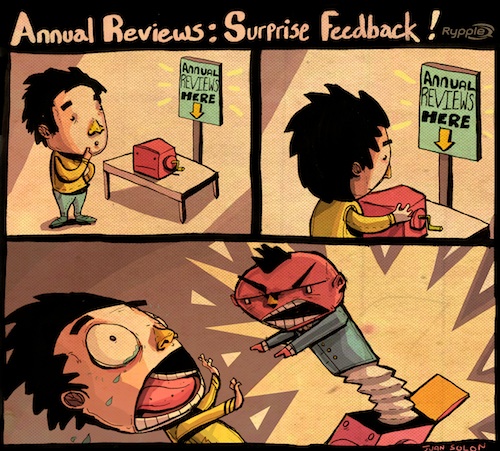
Uploaded images by Juan Carlos Solon.


I agree with the barrier and the solution (although I've added an additional point at the end of my comment).
This is a favourite topic of mine in discussing with clients the broken practise behind most performance management schemes. I typically use a sporting analogy, since that is the common language for pretty well everyone in sports-mad Victoria, Australia. My sporting analogy is this:
- A group of talented individual players are chosen for a team sport - let's choose soccer in this instance (the type of team sport isn't too important)
- Each player has earned the responsibility of a role on the team
- Each player is told how their performance in that role will be measured on the things that matter. For defensive players it might be their ability to mark the opposition's attackers, their tackling and defensive clearances, for mid-field players it could be their tackling, passing and positional awareness, for offensive it could be as simple as goals and assists (but is likely to be more complex).
At this point each player will be nodding in agreement. This all makes sense, they've been coached, selected and groomed in this sport and for their role since they started to play they game. They know the rules and they know what success looks like.
Then you place Management 1.0 thinking over the top and tell the players: "so we're going to keep track of every single instance of your performance against the measures that matter for your role, and at the end of the season we'll tell you how you did."
To which the players shocked response is "At the end of the season, are you kidding? How is that going to help our performance. Why not at the end of every match, every half time, before during and after training?".
To which the lame management response might be "Well we thought that might be too hard...."
I think the solution to this barrier requires two things:
1) a set of behaviours and habits of the type described by Jesse, AND
2) The ability of the manager to recognise and perform their duties as a coach
This ability isn't innate in all people in a management position. In the same way that not all managers can be leaders, too few managers are able to be coaches. We need to select and measure managers of people on more than just their subject matter expertise.
- Log in to post comments

Well stated and imagine the different results to the innovator. You vulnerably place your 2-bits onto a table and you get feedback that suggests a few questions you might ask, or answers you might unpack, or even a few things you did well...
That response alone, builds the kind of serotonin into the brain that goes forward, takes risks for improvement, and sends people back to relate to the commenter!
Now consider the same scene, where you placed ideas onto the table and a lurker, without any ideas to improve your design, jumps in and leaves a hidden grade that knocks the piece to the bottom. That same act sinks brainpower, builds distrust and reminds people to follow norms rather than design anything new or original.
From the brain’s perspective: Openness and sincerity create trust. Hidden motives, behind anonymity encourages toxins that destroy growth. What do you think?
- Log in to post comments

I truly agree with this. What if, we can openly rate everyone's performance and as a result, feedback becomes part of ensuring you continue to keep up?
A mentor once told me, "Work like you may get retrenched tomorrow" --> That is uncertainty that produces good stress. An open feedback forum may provide the same, and if our performance is dependent on others, we better score!
In fact, how about if we rate our leaders too?
I have included some of these ideas here on my hack, at this link. http://www.managementexchange.com/node/11305
Thanks and looking forward to feedback. :-)
- Log in to post comments

Hi Jesse
As someone with a deep interest in feedback, I thoroughly enjoyed reading your description of this barrier. I like the survey work and the root causes that you have listed. And I couldn't agree more that feedback has a certain similarity to going to the gym! I think you are absolutely on target about the whole issue of regularity and making it a constant practice. At least for me, for whom both exercise and feedback are not the easiest or first thing I think of doing.
I believe feedback presses on us as people in places we might not feel good about going -- like our own inner views of ourselves. For one thing, people identify with the person who is their receiver and worry that it will hurt the other person. Or they may worry that if they start down that road, it will result in a defensive reaction and soon they will become the receiver, and who knows where that might go?!. Even the process of asking for feedback, which is a special interest of mine and I believe is a core breakthrough area, is tough for people to learn.
Here's a thought I've been tinkering with for a long time, and love to discuss. Feedback, per se, is assumed to be a source of personal and professional change. I give you feedback; you take it in; you change how you behave or perform. You give me feedback, I take it in, I similarly change what I do. But it is not always that straightforward, right. In fact, you or I MAY need to hear the feedback for a very long time before it really becomes actionable. We may need to be truly open to it. We can't just go through the motions. Feedback can penetrate (or attempt to penetrate) self-image. That's why, I believe, so many 360 degree evaluations actually do not result in change. The processes of growth around self-image seem to be very slow, especially around the really big issues of temperament, interpersonal relationships, and leadership. How can we help people make the choice to receive and really open to their own possibilities through feedback?
So to me, the extension of the barrier is what people do with feedback and how they do it. Thank you so much for bringing this whole issue forward as part of our learning, and also for the great list of materials. To me, this issue just begs for a dialogue!
- Log in to post comments

Hello Jesse,
I wonder if this will come to your notice. I have not been getting notifications from MIX of late.
Saw your reply comment today. I agree it is possible to improve Feedback. David Packard, Ken Iverson, Sam Walton and others in fact succeeded in making it a culture. My point is that organizing and driving Feedback takes up a lot of personnel energy and leadership time. The results of the investment are uncertain. Further, any growth in the enterprise will raise interactions geometrically raising the load on personnel.
Q: Why tax personnel and leadership effort for raising Feedback when the same and much much more can be achieved with the inexhaustible energy of IT? The personnel route made sense so long as IT could not drive organization and discipline. Now, with this possible, personnel can concentrate on bringing about a quantum jump in performance with the same resources.
May be I am overlooking something. Will be happy to receive your opinion.
Regards,
Raj Kumar
- Log in to post comments
Hello Dhiraj,
The interaction here motivated me to modify my old Sketches and create a new Hack dedicated to Feedback at http://www.managementexchange.com/hack/assuring-results-empowerment-and-... .
- Log in to post comments
Your Barrier raises an important question. I see Raj has also commented on your post. In this context I enjoyed Raj's analysis of Feedback at http://www.managementexchange.com/barrier/importance-dreaming-about-free... .
MITA has scientifically studied human behavior patterns to determine interactions that will lead to constructive interaction. I assume this will also include Feedback. You may like to have a look at http://www.managementexchange.com/hack/celebration-innovation-%E2%80%93-.... Raj has harnessed IT to drive free-flow in context. He says this will assure Feedback. See http://www.managementexchange.com/hack/compelling-energy-quantum-jump-or....
It will be interesting to know what you, with your experience, think of the two approaches. On the face of it your approach has an affinity with the approach of MITA.
Regards,
Dhiraj
- Log in to post comments
I entirely agree with the stated Barrier. However, the solution asks for the very element which it identifies as the shortfall - energy. Next, it is high on form and that requires organization and discipline, which again translates to energy. Do you think the solution will sustain? Would you consider other sources of energy for feedback of the kind gathered by Discussion Boards attached to almost all web news stories?
Regards,
Raj Kumar
- Log in to post comments

- Log in to post comments
You need to register in order to submit a comment.