


Hack:
Compelling Energy for a quantum jump in organization performance with the same resources
Feedback delivers goals. Busy administrators lack the Time and Energy to drive the required Knowledge free-flow in context. IT today is a helpless tool because a one-size-fit-all interaction process is impossible. My all-sizes-fit-one process creates the IT-is-inexhaustible-intelligent-energy paradigm. It fosters a teaming culture for Knowledge free-flow in context. Success follows.
The Goal: A quantum jump in the performance of organizations with the same resources.
- The goal is important since mankind is threatened today as never before. Environmental degradation, climate change, terrorism, accelerating earth consumption, unchecked population growth, populism, profligacy and self-aggrandizement are related phenomena that mankind must tame and quickly. The phenomena demand a superior ability to administer resources.
- The performance of organizations directly reflects the ability to administer resources.
- Policy and Strategy are the main instruments for effective administrative action. However, they alone cannot transform performance. Today, in the absence of a mechanism for application of Knowledge by personnel to achieve goals, there is a huge Policy/Execution or Strategy/Execution gap.
The Problem: The stagnation of Collective Ability
- Even intuitively it is clear that constructive uniting of the collective behind the leadership can transform results with the same resources.
- The civilized world is in the process of exiting the old command and control systems as they are poor in uniting knowledge workers behind the leader. An alternative has not taken shape though idealisms abound.
- Peter Drucker noted (1) in 1992 that productivity or ability of the Knowledge worker has, for all practical purposes, stagnated during the twentieth century while that in the manufacturing sector has grown forty-five fold due to the advent of the Assembly Line.
- Even the best organizations rarely exceed 30% of their potential (my estimates based on findings of Marcus Buckingham (2): only 25% personnel are committed, 50% sit on the fence and 25% work against the interests of the organization; and Jerry Collins (3): the best organizations beat market performance by an average of 7 times). Further, Buckingham’s data shows Collective Ability varies widely across the organization.
- My Barrier 'Absence of a means to exploit the latent collective ability for pursuing success' identifies Trust and Teamwork as the cornerstone of Collective Ability. The barrier states the Conventional Wisdom that governs Knowledge work today: only personnel can organize their Knowledge interactions.
- It is possible the physical upper limit to the time and energy personnel can spare for self-organizing their interactions to raise ability has already been reached. Besides, the first priority of personnel is results and not self-organization.
- The problem of stagnation is severe as the incidence of Knowledge interactions is growing rapidly per McKinsey (4).
It is likely that stagnation of Ability in applying Knowledge has suppressed the trust and the teamwork needed to emerge the reality, concert action and share responsibility. Fear of opportunism by peers, the reluctance to participate or commit, build-up of hierarchies for control, inability to progress the ‘And’ over the ‘Or’, rise of individual incentives, rampant cynicism of management wisdom, executive action disconnected with the Reality, and self-aggrandizement are some of the major symptoms of Stagnation of ability. Most of the problems that plague managements today like poor personnel autonomy, leaving brains at the front door, rising stress levels, internal strife, the reluctance to experiment, and politicization of decision making are amongst the secondary symptoms of the stagnation.
NOTE: The hurdles resolved by this hack are presented as Barriers for easier comprehension. Also, the hack has been abbreviated for easier absorbtion. Notes are linked where relevant. Rapid overview provided by presentation: Solution Overview (Click Here).
My Breakthrough Solution:
My recent hack ‘Solving the ages-old problem of the 'ignorant diagnosis' traces the ills of Management to the vicious Knowledge trap of either wishful thinking or the obvious that snares both Knowledgeable personnel and collectives. The trap is activated by multiple interpretations fitting the same facts and human folly of choosing self-interest over reality. My Hack ‘Achieving the ends of Knowledge with feedback’ explains how free flow of Knowledge in context serves to raise the Collective Ability. My Barrier 'Neglect of the accumulated Management Wisdom' introduces the concept of a compelling Knowledge Assembly Line to reliably assemble the interactions that take place spontaneously on each event as it circulates. The assembly coordinates the interactions to create a pipeline for the natural flow of Knowledge. The flow is quite similar to the popular Discussion Boards on Web News Stories. My hack ‘Creating a common language to unite stakeholders’ explains the development of a language that uses the Knowledge captured by the Knowledge Assembly Line to anchor Dialogue or free-flow of Knowledge. The concept of a language for daily usage explains why the Knowledge Assembly Line is adopted for all interactions.
The following is an insight to my Breakthrough process for converting IT from just a tool for Knowledge interactions to inexhaustible intelligent energy. My work goes on to harness this resource to provide the immense energy required for organizing and driving the Knowledge Assembly Line that tames Knowledge interactions.

The breakthrough does not create technology. It is a science developed from the universal norms, logic and relationships of teamwork. The science is used to harness technology. In brief:
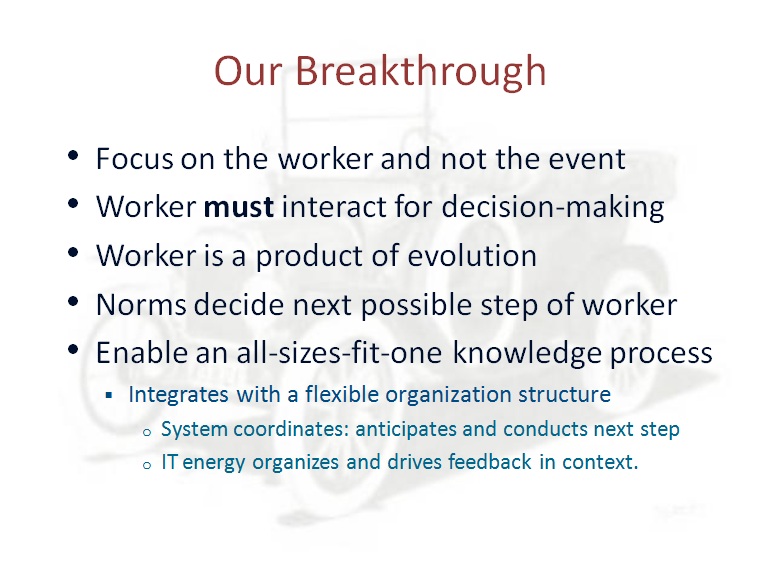
- Civil servants and corporate professionals are end-products of the evolution of teamwork; their interactions are therefore governed by norms. I have identified the finite repeatable Actions with which they interact and the norms for deciding the Actions that follow a given Action. This enables a single rule for administrators to select their next Action on an event. Repeated application of the rule on an event during its circulation creates a single process to coordinate administrators for conducting all their Knowledge interactions. In effect it sets up a Knowledge Assembly Line. The administrators are coordinated even if distributed in space and time. The Knowledge they exchange flows through the pipeline established by the coordination in a manner quite similar to the Discussion boards on news stories. The difference is the emphasis on Facts and Assumptions by the author for converting the flow into Dialogue. The science also conceives a universal organization structure that satisfies the optimum structure defined by Nonaka (5).
The Architecture to conduct interactions and assure delivery of the Knowledge Assembly Line.
The technical breakthrough is based on my published paper (6) on the Science Of Interactions. I have now succeeded in migrating my implementation of the science to the enterprise scale. It consists of two parts:
- Breakthrough Part -1: Development of a flexible and universal Organization Structure integrated with event capture;
Note: The hierarchy in my system is not meant for control but for guidance and mentoring a defined set in relation to a pre-defined domain.
Please CLICK HERE to view full notes for this Section
- Breakthrough Part-2: Creation of a scalable and reliable single process to converge IT with Knowledge work and spontaneous interactions for compelling and systematic delivery of the Knowledge Assembly Line on each decision event. CLICK HERE to see the model for the Line: the Comment Board for news stories. See Doc_2_System Flow or CLICK HERE to view the Dialogue or free-flow established in context and experience its ease of conduct.
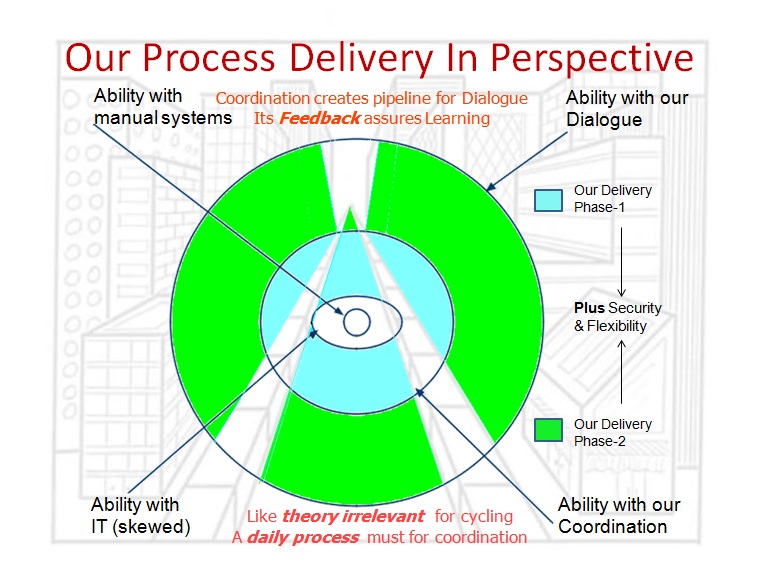
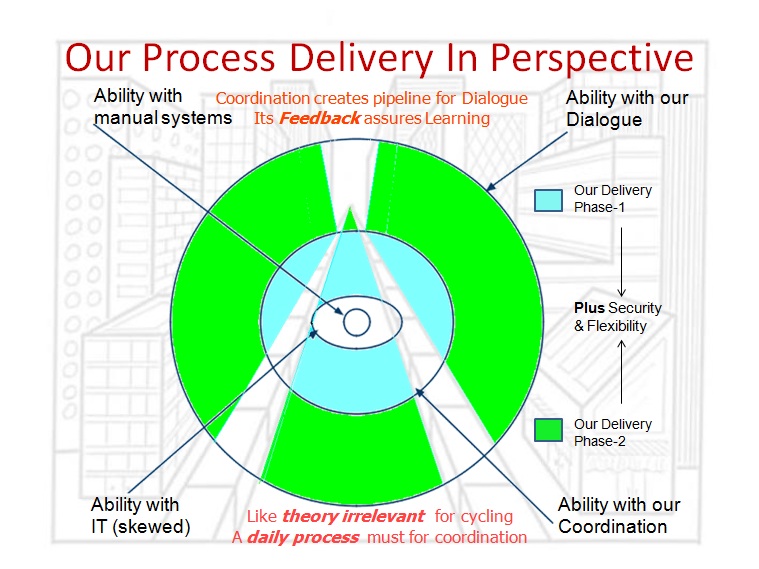
The change that organizations need to make in their core processes for adopting my solution:
ONLY replace use of email for business communication over the intranet / extranet with my infrastructure for all work and interaction. (Extranet covers the extended organization of selected customers and suppliers)
- The solution is primarily a communication backbone for the enterprise driven by IT. It replaces email with a smart interface that is over ten times more appealing for business communication and does not sacrifice any virtues of email.
- Once put in place the interface is compelling for the conduct of interactions and coordination on each event regardless of chaos. It offers popular IT tools in context for work and collaboration. There is no disruption. Adoption takes place without incentives as satisfaction of the needs of the Knowledge workers is built into the way of working. The natural flow of Knowledge brought about by the coordination is captured systematically. The Dialogue Board comes to the User. It enables Feedback. See Doc_2_System Flow.pdf in Materials Section. The ease of working and Feedback induce a culture for meaningful collaboration on each event regardless of the interaction load. The culture may be expected to develop the discipline and skills needed to raise Collective Ability or Trust & Teamwork for application of Knowledge. Positive reinforcement cycles for performance gains are set into motion. Further, systematic capture of all Knowledge exchange raises the available Knowledge and provides information for retrospective sense making.
- The flexible hierarchy defines personnel available for mentoring and support activities, the distribution of responsibilities at a point in time, and location of archives for particular event types. Experts can be identified based on their past contributions. The team that actually works on an event can be as dynamic and x-border as needed. The organization thus has the choice to be as conventional or emergent as desired. It can choose to evolve gradually.
- An evolved leadership can leverage the means established to progress the ‘Freedom’ of the personnel for raising the level of their contribution. This is because Freedom of response with access to senior levels of management translates into free-flow of Knowledge as explained in my Barrier ‘The importance of dreaming about the free flow of Knowledge’.
- The 24x7 tireless communication platform required is developed using Replication technology. The technology is as robust and time tested as email, if not more so, since it has developed as an intrinsic component of data management since the late 1980’s. My software smartly synchronizes database changes whenever connection takes place between a client and its server shared by multiple personnel, and between location servers. The smart replication leverages the comprehensive categorization achieved. It takes into account norms of teamwork, hierarchical relationships and processing performed in addition to chronology of database changes.
- Paul Strassman (7) has built up a reputation for a well-founded jaundiced view of IT in service of business administration. The heart of his viewpoint is that the bureaucracy has employed IT to build up its complexity. My work is focused on easing the conduct of Knowledge interactions, liberating personnel from disciplined performance of interaction procedures and empowering them to surface reality. Administrators, particularly in a bureaucracy, do not have to remember dogma or worry about organizing themselves for exchange of Knowledge or observe discipline in doing their work. All time, energy and discipline intensive activities relating to meaningful Dialogue are taken care of by logic and norms driven by IT. The administrators simply have to focus on progressing their own satisfaction and happiness.
- Today there is no process to assure Collective formation, reliably process decisions and refine judgments. There is total dependence on the drive and energy of busy and pre-occupied personnel to service this critical need. For all practical purposes Collectives do not have a means in which they can repose Faith for achieving success. They need it for commitment to the pursuit of success. The Faith is particularly needed where personnel are removed from the action but contribute to it or where the results follow over time. The way of working presented has proven itself for rapidly earning the Faith of personnel. The Faith reinforces the culture induced for superior application of Knowledge by Collectives. It is a strong antidote to cynicism and disruptive individualism.
- Bottom Line: I have taken the delivery goal from a review (8) by Tom Davenport, known as the pioneer of Knowledge Management. It mentioned a study by Calgon Carbon that concluded a 10% rise in trust and teamwork can lead to a 30% rise in the performance within two years. This may not be the norm but it does indicate a way to overcome the stagnation of Collective Ability.
- My work provides a reliable Feedback System, powered by its own inexhaustible and intelligent energy, for teams to effortlessly develop their latent potential and raise their Collective Ability, i.e., trust and teamwork, for applying Knowledge. It also enables leaders to mentor and guide this ability.
- It is to be noted that the leadership acquires the facility to mentor as well as learn, i.e., review and correct its own assumptions, generalizations and myopia. This is quite distinct from the command and control role it often lands up playing today because of the one-way Systems in operation. The improvement in Ability and rapid response achieved by empowered personnel serves to reduce the Strategy-Execution Gap with the same resources. Organizations can expect to raise their Ability by 25% within two years with more gains to follow as the organization evolves.
With support for launch of pilots my work is capable of establishing genuine convergence to transform trust and teamwork. Any organization may easily convince itself of the value-add before going the whole hog.
The testing will require a Windows server, an SQL server, a web server and clients of modest power running Windows operating system, SQL Express and SQL Light (SQL needed for offline operations). Popular software for document development like Windows Office suite is assumed on the clients. The organization would need to provide software for net meeting and calendaring and other popular network tools if it wishes to exploit them in conjunction. The required infrastructure is already in place in most organizations. Two levels of direct testing are possible:
- Level-1: Hands on workshop for top and senior management. To be effective it needs to be conducted in context of the operations of the enterprise. It will take between 3 and 4 months to study the enterprise, select a representative department with distributed operations and incorporate the operations into the system framework extending right to the top of the organization pyramid. Thereafter a half day workshop will be sufficient to present the philosophy of the system, train the participants in the system and get them to conduct interactions and solve a management problem for the selected department in a simulated environment. The participants will also get the opportunity to experience the following in the workshop:
- Transparent offline operations
- Flexibility of the organization structure – hierarchies may be reduced or increased as desired
- Smart handling of housekeeping and structural changes by the system.
- Total and reliable Knowledge Management with an extensive database for retrospective sense-making.
- The conversion of IT from a tool for collaboration to intelligent energy for far superior Knowledge Application.
- Why the system will compel its adoption, improve the work environment, reduce management process delays substantially, help identify and overcome limiting conditions, and drive positive reinforcement cycles for performance gains.
- Level-2: A pilot covering about 50 personnel. This will take an additional 4-6 months assuming that the pilot is implemented for the department selected in level-1 above and a related department. Ideally it would cover distribution of the departments over two locations. The additional time will primarily be absorbed in data development and developing the communication abilities of the personnel. The system is expected to progress its own adoption with help from the management to overcome inertia. In addition to the items stated for Level-1 the organization will be able to appreciate:
- A rise in Collective Ability by the end of the pilot period
- Far superior work environment with happier personnel
- Total adoption of the way of working without disruption of existing systems
- An incipient culture for free flow of Knowledge without incentives
- Ability of the leadership to monitor thinking and easily mentor and influence it where needed
- Implementation of desired security to protect the Knowledge work and interactions
- Personnel working effectively, as though they are in office, while travelling or from their homes.
- Rapid implementation of organization changes per market need or for streamlining operations or for progress towards emergent concepts of management.
Once convinced, the organization can roll out the way of working across the enterprise within a year with in-house teams.
I have developed the hack through sustained R&D over the past 20 years post a corporate career and my work with the Government Of India's system of administration, a legacy of the colonial era. I presented a technical paper on the governing science and the related architecture to transform the power of IT for delivering success at the Third International Conference on Intelligent System Design And Application held at OSU, Tulsa in August, 2003. However, the interpretation of the design and its usefulness for administration as presented in this Sketch is based on several works as well as my successful migration of the original design to the enterprise scale post 2003. The following are the major works referred to in the Sketch in order of appearance:
(1) Drucker Peter, F. (1992). ‘The new productivity challenge’, in Drucker, P. F. , Managing For The Future: The 1990s And Beyond: 79-95. Oxford: Butterworth-Heinemann Ltd.
(2) Buckingham Marcus. (August, 2001). Marcus Buckingham thinks your boss has an attitude problem. Fast Company, Issue 49. http://www.fastcompany.com/online/49/buckingham.html (Accessed July 01, 2010).
(3) Collins, J. (2001). Interview: Good questions, great answers. Fast Company.Com. http://www.fastcompany.com/magazine/51/goodtogreat.html (Accessed July 01, 2010).
(4) MCKinsey Studies: Employee interactions: creating competitive advantages - McKinsey Quarterly - Organization - Strategic Organization:
https://www.mckinseyquarterly.com/Organization/Strategic_Organization/The_next_revolution_in_interactions_1690
(5) Nonaka, I. (February, 1996). Interview: Knowledge has to do with truth, goodness, and beauty. Claus Otto Scharmer. Dialog on leadership. http://www.dialogonleadership.org/docs/Nonaka-1996.pdf (Accessed July 01, 2010).
(6) Kumar, R. (2003). Using IT to assure a culture for success. In Ajith Abraham et al (Eds.), Proceedings of the Third International Conference on Intelligent Systems Design and Applications: 353. OSU, Tulsa, USA, Springer Verlag, Germany.
(7) Strassman Paul. (June, 2004). The Impact Of Transaction Economics. Information Economics Journal.
http://www.strassmann.com/pubs/iej/2004-06-b.pdf (Accessed July 01, 2010).
(8) Calgon Carbon. (1999). As reported by Davenport, T. and Cantrell, S. (2002). The art of work. Outlook Journal
http://www.accenture.com/Global/Research_and_Insights/Outlook/By_Alphabet/TheArtOfWork.htm (Accessed July 01, 2010).


Hello Raj,
I was so inspired by this hack that I used it to create one of my own. It was a complete answer to my search for a Management Solution that evolved judgments. I shall repeat:
The Secret waits for the insight
Of eyes uncluded by Longing
Those that are bound by desire
See only the outward container.
Tao-Te-Ching observed that centuries ago but the way to the secret was missing. It is missing even today for a Group. Put 5 people of IQ=130 in a team and you are likely to get a team IQ of sub 100. Not that people are natural fighters. It is just that they lack a method to agree. That is why your Language hack appealed to me.
But a method needs energy that lays the groundwork. That is what the art of organization is all about. It lays the groundwork for people to indulge their beliefs. Your compelling energy does that. I had hoped Bill would warm to it but perhaps he wanted to understand how you achieved the magic. I am taking your exhibits as your word. They make what you say plausible.
Best wishes
Rohit
- Log in to post comments

You know, Scott Ferguson was the first to feel uncomfortable with my concept of a Knowledge Assembly Line. Raised in Detroit he had a natural aversion to Assembly Lines and had developed a passion to design humanistic workplaces. Reluctant to raise his fears of dehumanization in the Knowledge workplace as an open comment he meaasaged me. We launched on a dialogue but before it could take hold he, for perhaps personal reasons, dropped out of MIX. I pray he is well.
I had foreseen fears of the kind expressed by Scott so sought to clarify the distinction between the Knowledge Assembly Line and Taylor's Assembly Line at the outset in the Challenges Section. You have read this hack in detail. Dan has spent time on my new hack 'Achieving the ends of Knowledge with Feedback' (http://www.managementexchange.com/hack/achieving-ends-knowledge-feedback). He has a deep concern for Trust & Teamwork in the workplace. He came to the conclusion the nature of intelligent energy created by my work had the substance to foster Trust. Teamwork was part of its science. I have decided his work has the power to guide the direction my implementation will take. i am looking forward to sharing my pilot results with him.
Perhaps a shared belief with rich experience is what you had in mind. Have a look at Dan's hack: 'Cracking the Code on Group Trust: The Team Trust Survey'.
Thanks for the abstract from Tao-Te-Ching. I shall keep it for inspiration.
Warm regards,
Raj Kumar
- Log in to post comments
Thank you for expressing an interest in my hack. Dhiraj is excitable. This is one of those instances I am enjoying his excitement.
Essentialy my work re-writes a very basic conventional wisdom: that people own their knowledge and can choose not to share it. I have progressed on the principle that Knowledge workers must interact to perform their work. They can ill afford to have poor judgments. That would affect their survival. By leveraging norms of teamwork derived from evolution I have constructed a single process for conduct of all Knowledge work. This enables me offer an irresistible way to interact using IT. The value-add of my work is a by-product.
Re-writing a basic wisdom, I have discovered, is a tough proposition. It has taken me years to find the philosophy that guides all Knowledge work and establish my work is a method to implement that philosophy. I have explained this in my hack: http://www.managementexchange.com/hack/assuring-results-empowerment-and-... . I regret you may find this hack a bit cynical for I have not had a debate since long.
I have treated trust and teamwork as an essential component of feedback, and offer intelligent energy for management of interactions so that relationships can develop and constructive thinking takes place. Your survey wll guide me in shepherding my clients to evolve positive relationships. The great leap my work offers is that everything is organized for personnel who wish to contribute. There is no groundwork they need engage in for teamwork or feedback. They can hit the ground running with their ideas/insights.
I am going to copy this comment to my Compelling Energy site and would request you to do likewise with your response. I have the interests of the readers of my site in mind.
Regards,
Raj Kumar
- Log in to post comments

- Log in to post comments

Hello Raj,
Dan has an interesting hack on Group Trust. What I found refreshing was his candour in admitting priorties for creating trust. You may like to have a look at our dialogue on relevance of free-flow to trust.
Regards,
Dhiraj
- Log in to post comments
Yoiu are a great chap. Thanks for adopting my work.
Regards,
Raj Kumar
- Log in to post comments
- Log in to post comments
Hello Raj,
Dan has an interesting hack on Group Trust. What I found refreshing was his candour in admitting priorties for creating trust. You may like to have a look at our dialogue on relevance of free-flow to trust.
Regards,
Dhiraj
- Log in to post comments
Appears you have been totally absorbed in your new hack. Just a while back I wondered why you have faced problems in bringing such an obviously high value-add product/service to market. It is rare that consultants create a means to walk the talk. They talk and leave. Your infrastructure assures the results. I have already upddated this thought to your Language post. Do you think your work will be less appealing or applicable to MNCs? Could that be a reason for their lack of interest? In other words your work or process is not as universal as you believe it is.
Regards,
Dhiraj
- Log in to post comments
Thanks for the question. I have yet to visit my Language hack. The problem of demand has to do with the entry barrier. I shall explain this more fully in my response at the Language hack. Let me focus on the MNC aspect here.
My work is a breakthrough in the utilization of technology and not creation of technology. In fact, it uses off the shelf technology. I expect most organizations will already have the operating systems and SQL server required in place. It is for this reason I stayed away from building an IT service organization. There is enough excess capacity in the market place. I reasoned why not leverage what exists? However, this is not understood by a large company like an MNC. They reason my work is new though the concept of Dialogue goes back ages and as per Drucker is the future, and my System may lack support and therefore would be an adventure. Besides, they reason, why have the large vendors not supported my science? Surely I could not have beaten the world to it. The doubt adds to their feeling of adventure. Scared of misadventure they have kept away from my work despite the truth that my work will significantly raise the competitive advantage of any company with the same resources and can be supported by any mature IT outfit since it is an exercise in organization. Since my costs are low they have satisfied themselves that they can buy into it once it is proven on the enterprise scale at multiples of the cost.
Perhaps the quote of Machiavelli I have stated in the Challenges section says it all.
Regards,
Raj Kumar
- Log in to post comments
Hello,
On the last occassion, I had trouble updating a comment here. Encouraged by your other hack accepting my comment I am trying again here.
Prof. McAfee of MIT has sought to promote E 2.0 or Web 2.0 within the enterprise to obtain the free-flow of Knowledge displayed by the Discussion Board on web news stories. He has been unsucceful for reasons explained by your Barriers listed here. I liked your analysis of the problems and your solution of the Knowledge Assembly Line. I note it has worked in the ossified environs of the Government.
I wish your Assembly Line success. The world needs it to exploit its limited reserves of mental energy. Now even the humans know that the world is in a mess.
Regards,
Dhiraj
- Log in to post comments
Thanks for your understanding and good wishes. The key will be my ability to bring about a shift of mind from Knowledge Management and love of Knowledge to Knowledge Application. It is quite like effecting a change in the mind of parents from love to Freedom as the children grow up. They have to encourage interactions with the world and develop relationship for mentoring. I am sure they would wish they could do it with technology.
Presently my means for Dialogue is designed for the corporate space :)
Regards,
Raj Kumar
- Log in to post comments
Hello Raj,
I visited with Nayantara while passing through Delhi and blindly used her computer to catch up on MIX. Just realised I have made silly errors in posting you. Sorry..
Regards,
Rohit
- Log in to post comments

Hello Bill,
I have freely progressed to build a hack using yours as a starting point. It may be accessed at http://www.managementexchange.com/hack/intrinsic-force-superior-management. It progresses your objectives. I pray it shall meet with your approval.
Regards,
Rohit
- Log in to post comments
Dear Raj Kumar,
Your comment in your new Hack at: http://www.managementexchange.com/hack/creating-common-language-unite-st... on the poor response to problems by MIX staff has touched a raw nerve. MIX is a great idea, well integrated with the software. But its conduct is depressing. Firstly, they have yet to revert to me on the problems I faced in registering about 45 days ago. Had I not changed computers I would have still been struggling to join! But even more deplorable is the way contributions are graded. People can downgrade a Sketch without submitting a Build or a Comment! This is a competition. Rivalry is inescapable. Grading without transparency and any responsibility makes it easy for Rivals to bypass merit and climb over the works ahead of them. I have seen your new hack perform like a yo-yo. This time the grading is visible. Does it mean even the MIX authorities are engaging in the cowardly act of blind evaluations of content?
Just yesterday McKinsey released a new article on the poor attention paid to interactions though they govern the conduct of Knowledge work (see https://www.mckinseyquarterly.com/Organization/Strategic_Organization/Bo...). Nobody has the slightest inkling of how to tame (your word) Knowledge interactions and this is at the root of Management problems and stagnation of productivity. Your work is the only one that not only understands the importance of interactions and the havoc their growth is causing but actually proceeds to leverage a powerful philosophy and CREATES an inexhaustible energy source to tame them. You have taken great pains to explain your Hack and how it will bring alive the accumulated Management Wisdom. I have already expressed my expectation that your work will release a force to advance the conduct of Management along the trail blazed by the likes of David Packard and Ken Iverson and others. Could MIX have desired anything more? In the face of so much ignorance I have decided to confine my contributions to your work.
I could be wrong in my assessment of your work but it depresses me the MIX staff are making no effort to understand your work, grading your Hacks without so much as commenting on them and throwing the field open to opportunism. I am going to update this comment to each of your seven contributions in protest against the prevailing ignorance and attitude and give top marks to those of your contributions I have not graded. They deserve the marks.
I must do something: The MIX staff are throwing away the beautifully crafted opportunity created by Gary Hamel to advance Management.
- Log in to post comments
Dear Raj Kumar,
Your comment in your new Hack at: http://www.managementexchange.com/hack/creating-common-language-unite-st... on the poor response to problems by MIX staff has touched a raw nerve. MIX is a great idea, well integrated with the software. But its conduct is depressing. Firstly, they have yet to revert to me on the problems I faced in registering about 45 days ago. Had I not changed computers I would have still been struggling to join! But even more deplorable is the way contributions are graded. People can downgrade a Sketch without submitting a Build or a Comment! This is a competition. Rivalry is inescapable. Grading without transparency and any responsibility makes it easy for Rivals to bypass merit and climb over the works ahead of them. I have seen your new hack perform like a yo-yo. This time the grading is visible. Does it mean even the MIX authorities are engaging in the cowardly act of blind evaluations of content?
Just yesterday McKinsey released a new article on the poor attention paid to interactions though they govern the conduct of Knowledge work (see https://www.mckinseyquarterly.com/Organization/Strategic_Organization/Bo...). Nobody has the slightest inkling of how to tame (your word) Knowledge interactions and this is at the root of Management problems and stagnation of productivity. Your work is the only one that not only understands the importance of interactions and the havoc their growth is causing but actually proceeds to leverage a powerful philosophy and CREATES an inexhaustible energy source to tame them. You have taken great pains to explain your Hack and how it will bring alive the accumulated Management Wisdom. I have already expressed my expectation that your work will release a force to advance the conduct of Management along the trail blazed by the likes of David Packard and Ken Iverson and others. Could MIX have desired anything more? In the face of so much ignorance I have decided to confine my contributions to your work.
I could be wrong in my assessment of your work but it depresses me the MIX staff are making no effort to understand your work, grading your Hacks without so much as commenting on them and throwing the field open to opportunism. I am going to update this comment to each of your seven contributions in protest against the prevailing ignorance and attitude and give top marks to those of your contributions I have not graded. They deserve the marks.
I must do something: The MIX staff are throwing away the beautifully crafted opportunity created by Gary Hamel to advance Management.
- Log in to post comments
Hello Nayantara,
Thank you for your appreciation and kind wishes.
Your Barrier is a remarkable appreciation of the direction charted by Gary Hamel. I found your perception concerning the importance of knowledge over people provocative and am sure it will make a valuable contribution to thinking on management.
Thank you for your understanding of the forces at play as represented by me. In particular, your quotation from MKinsey's study highlighting the importance Knowledge application has acquired in the work place merits repetition here:
“…70 percent of all US jobs created since 1998—4.5 million, or roughly the combined US workforce of the 56 largest public companies by market capitalization—require judgment and experience.”
Other observations of McKinsey’s study lend substance to the problem framed by me:
• Recent studies—including landmark research McKinsey conducted in 19972—show that specialization, globalization, and technology are making interactions far more pervasive in developed economies. As Adam Smith predicted, specialization tends to atomize work and to increase the need to interact.
• The growth of interactions represents a broad shift in the nature of economic activity. At the turn of the last century, most nonagricultural labor in business involved extracting raw materials or converting them into finished goods. We call these activities transformational because they involve more than just jobs in production.3 By the turn of the 21st century, however, only 15 percent of US employees undertook transformational work such as mining coal, running heavy machinery, or operating production lines—in part because in a globalizing economy many such jobs are shifting from developed to developing nations. The rest of the workforce now consists of people who largely or wholly spend their time interacting.
• Eight years after McKinsey's 1997 study, the firm's new research on job trends in a number of sectors finds that companies are hiring more workers for complex than for less complex interactions. Recording a shipment of parts to a warehouse, for example, is a routine interaction; managing a supply chain is a complex one.
Thank you very much for helping me make my point.
Regards,
Raj Kumar
- Log in to post comments
Hello Raj Kumar,
I could not reconcile Gary Hamel’s writings with the direction adopted by the views expressed in MIX and was helpless. I did not have a concrete starting point to disagree till I came across your hack.
I must confess your hack was forbidding with its length and its references to IT but the promise of intelligent energy was sufficient for me to seek its core. Stripped to the bare essentials your hack has a simple enough message: IT may be reliably harnessed to compel the practice of meaningful dialogue across any organization on each business event, i.e., free flow of knowledge with the enthusiastic support and commitment of the personnel without any form of brain washing. I appreciate this translates into trust and teamwork, and compelling organization and drive for the collective application of knowledge.
My Barrier will provide you an idea of my understanding of the implications of your hack and how I perceive its importance.
With best wishes for the pilots you are seeking,
Nayantara
- Log in to post comments
You need to register in order to submit a comment.