



Story:
"Innovation Project" is an oxymoron: how a coached social network experiment put the "us" back in stimulus
Innovation should be the most enjoyable form of work, but the project modality leaches all joy from it: deadline pressure, boss-driven scope, and a team made up of "the usual suspects". Innovation needs time for exploration, space for initial brainstorms to evolve into actionable ideas, and freedom for natural coalitions to form around concepts. A large, virtual group of University of Chicago MBA students - with help from a Moderator - tested a prototype coached social network designed to revitalize the front end of innovation. In 5 weeks, starting with the broad challenge "How can business save the world from climate change?", the group generated 22 core ideas (expanded by 88 Comments), that were organized into 8 larger Themes. The experiment demonstrated the power of harnessing the imaginations of a diverse, committed group to a big challenge using lightweight tools supplemented by seasoned facilitation expertise.
The innovation was created by FXX, a Mountain View, California based strategic growth and innovation consulting firm. The firm is five years old, and competes with many boutique consulting firms such as Strategos and Innosight.
We distinguish ourselves by being resolutely INNOVATOR-centric, as opposed to the IDEA-centric approaches central to most "democratic" innovation coaches. We believe that innovation success comes not from chasing hundreds of ideas but from identifying the successful innovators, those with the instincts to drive ideas, experiment and (often) fail, go around obstacles, cut through bureaucracy and defy orthodoxy.
We provide coaching and tools to support three (often overlapping) types of client challenge:
- Growth strategy
- Generating new product or service opportunities
- Innovation capability-building.
We operate horizontally, which means we apply field-tested principles and approaches to client challenges in any industrial sector. Our client list includes Disney, Akzo Nobel, Pfizer, National Semiconductor and Best Buy.
The standard approach to growth challenges (aka innovation programs or New Product Development) applies cost-side investigative techniques to revenue-side issues. In other words, the standard Analyze-Diagnose-Recommend-Implement cycle, organized into a full-time project with start and end dates, and a client-picked scope and team.
Many years' experience assisting clients with growth programs has led me to conclude that this modality is wrong for innovation, and leads to countless failures of revenue-focused initiatives, with all the attendant career risk, frustration, and bad feeling for the participants. Innovation requires a more fluid, exploratory modality, one where the end is not foreseen at the beginning: the scope, number and skills of the team, the timetable, the learning methods should all adapt based on iterative cycles of hypothesis-based inquiry. This fuzzy logic, however, suits neither the classic consulting business model nor the patience span of the average SVP.
Crashing this insight together with the advent of lightweight, web-enabled, software-as-a-service tools for harnessing the power of distributed expertise, the solution was quite simple. Innovation could be fun, engaging, and self-directed again with tools that allow coaches with innovation process expertise to guide self-organizing teams through emergent discovery. "Incite!" was born....
Incite is a coached social network for innovation that:
- allows for open, collaborative development of new ideas
- enables initial concepts to evolve through sharing, commenting, and combination into themes
- tracks growing enthusiasm for popular concepts, simplifying selection of the team to screen/develop ideas
- reveals hidden innovation capability.
The basic premise is that social tools support a broad, inclusive, emergent dialog; expert coaching shapes and elevates the content. A combination should provide the best of all worlds, escaping the limitations of both schedule-driven full-time projects and guidance-free online platforms such as Spigit or Imaginatik. The Chicago trial was a live pilot for the Incite! solution.
The trial was organized into a 5-week program, with a core team using Incite! to share ideas, and a 5-person Control Group pursuing the same scope using their own emergent process in parallel. **See attachment "1 - Experiment flow"**
An initial 45-minute briefing on January 30th 2010 was attended by a group of 35 students and covered:
- Set up and objectives for the experiment design
- Specification of roles for three groups:
- Incite! Users (the "Incite! Group")
- Control Group
- FXX Moderator, Jeremy Clark
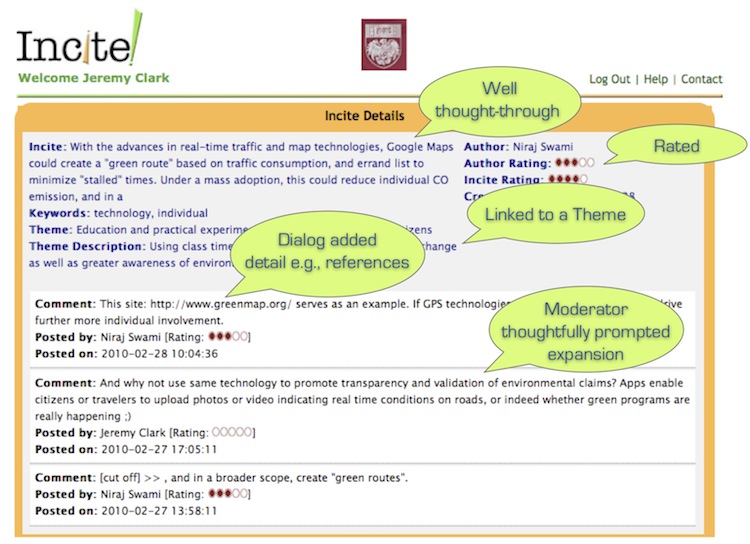
- Demonstration of the Incite! platform. **See attachment: "2 - Incite screenshot"**
- Recruiting the Control Group
- Details of participation incentives in the form of cash prizes for top contributors.
The starting scope agreed upon by the group was "How can business save the planet from climate change?". The topic was intentionally broad, to maximize potential for sub-topics to emerge (for example: Regulatory/Public Policy, Market Solutions), that would attract membership from participants passionate and/or knowledgeable in those areas.
Incite! Group:
The test was designed as a pure attraction model. Aside from the Control Group volunteers, all participants in the Briefing received an open invitation to Register on Incite!; in fact, anyone with a University of Chicago or UC Booth Business School email address could register, to allow for expansion. The experimental Incite! instance was launched on January 30th, 2010, and the experiment closed on March 6th, 2010. Incite! works as follows:
- Users enter "Incites", which are short statements that can be an idea, or a problem seeking solutions, or a provocative insight about the scope topic. Users can also add tags to facilitate future searches for related entries, or a URL to a reference source.
- Other users then "Comment" on the original "Incite", or attach ratings of both User and entry, in order to build a thread that improves or expands the original thought.
- The Moderator regularly reviews submissions and curates the unfolding dialog by:
- posting global comments visible to all Users to steer the dialog appropriately
- adding Comments that elicit more detail from the Incite submitter
- referencing other Incite/Comment entries, in the interests of creating small interest groups around topics
- proposing "Themes", groupings of Incites and Comments, creating a title that suggests a relevant meta-topic worthy of deeper exploration.
A weekly summary contribution report was shared with all registered participants of the Incite! group **See attachment "3 - Example weekly report"**.
Control Group:
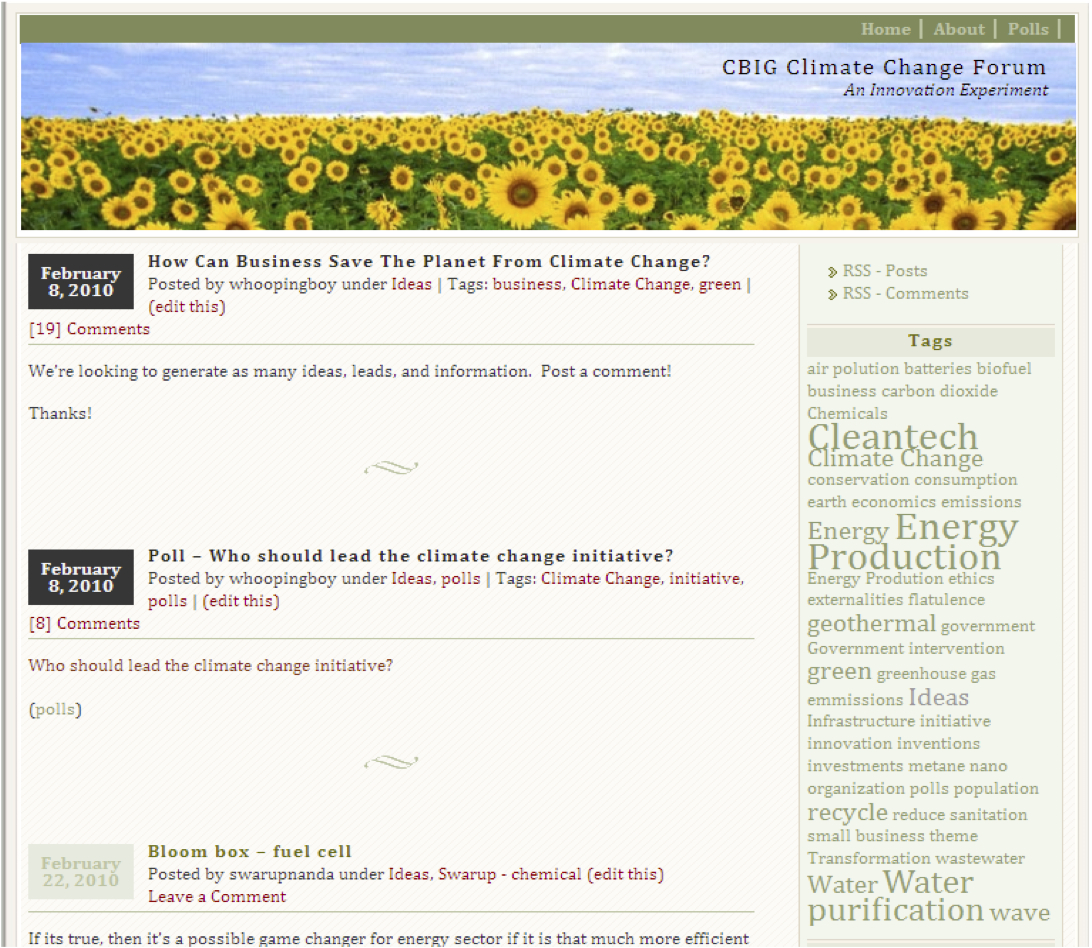
The Control Group was given no parameters except for the same scope and timeline as the Incite! Group, plus an offer of a mid-stream coaching session with Jeremy. The Control Group first set a schedule of meetings, all of which were held virtually; all experiment correspondence was handled through conference calls, email, and Wordpress. Their first decisions established a collaboration platform choice (a Wordpress blog site - **See attachment "4 - Control Group Wordpress blog page"**) and a taxonomy to organize the site into topics below the climate change scope. The topics chosen were high-level elements, (Air, Chemical, Earth, Fire, Water), intended to be nonprescriptive in terms of insights or ideas sought.
The first four weeks were generative, and relative to the Incite! Group, the Control Group was able to spend less time on synthesizing the contributions into broader conclusions or themes. There was also no rating or evaluation capability on Wordpress, so the Control Group themselves was required to perform evaluation on the ideas in order to select a candidate for the Best Idea prize. Contributions varied widely across the Control Group, with some playing more of a coordination/process role, others focused on content or recruitment of participants.
The first challenge was building and maintaining participation while under a time deadline, for both the Incite! Group and the Control Group. A starting hypotheses held that incentives would be needed to drive active and balanced participation. For example, it was considered essential that community behavior be additive rather than selfish, therefore there would be a need to prevent grandstanding, in which a User broadcasts, Twitter-style, many high-level thoughts while not working to improve the first thoughts of others. The trick would be drive constructive behaviors without skewing the results of the experiment.
Following discussions between the Moderator and the CBIG Co-Chairs Swarup Nanda and Archie Gupta, the solution chosen was five prize categories, configured to drive constructive engagement:
- Most Prolific Incite! Contributor - the User with the highest Σ (Incites + Comments)
- Most Collaborative Incite! User - the User with the highest ratio of Comments to Incites submitted
- Most Influential Incite! User - the User with the highest ratio of Comments attracted by other Users, to Incites submitted
- Best Idea from Control Group Contributor - a crude, Control Group-only voted measure to incent creativity
- Process MVP within the Control Group - the participant who made the most critical contribution to organizing the Control Group effectively.
__________________________________________________________________________________________
A second challenge was understanding network behavior within a virtual group, using the rudimentary reporting capability of what was only prototype software. For example, it became clear in Week 3 that, following initially rapid user growth to 25, contributions were now being mostly submitted by a core group of 5-8 active users.
Benefits and Measures - Incite Group:
- Incite User community at the end of the experiment: 22 (of c.30 attendees)
- Of which, Active Users: variable from 5-7
- Incites contributed: 22
- Comments contributed: 88 (4:1 ratio)
- Peak contributions per Active User: Incites 20.5; Comments 4.75
- Themes created to group Incites: 8. These can be thought of as "Fishing Holes" worthy of deeper exploration:-
- "Embedded intelligence in systems to optimize energy use"
- "Sticks and carrots to drive positive behavior change"
- "Education and practical experimentation for all students and citizens"
- "Green-Green-Grassroots" (**See attachment "5 - Incite Theme example"**)
- "Revealing environmental-impact adjusted costs of production"
- "Promoting sustainable development as both vital and viable"
- "More efficient energy extraction or (re-) capture solutions"
- "Market Mechanisms"
- "Embedded intelligence in systems to optimize energy use"
- The role of the Moderator to synthesize, elevate, and stimulate deeper dialog across the group, as compared to typical online platform that merely stores and tags content with no enrichment contribution ** See attachment "6 - Illustrative Incite thread"**
- The ability to reveal the passionate minority of truly self-selecting innovators ("Active Users"). This is a revelation compared with a traditional innovation project modality, in which the team is typically handpicked by the executive sponsor, and thus contains an involuntary mix of motivations and talents.
Benefits and Measures - Control Group:
- Control Group size: 5 (throughout experiment; levels of participation varied)
- Postings (top-level contribution): 35
- Comments: 62 (~2:1 ratio)
The key advantages of the Wordpress blog were ease and speed of set up, and high-quality User Interface that included built-in analytics on contributions. Control Group members promoted the site and invited contributions from their personal networks, using social networks including Facebook and Twitter to reach a wide audience. Special interest groups with a high probability of having a useful point of view on the scope, including the University's student environmental club, were also targeted with the scope of the experiment and the blog link.
Themes and ideas generated by the Control Group were typically at a higher level than that achieved by the Incite! Group, e.g.,:
- "Private industry and commercial enterprises should take the lead. Stakeholder themes:
- Consumers/Employees: Change behavior through educating, positive/negative incentives
- Shareholder: Execute shareholder interests by cost saving or innovating ($$$)
- Government: tax incentives, educational credits, policy changes"
Process lessons:
- Spontaneously teaming up individuals with many different points of view, network strengths, role predilections, and content expertise introduces many dimensions of variability to process management. An obvious way to mitigate the process overhead of this variability is to impose more structure (rules) within Incite! and/or across the experimental approach in general. However, the consensus among the CBIG participants was that an open framework overseen by a Moderator with broad expertise in supporting innovation teams is the best way to enable an appropriate structure to emerge given any set of group characteristics.
- A key Moderator role is guiding participants through the various phases of an innovation inquiry, from group formation to process understanding, and so on through the entire cycle, ensuring key learnings are absorbed and group behavior optimized for the analytical imperatives of the phase.
- Control Group: While a virtual team can be made to work effectively on a shared challenge, the Control Group believes their performance would have been enhanced if the core Group had a shared grounding in robust innovation principles and outline process to anchor their work.
- Control Group: recommended evaluation criteria:
- What is the most valuable idea that could be executed within 1 year?
- What is the most ambitious idea?
- What is the best policy idea?
- What is the best idea for practices?
- What is the best product idea?
- Innovation tournament designers confront a number of tradeoffs to which the outcomes are sensitive:
- Is the desired outcome actionable ideas, impactful ideas, or a mix?
- Is a small community (decisive) better than a larger team (better coverage of roles)?
- Do you apply light structure (more potential for serendipity) or high structure (less risk of complete failure)?
- Etc.
- Feedback received from Incite! Users:
- On the value of Incite! as a platform for virtual innovation:
- “Helped me iterate my thoughts”
- “Improved my and others’ ideas”
- “Helped me understand larger relationships (themes)”
- On the process and potential tool enhancements:
- Rounds of competition might promote more engagement and excitement: e.g., weekly voting to select the winners for that period
- A "Virtual Currency" would be useful to allocate influence and establish reputation: e.g., each User starts with 100 points, receives 10 more for submitting an Incite!, perhaps 2 for a Comment: gives best contributors more influence in decisions
- More Community information would enhance usability - photos, etc.
- Daily progress/status updates would enhance usability - via email subscription
- On the value of Incite! as a platform for virtual innovation:
Content lessons:
- Incite! Group: Incites were expected to be high-level or partially-formed thoughts requiring shaping and evolution through a Comments dialog. In practice, Incites were typically well-described, with a primary object, a description of a mechanism, and a statement of the expected benefits. By contrast, Comments typically expressed the author's agreement or disagreement with the Incite, as opposed to an evolution of it. Some users proposed a wiki-based UI to replace the threaded discussion format, to enable "modification" of an Incite instead of commenting, which some felt more vulnerable to appearing critical of the author's original Incite. One user also proposed a group-centric evaluation process, in which the community can select either the evaluation criteria used for their inquiry (perhaps from a selection of alternative criteria), or the relative weighting of the criteria in selecting "winners".
- Control Group: with the early focus on platform selection and recruitment, much of the initial generation of dialog entries amounted to a multiplayer search for information already available under each of the 5 key topics. Relative to the Incite! Group, less effort went in to combining or sparking off existing input to generate new ideas. Whatever the length of tournament, there is a need to ensure some time is devoted to new idea generation and elaboration, and the reflex action of searching for what’s already out there has to be resisted or overcome.
Rick Fowler, Leonard Kang, Keith Gillette, Xiaomin Wu - all currently-enrolled students in the MBA Program at the University of Chicago Booth School of Business.
Jeremy Clark, President, FXX, Inc. - experiment Moderator.
Swarup Nanda, Archie Gupta, Nikita Sharma, Stenio Ferreira - current co-Chairs of the Chicago Booth Innovation Group.
Attachments:
- Experiment flow - outlines the parallel tracks of the Incite! Group and Control Group processes
- Incite screenshot - illustrates main features and UI of the platform used by the Incite! Group
- Example weekly report - regular contribution update, sent weekly to all Incite! Group Active Users
- Control Group Wordpress blog page - screen capture of the Control Group's chosen platform
- Incite Theme example - illustrative linkage between Incite and Comment thread and a Theme created by Moderator
- Illustrative Incite thread - shows how a dialog thread evolved from an original prompting Incite.



Hi Jeremy
If I'm reading your story correctly, the use of expert process consultation to help bring themes and ideas together is a significant plus for outcomes. I have seen this to be so in some of my own facilitation work, and also always felt that it was a hold-over from mental models typical of hierarchy -- where someone else would always tend to be responsible for the development of those larger "strategic" themes. I am also imagining that this work is teachable/learnable and that as groups develop experience within the forums you suggest, they will increasingly want to take an active hand in the development of those themes and become better and better as self-organizing themselves into clusters of interest. Is that how you see it, too? Or do you feel that the process consultation would realistically always need to be present, perhaps in an evolving form?
BTW, this is a wonderful story and very inspiriting in terms of the level of detail and evidence-based work.
- Log in to post comments

- Log in to post comments

Hi Jeremy
On this hand *holds up right hand* I'm devastated. On the other hand I'm pumped about this idea!
Why am I devastated? Because I've been working up my entry for the MBA hack for a few weeks now and it totally revolves around 1) what you've done here and 2) intuit brainstorm that you referred to in a comment I read (which I'd never heard of previously). In fact, I now feel I have to rework my idea so as not to be accused of plagiarism! Just goes to show me that there's no such thing as an original idea.
Nevertheless, my concept has some variations on a theme and I'll use your post as an inspiration. The fact that you and your group of testers worked it through tells me I am onto something (ie, we're all onto something). Much of your approach resonates with me and I think I will still provide an entry that refines and modifies some ideas you bring to the table. Who knows, maybe between us, and the London Biz School who also vary this theme we can create a widely accepted tool to revolutionise the business world.
Cheers
Michelle
- Log in to post comments
- Log in to post comments
Hi Jeremy,
I offered these observations in response to your comment to my Hack about viewing organizations as living systems, but I thought I'd share them here, too, in case it helps spark discussion around your story.
What a great example of engaging the life within a group. You offered a powerful (convergent) question: "How can business save the world from climate change?" And your expert coaching and moderating created the fertile conditions for collective creativity to emerge. Here are some of the key words that stood out for me from your story:
* "fun, engaging and self-directed"
* "self-organizing"
* "emergent"
* "open...collaborative"
* "initial concepts...evolve"
* "a pure attraction model"
* "passionate...self-selecting innovators"
In your comments, you talk about "emergent group magic." That's one way of thinking about organizations as living systems -- a group of people comes up with something that no one of them walked in with. The group came up with it.
All of this stands in stark contrast to the traditional "innovation project" model you describe, which "applies cost-side investigative techniques to revenue-side issues. In other words, the standard Analyze-Diagnose-Recommend-Implement cycle, organized into a full-time project with start and end dates, and a client-picked scope and team." What could be more mechanistic than that?
You've offered fantastic proof of my theory -- thanks! :-)
- Log in to post comments

Thanks Jeremy, I am intrigued by your ideas for more innovation here -- especially for teaming up people with differing points of view. Great ideas to build on in your post!
We too encourage that with leadership courses, and in fact insist that insights contain evidence of having engaged those who offer suggestions from various perspectives.
The key here is to teach tone skills that build goodwill across differences, and to facilitate in ways that opposing views emerge in significant ways? Have you seen these tone and facilitation skills that can bring about the changes you offer so well here?
- Log in to post comments
- Log in to post comments
You need to register in order to submit a comment.