


Hack:
Using Simple, Mobile Technology to Create a Culture of Radical Transparency
We want to be flatter, more transparent, and more productive.
So we turn to technology.
Leveraging the disruptive, geosocial capabilities of the smartphone, we hacked together a mobile productivity app that allowed our team to “check-in” to work objects such as customers, projects, and products with a tap of the phone. The result? Radical transparency from the CEO to the intern, eye-opening productivity analytics, and a dramatic fall in the use of company email.
The communication and collaboration tools we were using in the office simply did not match our work.
While our work revolves around structured objects like projects, customers, products, and vendors, our email system revolves around only two things: senders and recipients, with a whole bunch of free form text layered on top.
Crucial information falls through the cracks, requiring for more meetings, more managers, and more overhead.
Rather than continue to flood the team with email, meetings, and management, we built a better tool. One that allows us to be more transparent and productive, while avoiding the insidious tax of status meetings and non-producing middle managers.
We call this tool HYVE.
We built an app that makes it easy for team members to keep track of customers and projects. HYVE allows us to surface achievements and small victories as they happen, thereby creating a transparent culture of productivity.
HYVE is centered on three design principles:
-
Mobile. HYVE is easily accessible both in and out of the office, anywhere your phone is.
-
Social. More efficient, transparent communication was a driving force behind this project. HYVE is optimized for easy, interactive content consumption and publishing on a transparent platform.
-
Simple. A look at the consumer app landscape and the success of services like Instagram supports our theory that simple apps yield higher engagement. Simplicity of UI is paramount.
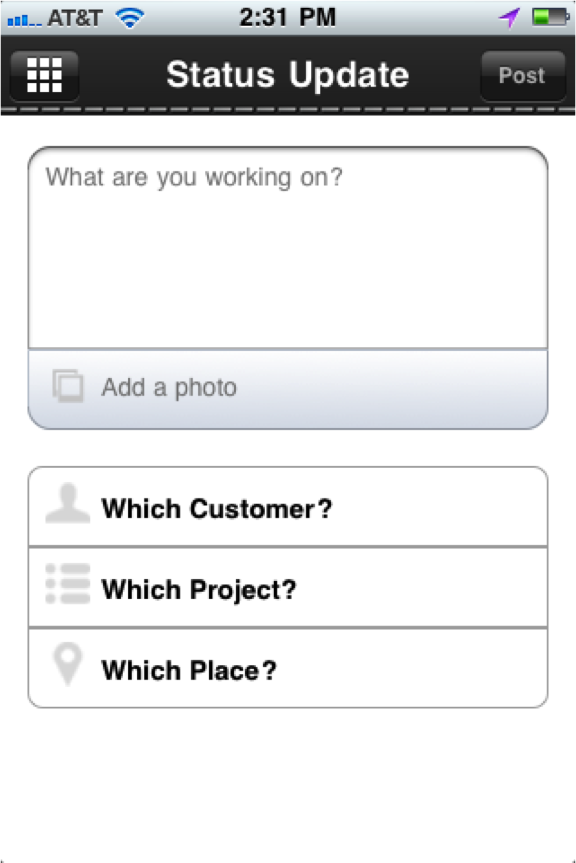
We then mapped our key business drivers to what we call "work objects." These “work objects” are structured digital items that we "check-in" to, share, follow, comment on, and aggregate. For our company, the three primary objects are: Customer, Project, Location. So with three taps of the phone, each of us records what customer we are working on, which project, and where.
On the UI side, we embrace a “tapping, not typing” philosophy. We know that typing text into a mobile device can be a burden. By leveraging the smartphone's sensor-like capabilities around lat long and user behavior, we can surface appropriate “work objects” for our team to easily tap into.
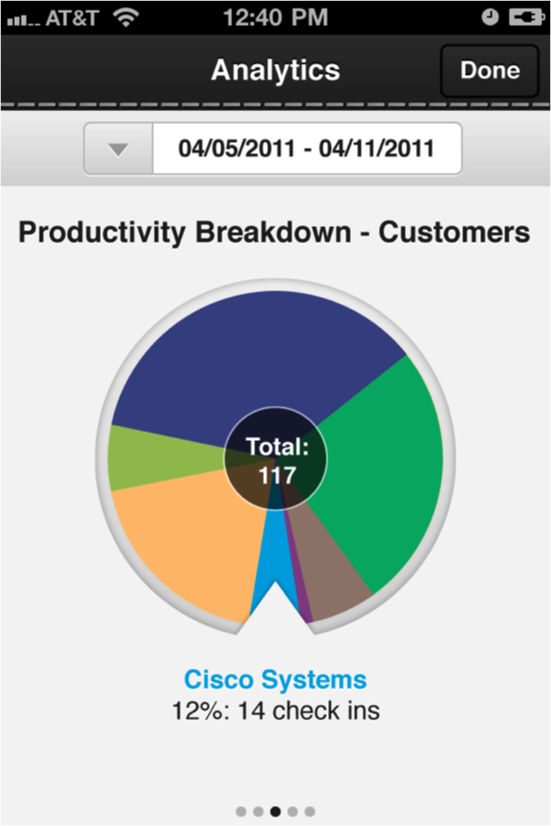
Furthermore, by adopting structured updates, we open up a whole new world of analytics. Unlike free-form content streams in other social business services, HYVE does not require sophisticated parsing tools to understand what is being accomplished. HYVE collects structure at the input layer, which results in wonderful analytics upon output.
Finally, we layer-in some simple game mechanics to reward activity that is aligned with our strategic goals. For example, a check-in to a Fortune 1000 customer is worth more points than a check-in to a bookkeeping project.
The end result is a mobile, social, simple app -- designed for maximum engagement, structured analytics, social sharing, and radical transparency.
The practical impact of our hack has been dramatic.
- Internal use of email has dropped by 34%.
- Regularly scheduled all hands meetings were reduced to one Monday morning stand-up meeting.
- Friendly competition has broken out over weekly productivity leaderboards.
- Middle management positions have been eliminated.
Most importantly, our culture has shifted from opportunistic information sharing towards radical transparency.
HYVE works beautifully for small teams and work groups. Before rolling it out to a large organization, our recommendation is to pilot the app among a group of early adopter knowledge workers. Track engagement, experiment with game mechanics, and get a feel for how the group is using the tool.
Two-way transparency is critical to the app's success. If management is not prepared to share what they are working on, they shouldn't ask employees to do so. HYVE is not a big brother app. Instead, it's a baby step towards a mobile-optimized culture of radical transparency.


I think he provide the great solution to make an app for this particular purpose. I am working in a web apps development company and i will use this idea to deliver a best app for our clients.
- Log in to post comments
Radical transparency as Lawrence describes is indeed the future of collaborative environments. As managers demand more transparency from the employees, managers need to adopt the idea and hence, technology. The mobile app would provide for their colleagues where any individual is, what they are working on, or whom they are dealing with on a real time at any particular instant. The beauty of the technology is all this information is voluntarily given by the employee with a simple click on his cell phone.
However, it would be interesting how secure this information could be made. It would have been better if the article had also used other comparable indicators like length / time of instant messages, phone calls, or total communication among employees instead of company emails. Emails typically are the more formal type of communication, even in high information oriented organizations. It also depends how much process oriented the work is, or if most of the work is customized, e.g. customer service guys where implementing any quantitative performance measures are difficult to implement.
- Log in to post comments
This could work well in marketing and sales scenarios, small team can build transactive memory quickly and start working together with help of HYVE. The best part is interaction, ease of use and faster updates. The problem work life balance can be resolved by limiting the usage time each day or number of logins/updates. This is good solution which resolves problem related to people, technology and infrastructure.
- Log in to post comments
You need to register in order to submit a comment.