


As the centers of gravity in terms of economics, demography, and geopolitics become increasingly diverse, most of today’s managerial practices will be found lacking by the second decade of the 21st century. The world economy is changing at the speed of light with hundreds of millions of people entering as active participants who seek more meaning in their work environment. Executive failure to sense these trends will bring, if it has not already brought, the most dramatic economic collapse in two centuries.
We need new management practices that will take into account the diverse stakeholders and the vast knowledge held by people at all levels of organizations. Put in another way, we need a new management system that can operate in an environment where all participants are encouraged to be involved in the decision making processes.
Such will be beneficial to all types of organizations, whether for-profit or not-for-profit.
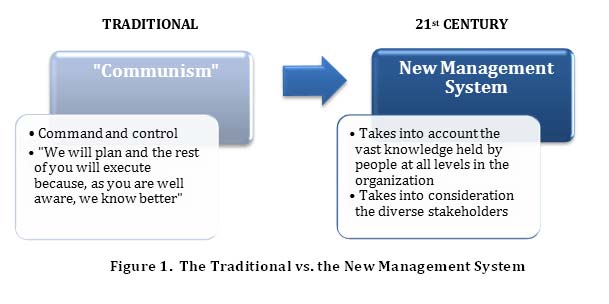
Most of today’s managerial practices still belong to the beginning of the 20th century when Frederick W. Taylor introduced Scientific Management. The well-known story was that he preferred workers to leave their minds at the gate and come to work with their hands. These practices are similar to communism and are characterized by the traditional command and control mechanisms and the traditional strategic and budgeting processes. They reflect the notion that the few know better than the many. “We will plan and the rest of you will execute because, as you are well aware, we know better.” In most cases, the “smart guys” either from the CEO suite or from consulting services, are called in to shape the organizational strategies. This phenomenon ignores the vast knowledge and experiences already available within organizations.
People these days, however, seek meaningful working experiences. Nobody wants to be a cog. If more than 33% of their lives are to be spent in creating value, they want to influence the processes, each in their own capacity. They do have the capacity except that the current managing practices do not allow them to utilize their knowledge.
The consequences are dire: people feel their voices are not heard and they feel detached from the organization in which they work. Hence, they doubt that their potential will ever be fully realized.
The second decade of the 21st century critically needs a new management system. The contemporary capitalist regime is losing its attraction due in large part to the economic tsunami we have all experienced the past four years. It is afflicted with greedy executives and with narrow-minded strategies that do not take into account other stakeholders: the environment, the society, and the new types of people who make up the work force. We need a framework that will enable people to participate and feel that their contributions matter to their organizations and the entire stakeholder community, as illustrated by Figure 1.
The Logical Framework or LogFrame, developed by Prof. Joseph Ben Dak, Larry Posner, and Leon Rosenberg in the 1980’s, can serve as a starting point for the new management system mentioned above. Ben Dak, et al. developed the framework with the aim of having a robust strategic process that could deal with complex environments from the very first stages of planning to the execution stage and would take into account the many stakeholders and interests. The LogFrame was first applied to mega projects managed by the military and to the seemingly very different international NGOs in developing countries.
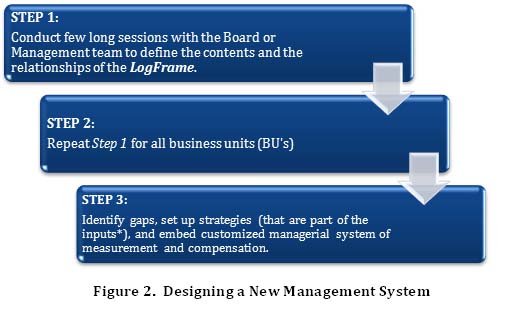
We have decided to take the LogFrame one step further by embedding a unique managerial system of measurement and compensation and then applying it to more of the for-profit organizations. With a value creation mindset, which would be explained in detail later, what the LogFrame aims to do is simple to understand: involve the workforce, measure correctly, and compensate correctly to achieve the right sense of ownership and meet the expectations of the entire stakeholder community. One might call the LogFrame the “Trust and Respect” framework: You trust your people and gain genuine respect. Once you break in, this “flywheel” gains speed and relationships change accordingly. The managing environment is put on a different platform.
The combination of the LogFrame and the Value Creation Mindset creates a powerful tool. Managing becomes much more effective in terms of holistic results in the (1) firm, (2) human environment, (3) physical environment, and (4) entire stakeholder community.
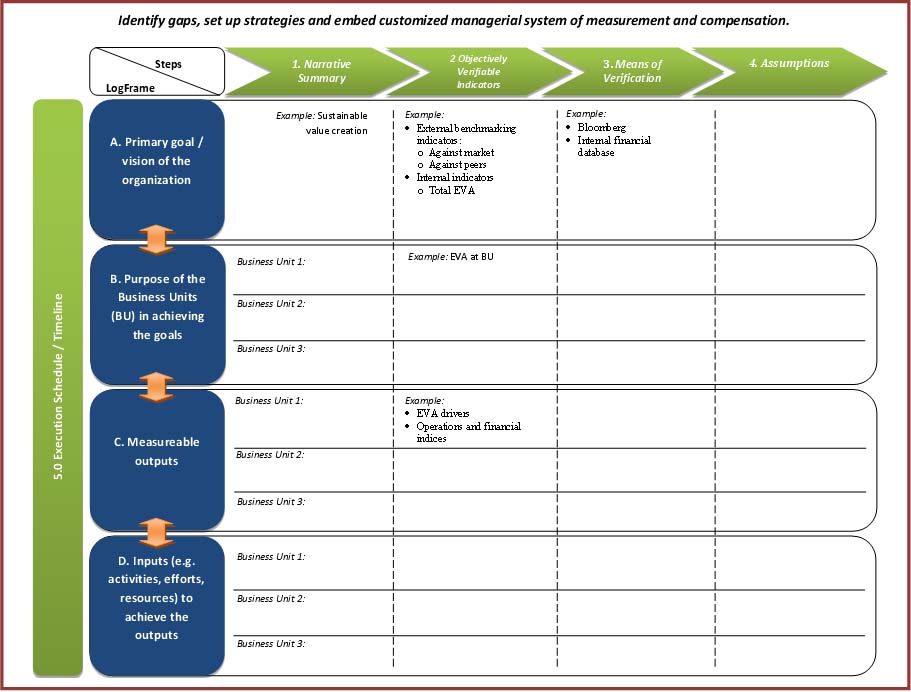
These are the prime goals of the Business Units (BU). Every organization has a number of BUs or departments and each has to have a purpose. Others might call it mission. By achieving its purpose, the BU directly helps the organization to achieve its goal.
3. Outputs
These are the measurable indices. Inputs are converted by the people into outputs.
B. Defining the Contents and the Relationships in the LogFrame
For each LogFrame component, the narrative summary, objectively verifiable indicators, means of verification, and assumptions must be well-defined in the order shown by Figure 4.
The details for each step are described below.
2. Objectively Verifiable Indicators
These are the indicators that reflect the narrative summary in numerical values. These indicators are at the heart of the framework. Choose the wrong indicators and you miss the picture!
At the Goal level, the indicators can be of two types: external and internal. An external indicator should benchmark organizational performance (1) against the market, taking into consideration the risk associated with the company (technically speaking via the WACC); or (2) against the peers.
An internal indicator should measure value creation in the form of economic profit or the Economic Value Added (EVA®). EVA takes into consideration a number of elements:
- The cost of the money the shareholder has invested, ascertaining that the executives are taking into account the risk associated with the operation of the firm
- A long-term approach that sees intangible assets as the main generator of growt
- Replacing the bias of the accounting framework with the economic framework (which reflects the economic reality of the firm) as a springboard for decision-making
At the Purpose (BU) level, the indicator can be the EVA® of the BU. This has a clear and direct connection to the EVA® of the organization.
At the Output level, the indicator can also be in terms of EVA®. If this is not possible, the EVA® value drivers (drivers that boost the EVA®) can be used, preferably in the form of operations indices combined with financial indices. For example, in the media industry, we combine viewership or reach measures with either revenue or costs, depending on whether the current strategy is to boost revenue or reduce costs. Such combination provides the people at the operational level with the right perspective on how to create value.
Internal data can be obtained from the accounting system of the organization. These data can be transformed into economic data using state-of-the-art techniques.
We must bear in mind that one of the classic definitions of management is “seeking desired outcomes by allocating scarce resources and by working with people.” Our scarcest resources nowadays are the time of our people; and the people’s sense of ownership: their willingness to invest heart and mind in the organization because they feel it is their business.
Agency Theory has taught us a good lesson lately: People tend to behave in unexpected ways if you mistreat them. The secret to changing the behavior of the entire workforce lies in creating a sense of ownership for all. People do act differently when they are doing something for themselves—it’s only human. If you earn a sense of ownership, then you can expect a different level of performance from the very same resources.
The value creation mindset involves three essential steps that must be integrated with the LogFrame to create a sense of ownership in the workforce:
Here we measure the economic performance of operations. The difference between economic and accounting measurements is that economic measurement looks into opportunity cost and benefits, such as capital, land, time, and risk. In moving from accounting principles toward economic principles, there are many adjustments that should be made. However, one must define those adjustments that have the most meaningful impact. In most cases, five to ten adjustments are sufficient. This requires expert knowledge of the industry and company levels, as well as of the specific DNA of the organization. Coupled with extensive economic and financial expertise, this knowledge will make the framework reliable and effective.
3.
Manage less. Yes, manage less!If people are working for their own benefit, the manager can relax: he/she does not have to micro-manage the teams. Because they are doing it for themselves, people will feel they have more freedom to innovate. Frederick Taylor would be shocked to see people using their brains, and not only their hands! In all seriousness, the workforce of the 21st century seeks freedom, self-fulfillment, and a meaningful life. By “managing them less,” the management can gain a huge boost in performance and human satisfaction and will be able to manage the future and act as mentors and coachers to their workforce.


You need to register in order to submit a comment.