



- Disorganized content: Existing social media generally create very disorganized content, so it's time-consuming to find what has been said on any topic of interest. This fosters unsystematic coverage, since users are often unable to quickly identify which areas aren't yet well-covered and need more attention.
- Low signal-to-noise ratio. Social media content is notorious for producing highly redundant content, so enormous effort is typically required to "harvest" this wisdom to inform better, more broadly-supported decisions.
- Quantity rather than Depth. Social media systems often elicit many relatively small contributions, rather than a smaller number of more deeply-considered ideas, because collaborative refinement is not inherently supported.
- Polarization: Users of social media systems often self-assemble into groups that share the same opinions, so they see only a subset of the issues, ideas, and arguments potentially relevant to a problem. People thus tend to take on more extreme, but not more broadly informed, versions of the opinions they already had.
Here's just two examples (see this blog post for more): (1) Intel ran a web forum on organizational health that elicited 1000 posts from 300 participants. A post-discussion analysis team invested over 160 person-hours to summarize these contributions (at 10 minutes a post, probably longer than it took to write many of them in the first place). The team found that there was lots of redundancy, little genuine debate, and few actionable ideas, so that in the end many of the ideas they reported came from the analysis team members themselves, rather than the forum. (2) Google used their "moderator" system to collect ideas for which charitable projects the company should fund (project10tothe100). The company had to recruit 3,000 employees to filter and consolidate the 150,000 ideas they received in a process that put them 9 months behind their original schedule. The vast majority of these ideas were minor variants of simple suggestions (e.g. support public transport, make government more transparent, and so on). Surely that vast amount of effort could have been used to compose a smaller number of more deeply-considered ideas, rather than many shallow ones.
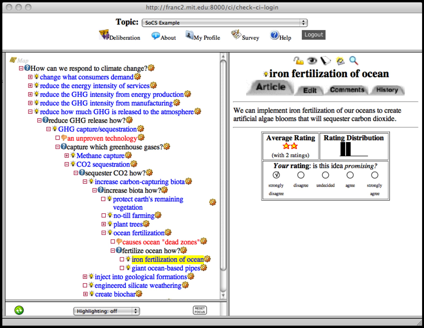
A screenshot from the Deliberatorium. Each line in the left pane represents a single issue, idea, or argument. Each such post can have it's contents viewed, edited, discussed, and rated in the right pane.
{C}
{C}
{C}
{C}
{C}
The community follows a simple process to ensure that the deliberation map is as useful as possible:

Every author starts by "unbundle-ing" their contributions into individual issues, ideas, and arguments, and adding their unique points to the relevant part of the map. A key tenet is the "live and let live" rule: if you disagree with an idea or argument, you shouldn't change the post to undermine it, but should rather create new posts that present the strongest ideas and (counter-)arguments you can muster, so all contributions can compete on an even basis.
Moderators help ensure that these guidelines are followed. New posts can, at first, only be viewed by moderators. When a moderator verifies that a post follows the deliberation map guidelines, they can be viewed, edited, commented, and rated by the full community. If a post doesn’t yet meet the guidelines, the moderator leaves comments explaining what needs to be done to fix them. Moderators play a modest “honest broker” role: their job is not to evaluate or change the content of a post, but simply to help authors ensure that the content is as accessible as possible to the community at large. Moderators can check each other's work, as they do in such systems as Wikipedia and Slashdot, to ensure they are doing a good job.This process is supported by such software capabilities as open editing (any user can check and improve posts), watchlists (which automatically notify users of changes to posts they have registered interest in) and version histories (to allow users to roll-back a post to a previous version if it has been "damaged" by an edit). The system also provides a powerful set of attention allocation metrics to assess how well each part of the deliberation is going, and thereby to help community members focus their efforts where they can do the most good.
The current user interface, while functional, obviously has an "old world" feel. This reflects my limitations as a programmer, as well as a strategic calculation. I've noticed that many hugely successful web 2.0 systems (such as email, news groups, Wikipedia, and Facebook) became that way despite having initially quite rudimentary user interfaces. The key success factor often seems to be the compelling-ness of the idea, rather than the polish of the implementation. I've focused, therefore, on rapidly exploring new ideas, rather than polishing old ones. Going forward, my hope is that the most powerful ideas explored in this work will be taken up by commercial vendors and incorporated in their products.

The carbon offsetting web forum summary map
This was a startling illustration of the potential of deliberation maps for harvesting a community's collective knowledge in a way that is qualitatively more useful than conventional social media.
Our first large-scale evaluation was at the University of Naples, where 220 masters students in the information engineering program were asked to weigh in, over a period of three weeks, on what use Italy should make of bio-fuels. All told, the students contributed nearly 2000 posts, creating a map that was judged by content experts to represent a remarkably comprehensive and well-organized review of the key issues and options around bio-fuel adoption, exploring everything from technology and policy issues to environmental, economic and socio-political impacts.

A small portion of the Naples bio-fuel deliberation map
We found that, initially, about 2/3rds of user posts were structured correctly as originally created, and this increased to about 85% by the end of the deliberation. Also, the remaining posts almost always just required some simple fix e.g. people would call it an "idea" when it should have been a "pro" (see this paper for details). Overall, we were encouraged by how well people could use the deliberation map structure. It made it possible to support the user community with the part-time support of just two moderators. We were hard-pressed to imagine any other approach that would allow over 200 authors to write what was in effect a substantial book on a complex subject, in a couple weeks, with no one in charge.
Our first business-centric evaluation was conducted with Intel Corporation on the question of how "open computing" (i.e. where users are given greater access to computing tools and data) should be used in the company. Contributions were purely voluntary. A single moderator was able to support the discussion with very little effort. The end result (see below) was that Intel received a substantive and well-organized overview of important issues in this space from 73 contributors, including many from outside the company, at close to zero cost.

Map generated for the Intel deliberation on open computing
We've also conducted evaluations with the US Bureau of Land Management and the University of Zurich, among others, and we've learned that, when compared to conventional social media, it can help you get better content on how to solve complex problems, at lower cost, small voices can be heard and, perhaps most importantly, it's much easier to find the "good stuff".
1. Embed the tool into a management process so that it's part of the "workflow" and taken seriously (for instance, make it a part of the strategic planning process). Your organization's members are much more likely to try a new approach if it is part of a conversation that matters.
2. As an initial test of the tool's effectiveness, conduct a "controlled experiment":
- Select a specific theme/question that needs to be answered as part of the strategic planning process (e.g., what will be the likely impact of emerging market growth to our business model? how will the competitive environment be changed as a result of a stronger role of states and regulation?)
- Set up two groups that are comparable e.g. in terms of their size, diversity, and skill sets. In one group, deploy the Deliberatorium to surface perspectives on the strategic planning question; in the other group, run the process in the traditional form.
- Compare the results in terms of (i) quality/depth of the discussions and their output; (II) level of engagement/satisfaction in the process by the users, and (iii) organizational effort needed to run and harvest the deliberation.
3. If the results for the experimental group are better than those of the control group, further build out the tool and supporting processes, and deploy more broadly at the next opportunity.


Hi Mark,
A few have the raised the point of "user search cost" being a barrier to usage. Presumably, this cost is positively correlated with the quantity of content. More stuff = more stuff to process in order to find where each piece fits best.
If the presumption is true (and we assume people care about respecting the best fit rule - probably safe to assume if there is a visible norm), then this is incrementally more threatening as the number of "deliberators" increases - which as I understand it, is what you ideally want to do.
Assuming this hasn't been solved...
Random thoughts:
1) Could some kind of text analysis tool be used suggest where to place an author's submission? (I.e., after writing a contributor the author hits a kind of "place me" button and it offers probable matches)
2) Could there be a kind of "fast pick" system, where as the user types their contribution a live filter narrows down possible locations based on key words or phrasing.
3) Could a choice driven system narrow down the "box" the contribution is likely to do in. I.e., the deliberatorium provides a decision tree and poses yes/no questions to the author, allowing the author to quickly filter out the non-relevant branches.
4) More of a stretch...if there is a natural "law" about the nature of progression (i.e., pattern of complexity) of a deliberatorium, then you could try to predict where the post is most likely to belong to in combination with any of the above.
Thanks for reading,
Sean
- Log in to post comments

1) Could some kind of text analysis tool be used suggest where to place an author's submission? (I.e., after writing a contributor the author hits a kind of "place me" button and it offers probable matches)
I think that makes a lot of sense. I've tried that out a couple years back, but I wasn't happy with the retrieval accuracy and completeness at that point, so I disabled it until I could implement a better approach. Currently, I'm thinking of using a variant of latent semantic indexing that takes advantage of the argument maps' tree structure to help improve the hit rate.
2) Could there be a kind of "fast pick" system, where as the user types their contribution a live filter narrows down possible locations based on key words or phrasing.
Interesting idea, like the google live search thing.
3) Could a choice driven system narrow down the "box" the contribution is likely to do in. I.e., the deliberatorium provides a decision tree and poses yes/no questions to the author, allowing the author to quickly filter out the non-relevant branches.
That's also interesting! But let's say the system, instead of following a binary decision tree, provides a list of the words whose selection would, at each point, most rapidly narrow down the range of possible matches, based on what you've already entered. Then you might not even have to type a lot of the time, you could just select words from the list suggested by the system.
4) More of a stretch...if there is a natural "law" about the nature of progression (i.e., pattern of complexity) of a deliberatorium, then you could try to predict where the post is most likely to belong to in combination with any of the above.
I think that would help as well. In an argument map, people will often add posts in a top-down manner, attaching new posts under the posts they've just recently created or edited or rated or viewed. We can use that insight to refine the list of suggestions that the system makes.
- Log in to post comments
Michael Harris (Michael.J.Harris@Intel.com) made an interesting point I wanted to share with the MIX community:
"Some research suggests independent brainstorming followed by collaborative sharing produces much greater diversity and quality of ideas than the method we typically use at Intel which is immediate, collaborative brainstorming.
The limitations of typical team brainstorming include free riding, evaluation apprehension, productivity blocking and conformity effects. I would think these same limitations could apply to online settings in which all participants have immediate access to all content.
Given the primary objective is innovation (with redundancy reduction as a necessary but secondary objective), what strategies might be applied to the deliberatorium to combat these types of limitations? For example, could you require participants to make a contribution before accessing others’ content and organizing their submission?"
- Log in to post comments
That's a great question. My understanding is that the problems you describe apply mainly to *face-to-face* brainstorming sessions. In such meetings, only one person can talk at a time, and people typically self-censor to deal with that bottleneck, e.g. based on their perception of the power dynamics in the room. I think that these problems are *much* less of a factor in asynchronous online brainstorming, since everyone can make contributions in parallel without taking away airtime from anyone else. That really seems to take the lid off. In fact, the problem often becomes "too much" participation, rather than too little. The judicious use of anonymity can also help with self-censoring. The Deliberatorium, for example, displays the ratings for posts but not *who* made those ratings, making it more comfortable for people to tag less-promising posts and thereby separate the wheat from the chaff. Some researchers have also made a case for allowing users to use pseudonyms for their account names, there are arguments back and forth on that.
In any case, I think it's a great idea to ask that people brainstorm independently before entering stuff into the deliberation map, it can probably only help. I'm going to make a note of that idea for future reference, thanks.
Mark
- Log in to post comments

This is a great tool to create content, store, organize and make decisions. It is based on the simple and powerful principle of issue-maps, enriched with many useful features (comments, search, tracking, rating, version management, etc ...), all in an effective user interface.
Of course the tool is not everything and the methodology (guidelines) is as important as the tool itself. Again, guidelines are common sense and efficient. All this allows to get easily a result content that is both detailed and clean. Particularly because the content is separated from the comments that improve the content (unlike a forum where content and comments are mixed).
- Log in to post comments
- Log in to post comments
- Log in to post comments
Deliberatorium is a really interesting project. I have been following it last months as well as Mark Klein’s research progresses. I also work in a large-scale deliberation project, called e-Democracia (www.edemocracia.gov.br). Created in the Brazilian House of Representatives, it’s an official website whereby people can share their opinions, critics and suggestions to legal texts with representatives.
The major challenges we have here in e-Democracia is these same very well-defined (by Mark) problems in large-scale platforms for debate: Disorganized content, low signal-to-noise ratio and quantity rather than depth.
And the solution, with Deliberatorium, in which participants are invited to set their opinion, argument or idea in an argumentation map, is great and functional! In my view, there is a just challenge in this kind of system and I know Mark’s aware of it.
It demands certain initial effort from the participant to read and search in the argumentation map where his point could be inserted. This effort may discourage participants who want to contribute but haven’t great technical knowledge about the subject, so it will be slightly costly to search where his contribution should be included. Moreover, there is a kind of participants who just intend to present a testimony but an argumentation map may seem not appropriate or open to this kind of contribution. One possible solution for that is just let people to participate the way they prefer, so the moderator will have to work harder to organize it.
But I’m sure Deliberatorium is dealing well with these challenges. In my opinion, this is one of the best solutions in this field by far.
Cheers Mark
Cristiano Ferri Faria
Brazilian House of Representatives’ e-Democracia Project
@cristianofaria
@edemocracia
- Log in to post comments

Among the excellent set of finalists, the two with which I'm most familiar – and admire greatly – are the Deliberative Corporation and MIT's Deliberatorium.
Both are grounded in a systematic form of deep and wide listening, informed structured dialogue, mutual understanding, and pragmatic negotiation geared towards effective action: and both point towards a more open, agile, rigorous and transparent system of civic and corporate governance.
Both seek to build on social media’s strength as a serendipity catalyst by giving participants the means to interact mindfully, to surface difficult questions, to learn collaboratively, creatively and cumulatively from each other, and to take responsibility and hold each other accountable for the decisions arising from their deliberations.
The deliberative work that both entail is demanding and inspiring – as the best work should be – and in an age of eddying noise and complexity, of financial and political uncertainty, and of intense pressure on resources, this work has never been more important.
Both would be worthy winners of the Management 2.0 Challenge.
- Log in to post comments
I got the video done and have added it to the post - hope you find it helpful.
Mark
- Log in to post comments
Hi
I heard about the Deliberatorium during a talk given by Mark Klein as an invited speaker in an AI conference. I immediately though that a) we could use it at our department to reach some consensus regarding more or less contentious issues, and b) this could be a nice application to combine with other AI techniques in order to try to ease the role of the mediator.
So far we are selecting a topic to discuss using the Deliberatorium and I have also recommended the site / the work to a PhD candidate. He is thinking about combining this tool with recommender systems in order to guide new users. I am confident that this will be a nice work and I hope we can work together with Mark in this direction.
Ana Bazzan
- Log in to post comments
As part of Mark's research, he and a colleague oversaw the development in the Deliberatorium of an argument map that outlined the range of possible approaches for addressing climate change.
Mark sent me a link to this argument map, and I found it to be quite impressive. It nicely captured the broad range of ideas that I had seen expressed, albeit in scattered and disorganized form, in the many books, articles, and web sites I'd been reading on climate change.
This map has become a valuable resource to our team as we think about new ways to organize activities on the Climate CoLab in coming months.
And we have implemented a somewhat simplified version of the Deliberatorium in the Climate CoLab, which allows members of our community to comment on and add to mini-argument maps that address specific issues in the climate change debate.
For an example, see http://climatecolab.org/web/guest/plans/-/plans/contestId/4#plans=subview:issues
- Log in to post comments
The Deliberatorium is a real step towards collaborative deliberation. I particularly like how the IBIS structure fits into the picture, providing an organization for ideas.
Breaking ideas into smaller elements is key to making individuals think about their posts and structure them correctly. I wonder if users will have difficulty breaking their ideas into the three elements proposed, and what to do if these elements are linked together? Do you know if users have problems with the structure and rules at first? It should take them some time to properly learn what and how to send their ideas and opinions.
I also worry that, with many posts, the tree might become too large, and cumbersome to read through, making it hard to find the appropriate location for a post. Even though you claim it won't, when I think of a service such as twitter, I can't help but imagine what an argument tree would look like (especially if some tweets had to be broken into 2 or 3!) This may become a problem for users. Perhaps some sort of search functionality would help?
All in all, a well rounded and thought out initiative, which will probably benefit many organizations!
- Log in to post comments
- Log in to post comments
What I liked most about Deliberatorium the possibility to use it a wide range of areas with minor modification. Although its use should not limited to management purposes, it has one (but a "big" one) advantage over other advantages: it's cheap. There is no regular business trips necessary to gather people together. Well, one may also add that according to his own will. Even so, that shows the flexibility of the platform.
At another presentation I remember seeing the idea of using a random populations for rating. That would work here as well for preventing "friendly" ratings.
Another thing might be limiting posts to a certain number of characters like on twitter. Eliminating endless user comments right from the beginning would also decrease redundancy as people - I assume - are more likely to read brief comments. That's also somehow the idea behind argumentation: Disintegrate the parts of a whole as an idea, a pro or a con argument.
- Log in to post comments
- Log in to post comments
- added examples and links to flesh out the problems current web 2.0 systems have with supporting complex deliberations
- added a short video with a fictional but illustrative use scenario, so people can see the tool in play
- discussed how to deal with potential challenges to using this approach, especially the critical challenge of working at scale
- Log in to post comments
It seems that this could add value to community organizing and on-going problem solving if the facilitation team were sustained for many years. Have you done any experiments with using this as a project management tool? For instance, if you put a set of blueprints for building a hotel on line, you could set up a template for discussions starting with the initial design and financing work through the first steps of laying the foundation through the final step of opening the doors to new customers.
If another group of people wanted to build a similar hotel in a different places they could follow that template and even learn from the work done in earlier projects. I have used concept maps to describe strategies that would result in more and better non-school tutor/mentor programs in inner city neighborhoods. http://tinyurl.com/TMC-4-Part-Strategy
If discussion nodes could be attached to each of the steps of these maps, the facilitation could be a form of project management intended to get more people involved, informed and active in achieving the goals of the project.
Instead of starting a discussion with a blank sheet of paper we’re starting with a goal in mind and working backwards to fill in what we and others already know. As we do that we’re working forward to know more and act on what we know to make volunteer-based tutor/mentor programs available in more places, based on the strategy that is outlined.
Is this possible? Is it already being done this way?
- Log in to post comments
- Log in to post comments

Intel IT has been pleased to work with Mark Klein from the MIT Center for Collective Intelligence on a series of investigations aimed at exploring the concept of collaborative argumentation.
Our projects validated the potential of the combination of social media and argumentation. Social media enables the hosting of large scale discussions with a vast number of diverse users over the internet. Argumentation captures the logical structure of debates and encourages evidence-based, critical thinking with systematic coverage of topics.
One of the biggest benefits of Deliberatorium was the ease of generating the argument map. The “moderate-as-you-go” approach promoted structured problem solving during the ideation and saved time during the post-processing of content. The compact format was useful to reduce complexity and highlight key content and contributors. As compared with threaded conversations organized by time in other tools such as web jams and wikis, the argument map saved time and effort synthesizing the results. Further, the argument map provided a useful artifact for later data mining and as a historical record. Since we often go back and periodically reevaluate our position on a variety of topics, the argument map can be used as a starting point without recreating the same content on complex issues.
In terms of real world corporate application, we already experienced some technology transfer by influencing Intel’s internal ideation tool to include basic argumentation capabilities. These enhancements were incorporated in a successful pilot, which then led to a production deployment. Outside of Intel, we have debriefed our commercial social computing provider on the collaborative argumentation research and results in order to inspire future products which could eventually be consumed at Intel.
Congratulations to Mark on his excellent work!
- Log in to post comments
I think that the Deliberatorium provides a valuable toolset that helps in managing large-scale decision-making discussions. I'd suggest the following to further increase the reach and capability of this approach:
+ Modularize and open-source the code so that it can be deployed alongside existing Wiki/collaborative systems. That way the user interface can be further refined and take advantage of other features. For example, if a social networking engine already has captured tags/reputations on people, these can inform the node ratings.
+ Partner with others in this space -- for example, I think it'd be intriguing to see Quora.com run some of their questions as Deliberatoriums, given the high quality of participants that they have attracted in various topic areas
While running a Deliberatorium on a given subject, I also think it might be useful to run a traditional threaded discussion in parallel, so that people can easily meta-comment in a freeform manner on the process itself, as the discussion is unfolding (i.e. I think that there are too many subtopics under this heading, we should break it up further, etc). This could be as simple as the "Discussion" tab in a Wikipedia page.
I think Deliberatoriums could be launched on a lot of consumer-friendly topics as well -- what type of car to buy, how to allocate a stock portfolio, etc. Here's where partnering with an existing knowledge-based service like Quora.com, Wikipedia, Yahoo Answers, etc would be particularly helpful.
Good luck to you guys on the MIX M-Prize!
- Log in to post comments
- Log in to post comments
I would be curious of the high level view of this component in a holistic collective knowledge platform.
This seems more like an experiment fit for and limited to academic practice (or an innovative R&D group at a corporation) when in isolation. Would I be correct to assume this is indeed a component and theory being developed as one part of a larger effort to develop collective intelligence platforms at MIT?
It seems to me that manual argument mapping through a proprietary system is not the best approach, considering the user education scenario. It is very easy to begin this exercise and maintain a high level of quality for small groups of highly educated and motivated people. But given an implementation of a wider audience, the demand on the moderators go up, the quality of content goes down and the receptiveness to yet another process usually hinders if not thwarts the effort.
Efforts like Vulcan's Evri, Halo, Microsoft's PowerSet and other such companies have proven that you can get the logic of an argument through NLP methods. This allows you to build truth tables and argument maps of large bodies of text. These methods are so accurate, they can "learn" from the text books and pass an AP exam. Another more well publicized version of the same technology is IBM's Watson.
While utilizing the social platforms with only what they offer, I believe you are indeed correct in saying that they have the downfalls listed in challenges. But to approach the issue by building another platform is a bit of an uphill battle. If we truly would like to unlock the potential of collective knowledge, I think the NLP route is a much more viable solution. This solution takes care of all of the downfalls and can even link out of dialogue logic and reason to the current issue at hand. It also allows the group to take non-user generated content from the ages and take that information into consideration.
Can you let me know if you've found this not to be the case and what benefits this hack provides over the NLP/collective knowledge linguistics method?
It is an interesting piece of work and fits well into the larger picture of collective knowledge linguistics and understanding. MIT seems like it is always nourishing the latest and greatest ideas. Bravo!
- Log in to post comments
- Log in to post comments
- Log in to post comments
- Log in to post comments

Hi Mark,
Great hack, thanks for submitting it. This is an critical area for those of us (almost everyone, I guess?) who work in teams, distributed around the globe, and figuring out how to move forward through online channels. I had a couple of questions on aspects of this that seem critical in distinguishing it from a listserv or Wiki, things you've touched on here but I'm curious to learn a little more.
I'm curious about the process behind Argument Mapping, and related, the role of the moderator. Seems like a lot depends on how the argument gets framed. Are there guidelines for how a whole raft of comments (like the one you took on with planeta.com) get categorized? How much does that rely on the moderator's judgment, or do you use anything like a tag cloud to group content under headings?
Also, as an editor, I'm wondering how you "export" the learnings or main ideas from this kind of environment in practice. In the implementations you've tried, does the moderator create a report or powerpoint presentation highlighting the arguments? Or is there something more automatic that can come out of this.
Again, neat idea. Would be interesting to see a screencast of it in play.
-- Dave
- Log in to post comments
- Log in to post comments

Visual annotations would be helpful such as colors or line thicknesses to show which branches have recent activity.
Would be interesting to run controlled experiments on the quality of discussions given different structures. For example, on the deliberation on responses to climate change, one structure might focus on actors (national governments, local/city governments, large (mutliple-geography) businesses, small (local geography) businesses and individuals) versus a product structure (industrial goods, consumer goods, food, services, etc.). A panel could evaluate the breadth, specificity, usefulness, etc of the ideas generated in the two structures.
Are there publically-accessible implementations?
- Log in to post comments
- Log in to post comments
You need to register in order to submit a comment.