

Hack

Hack: 21 types of fun - what's yours?

by Jonathan Winter - Founder at The Career Innovation Company (Ci)

September 30, 2011 at 2:49am

3 Ratings:

  • Overall 3
  • Innovative 3
  • Detail 3

Contribution Summary

Summary

Work can be fun. But until now there has been no systematic way to make it so. We analysed people’s motivation and built a taxonomy of 21 types of fun. It’s a new way to describe why people enjoy things they're not paid for, so fun can be designed into work.

Problem
As simple tasks are mechanised and work becomes more complex, we are relying more and more on intrinsic motivation. Pay is not enough - people will achieve far more at far lower cost if the work itself is fun.

The problem is, we don't have the tools and the language to redesign any kind of work and make it more energising.

All we have, at present, are some isolated case studies and examples. Most of those rely on competition as the central motivator. That's fine for competitive people (such as the male-dominated world of computer programming) but what about everyone else? How do we redesign work activities for people whose satisfaction comes from aesethetics, sociability or storytelling? Or how do we turn office drudgery into physical activity for the active, and into cafe conversations for the sociable?

To achieve this we need way to discover the many different kinds of satisfaction that matter most to people - the things that give them a buzz, a truly intrinsic reward - so that individuals, teams and organisations can re-design their work and take the 'work' out.
Solution
Here is the proposed (and already piloted) process to make work more fun. This process can be used at individual or team level in organisations. Fun profiling could also be used to match people to work they are likely to enjoy.
 
Fun Profiling: A way to analyse and redesign your work:
1. Analyse your motivation by thinking about fun non-work activities and ask: What energises me?
2. Invite your colleagues to do the same. (Notice: How does their fun profile differ from yours?)
3. Now analyse your work, or a particular item of work, using the same framework.
4. Based on the difference, it becomes obvious why the work is not as fun as it could be for everyone.
5. Re-design your work to incorporate activities that you and your team find more energising and fun.
Optional step 6. You can now halve everyone's pay, or bring in volunteers who will do it for nothing ;-)

To do this systematically requires a taxonomy of fun - a set of core concepts that describe all the different ways that an activity can be immediately satisfying and energising. So that's where we (at R&D think-tank Ci) made a start, in partnership with AIESEC the world's largest student-led organisation.
 
A new taxonomy: 21 types of fun
We asked students and young workers around the world to tell us what they do for fun (at leisure, outside work). Then, using 21 types of fun that we developed from models in the computer gaming industry, we asked them what kinds of satisfaction/fun they gain from those unpaid activities. For comparison, we asked workers about the satisfaction they gain from paid work.
 
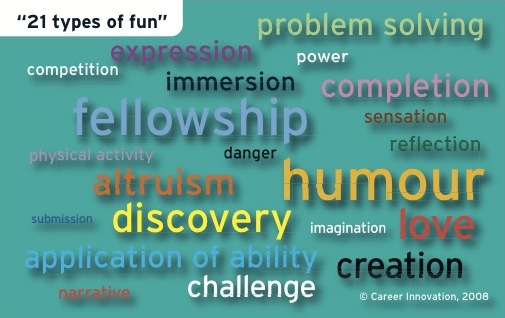
Here are the 21 types of fun, ranked in order with the top items being those most experienced in leisure activities:


21 Types of ‘Fun’

1

Fellowship

2

Application of Ability

3

Altruism

4

Discovery

5

Humour

6

Problem-solving

7

Completion

8

Creation

9

Challenge

10

Power

11

Love

12

Immersion

13

Expression

14

Narrative

15

Reflection

16

Sensation

17

Danger

18

Competition

19

Imagination

20

Physical activity

21

Submission

The result of our initial global research is a set of questions people can use to profile themselves and identify their 'fun profile', comparing their experiences and profile with other people around the world. This approach can also be used by individuals and teams to redesign their work, increasing productivity and enabling new forms of matching and (self-)selection for work tasks.
 
Practical Impact
The likely impacts include:
 
  • Higher engagement from people doing the work, leading to higher productivity and speed
  • Reduction in work-related stress and increase in wellbeing by increasing "energising" activities 
  • More intelligent work design by spending time re-thinking what needs to be done and how
  • More intelligent matching of people to work, through a systematic taxonomy of 'fun' motivational profiles
  • Potential to lower wage costs by designing work that can be done by volunteers
Challenges
Anticipated challenges include:
 
Challenge 1. Mindset
  • Scepticism from people who believe work should NOT be fun! This is linked to embedded ideas about the relationship between work and pay. Even our language betrays our mindset ("compensation").
  • People tend to think the way to make work fun is through social activities OUTSIDE the work rather than by redesigning the work itself (which is the real key).
Suggestions: Doing the 'fun profiling' for leisure and work is a good way to help people focus on the work itself. I have also found it helpful to ask sceptics: Why does voluntary work exist? What motivates people to volunteer? We will then need a rich set of examples of people and activities which - when matched - result in 'taking the work out of work'. And some quotes from people who love their work, and who now know why (as a result of the profiling). 
 
Challenge 2. Methodology
  • Most of the current examples of 'taking the work out of work' focus on competitions. This risks excluding people whose motivation doesn't come from competition but - for example - from human interaction, aesthetics, learning or self-expression.
  • The initial steps of fun profiling and analysing work is not enough. People will then need help to redesign the work, either individually or collaboratively with a team.
Suggestions: Organisations and teams will need some help to redesign their work, perhaps including a template design workshop plus a bank of examples of how to redesign the work, work environment, and work-flow. Initially consultants / consultancies / training workshops will be needed to refine and spread methodologies for work redesign.
First Steps
FIRST STEPS - example
Before we embarked on developing the 'fun profiling' idea, we took an early taxonomy of fun and gave it to a team leader in a well-known telecommunications company in the UK. He was keen to try it with his team.
 
The team leader proposed a simple process for his team to improve their team meetings, which they all agreed needed to be more engaging.  Using paper only (no online tools at this stage) they all rated their fun profiles, talking about the kind of activities they enjoy outside work. (By the way this was a great team-building conversation itself).
 
Then they set about redesigning their team meetings to include some of the components that would make it more energising - simple things such as more dynamic voting processes for decision-making as a group.
 
This initial success prompted us to develop a more robust taxonomy of fun, so we can profile many different types of people and their diverse leisure and work activities.
 
NEXT STEPS - proposed
We are keen to collaborate in joint venture with an entrepreneur or investor, a training company and software developer and potentially a university to test, refine, fund and deploy this approach more widely with organisations and with the public.
Credits
Lead developer: Jonathan Winter. 
 
With thanks to: Charles Jackson, Paul Townsend, Peter Kumik, Jill Pryse-Davies, Linda Shelley, Lindsey Fallow, Jack Fallow, Jonathan Hyde, Jim Pilarski, Dorota Kowalska, Chris Dunn, Steven Fretwell, Stephane Le Camus, Andrew Marritt, Lucy Symons and all our friends at AIESEC.
 
Sponsors of the Digital Generation Survey 2008: Marriott International, Unilever, UBS
Tags
HR, Recruitment, Selection, Motivation, Engagement, Fun, Volunteering, Productivity
Helpful Materials
www.theDgeneration.com
www.careerinnovation.com
www.aiesec.org
Images:
  • J0747 Ci Card_cards v.2[1].jpg
Videos:
  • http://www.slideshare.net/winterjp/ci-digital-generation-survey-2008-parts-123

Input

You need to register in order to submit a comment.

Join the MIX Now

You need to register in order to rate this contribution.

Join the MIX Now

Comments

Ivaturi Siva Kanti Swaroop

It was very heartening to see this article. The only way of most effectively carrying out any work is by making it a fun. A great spiritual teacher once remarked that, "if a child were to be given a responsibility to play with a cat, it wouldnt be fun. he plays with it daily because it is fun." So too with us, whether it is at work place or our own life, to be happy we should be able to make our work a play or fun. Hope more managements and people realize this.

Jonathan Winter

Thanks Ivaturi. I think there is so much potential to redesign work in this way, and I'm grateful for your comment. There will, I'm sure, always be aspects of work that are dull (and indeed, it can be a spiritual discipline to be content and see the value that lies in many mundane tasks) but there is huge scope to bring creativity and life into work. I hope that the work we have done to develop a 'taxonomy' will stimulate some new ideas and practices here.