


HR Doesn’t Drive Organizational Change. Let’s face it: By their very nature, the fundamental HR processes are aimed at safeguarding stability. But when you ask HR managers about the core competencies of their departments, they will tell you that the management of organizational change is at the forefront. They are wrong.
Forget what Dave Ulrich says. In his 1997 book, Human Resource Champions: The Next Agenda for Adding Value & Delivering Results, Ulrich challenges human resource professionals to define the value they create for the business. By doing so, he distills these roles for HR careers: strategic partner, administrative expert, employee champion and change agent. When it comes to that last one, we have to forget what Dave Ulrich says.
Whenever the human side is involved, organizational change projects tend either to ignore it or to completely outsource it to the HR department. Hopes, dreams wishes, and expectations are never taken into account, and training, communication and coaching are restricted to the minimum. The attitude in most projects is exemplified by this statement: "We’ll take care of the process re-engineering and the technical stuff; HR will do the soft stuff."
However, there are two fundamental reasons why you should not count on HR to drive a change:
1. HR is not a change agent
HR safeguards continuity in the organization. Let’s face it: By their very nature, the fundamental HR processes are aimed at safeguarding stability. But when you ask HR managers about the core competencies of their departments, they will tell you that the management of organizational change is at the forefront. They are wrong. The basic processes of HR and their accompanying goals are the following:
- Recruiting and selection’s goal: employment continuity.
- Training and development’s goal: knowledge and skills continuity.
- Performance management and appraisal’s goal: performance continuity.
- Compensation and benefits’ goal: stability in personnel costs. ␣ Work organization and communication systems’ goal: social stability
Therefore, HR should be approached as you would any other function in the organization, and HR should be the first target (and not: agent) of your change- management efforts. But there is more.
2. HR is an agent of continuity
As a support function, HR will be affected indirectly by a re- engineering effort and will most likely resist at firsthand. Does that disqualify HR from having any stake in the organizational change? Not at all.
Change always happens in three phases: unfreezing, changing and refreezing. As the key strength of HR is to stabilize the human side of an organization during and after a transition, it is its role to lead the refreezing stage. In order for the change to stick onto the organization, you are going to use the HR department’s tools and methods.
Therefore, HR is one of the first targets to work with. The faster you can enlist HR into becoming a continuity agent, the better. Just don’t expect them to be on the same page from day one, as they—like everybody else—will resist the change in the beginning.
HR as a co-pilot in long-term planning
From my experience, the only HR actions that have a positive impact take place at the beginning and at the end of a change program life cycle. This leads me to conclude that continuity, not change, is HR’s core business. Even when the organization is affected during the transition, HR should help you out in minimizing the disruption of continuity.
As an example, program staffing of key people is a task that needs to be conducted in close alignment with HR as it should involve career perspectives and long-term accountability. Gradually, as the program comes to a close, HR needs to become the owner of the deliverables regarding learning, performance, organization, and communication.
The role of HR in this case is one of sustaining the change and integrating it into its standards and procedures. In other words: safeguarding stability and continuity of the new organization.
In short, HR does not posses the skills that are required to manage change initiatives. Instead, HR’s strength is that of a ‘Continuity Agent’, a stabilizer if you will.
The Pitfall of Strategic HRM
And there is more. The second thing that causes severe headaches is the constant whining of HR managers that they should get a seat at the executive table. Let me cut this one short: HR managers should stop desiring a seat at the table of the executive committee because they will be raped and abused.
On top of that, as they get out of that room, HR will have lost all credibility as a fallback or buffer between workforce and management. The first thing people will ask as HR is still recovering from their C-suite domination is “whose side are you on anyway?”
The good news? You don’t need a seat at the table in order to practice strategic HRM. In case you would not have noticed, strategic HRM is a matter of anchoring and tying your actions to the Michigan model. Besides the fact that 1982 is an excellent wine year, it is also the year that Tichy et al. published the well known ‘Michigan model’(*). Unlike good wine years, nothing exciting happened ever since on the level of qualitative HRM theory.
N-o-t-h-i-n-g.
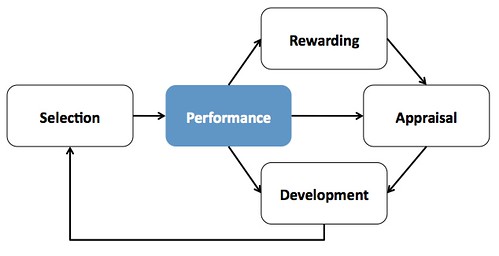
The Michigan Model (1982)
Strategic HRM is quite simple, but it requires focus and discipline. Forget the hypes like ‘competence management’, ‘talent management’ and don’t even think about ‘organizational change management’. Instead, focus on ‘selection’, ‘performance’, ‘appraisal’, ‘rewarding’ and ‘development’ and foremost the processes that tie them together.
Look Around You: Everybody hates HR, Quality and IT! And it gets even worse than that. Did you ever wonder why HR, Quality and IT are the favorite scapegoats in almost all organizations, regardless of the sector and regardless of the country they are in? The reason is not that they are not included in the so-called ‘value-chain’. The real reason is that they don’t have a clue about what a value chain is.
As a result they are perceived as not adding value to the product or service that an organization produces. So all these supporting functions find themselves in a defensive position before they even had a fair chance to demonstrate their added value. And when you act from that position, you simply have no focus on productive stuff, you avoid responsibility and you forget what you were there for in the first place.
OK - enough ranting; how does this translate into a long term strategy? There are 3 steps to take for HR in order to become a business partner.
The first step consists of structuring and automating the basic HR processes. This requires documenting the procedures, drawing the HR processes and streamlining them, and most of all: holding HR people accountable for them. As such, the first milestone to achieve is to become a reliable supplier to the business.
The second step consists of managing the competences. This implies diving into the business and spending at least 30% of your time out of the office and into the business. Competence, performance, career and succession are empty words if there are no activities in a value chain to put them against. Putting the right person on the right place requires some knowledge of that person’s role in the value chain of the organization.
The third step for HR is empowering the business by outsourcing the core part of their activities … to the business. Whereas step 1 may include the outsourcing of administrative tasks to a shared service center, this step will require a handover of activities to the business. That way, HR processes get managed where they live and exist: on the shop floor among the people.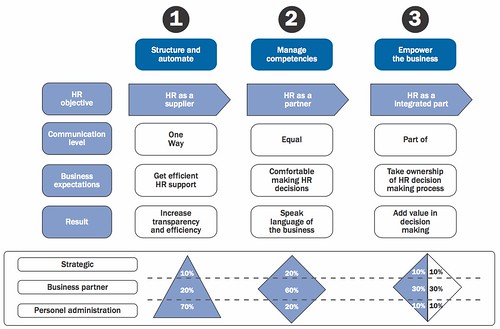
As the diagram above indicates the business expectations change as HR follows this step-by-step approach. These business expectations indicate the value HR should be creating for each step on the way. From this diagram it is clear that one should not try to empower the business in HR decision making from the very first step. Instead you should get the basics right first and get to know the business in the second place before you even know which decisions you can outsource to the business.
In the beginning of this three step process most of the attention will be spent ‘below the bottom line’: automating the basic and repetitive stuff. However, as you move along, automation and outsourcing of the basic personnel administration will free up time.
It is my contention that HR should be spending every minute of extra time as a result of automation in going (physically) to the business; even if that means joining their sales force on the road or getting their hands dirty on the shop floor. The point is that during step 2, HR will be building solutions (systems, procedures, structures, trainings, etc.) that are tailored to the business and then aligning them with the firm backbone that was established in step 1.
Finally, the third step is to shift a part of the HR responsibilities to the business. This only works with a firm backbone of basic HR processes (step 1) and HR solutions that are tailored to the business (step 2). This is where business people really start to use the HR tools at their hand in order to drive business decisions. In other words, at this point HR has shifted from a cost center to a value driver for the business.
It is a myth that HR needs a seat at the executive table in order to practice strategic HRM. Strategic HRM is a matter of reclaiming your place in the value chain in three steps: get the basics right, get into the business and shift the ownership to the business. As controversial as it may seem, giving away parts of the personnel administration to outsourcing entities and giving away parts of the HR decision making to the business makes HR more powerful as a business partner.
Instead of defending their position, HR directors would be better off creating an internal market for their services, aka: “what is your question to my answers?” Some IT managers are doing this already. In order to get out of this disorder I would advise HR directors to have a look at the service oriented frameworks of service that IT departments are building (ITIL, CMM, etc.).
Indeed, time has come for HR with balls, and like you I have been waiting for years for this transition to happen. Seems like it’s easier said than done. So here’s to all HR managers who run away from their own mess by saying they are change agents:
- Please bring facts to the table if you want to prove me wrong;
- Wake up, get your act together and focus on HR processes;
- Get rid of the distractions: outsource the repetitive stuff, empower the business and spend your time dealing with HR processes;
- You are not a change agent. Get over it.

Outsourcing some parts of the tasks can really save you more time and focus more on building new strategies and ideas in order for the business to be more successful. I agree that it can empower a business' core activities, it attain more efficiency and it can be more effective. You will not have any problem in handling some parts of the tasks because the specialists and experienced people will work on that.
- Log in to post comments
Interesting (albeit provocative and slightly aggressively worded) view. I overall agree with the sentiments of “Stop whining, get the basics right and earn your place at the table”. Two considerations however: 1) the pure “continuity” positioning of HR and C&B is a bit too simplistic for me. Sure, maintaining past and current levels of performance/cost /… is and always will be the basic yardstick (i.e. the basics). That doesn’t mean however that the objective isn’t and shouldn’t be “improve” in addition to “maintain”. 2) The necessary initial investment to “get the basics right” and “prove with facts and figures” (often requiring expensive software…) remains a tough sale, especially in dire economical circumstances. No excuses though – we all could do with more guts!
- Log in to post comments
This corresponds to my experience, in a stunning and depressing sort of way. If HR were simply benign as change agents other people in the organization might be able to work around them. But when they occupy a central position, and do not see the degree to which they claim the ground of improving engagement at the same time they promulgate intrinsically disengaging policies and practices, their actions are injurious at best and debilitating at worst.
But it's not as thought they don't occupy a legitimate and needed position within the organization. There is something to be said for a refuge of continuity in times of great change, and if HR dedicated itself to doing that well, they could collaborate with and complement the work of actual change agents within the organization.
Well done, Luc.
Regards,
Bill
- Log in to post comments
- Log in to post comments

I appreciate the care with which you developed both your observations and your response. I love that you say the solution will take guts - shouldn't we know that when we embark on meaningful change. Great hack. Thanks.
- Log in to post comments

THE HRM.,HAS A BACKGROUND IN COMMERCE,PUBLIC RELATIONS,AND SOCIAL ENGINEERING.TRAINING MANAGERS FREQUENTLY HAVE LITTLE FORMAL,OR INFORMAL BACKGROUND IN TRAINING OR LEARNING PRINCIPLES.THIS DOES NOT MEAN THEY ARE UNIVERSALLY INCOMPETENT.
- Log in to post comments

Love the last set of bullets - but perhaps you should base your own article on a few facts as well.
- Log in to post comments

That is a valid remark. My article indeed lacks examples and facts to underpin the arguments.
The background from which I have written this article is my experience as a change management consultant on large-scale ERP implementations.
In that context I function as a hub between the project / program and the different entities of an organization: operations, HR, Communications, etc. Over the past twelve years I have encountered only one single HR department with the will & skill to engage with operations and to be serious about business processes.
There is still a chance that my itinerery has brought me to poor-HR places and that I have only been looking at exceptions in an otherwise HR-insightful world. However, sometimes I am losing hope and that is why I have submitted this 'barrier'.
Thanks for your feedback.
Luc.
- Log in to post comments
You need to register in order to submit a comment.