



Story:
The Tube: IDEO Builds a Collaboration System That Inspires through Passion

Over the last thirty years, IDEO has grown from a handful of employees in one location to more than 500 in eight locations around the world. With this growth, IDEO’s methods needed to grow as well. We needed tools that would allow the entire organization—individuals, teams, and enterprise-wide groups—to share information and collaborate in a variety of ways. More importantly, these tools needed to encourage natural communities of passion to emerge. To tackle this opportunity, IDEO formed a Knowledge Sharing Team comprising technologists, human factors specialists, interaction designers, and software engineers to create a new suite of online tools that would meet these goals within a highly creative and collaborative culture.
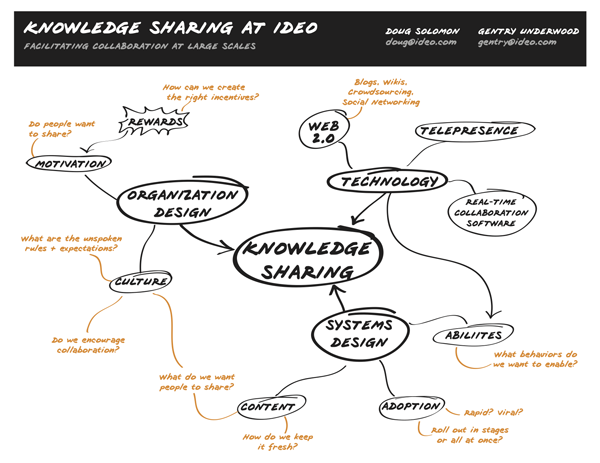

The team continues to enhance the functionality and usability of the Tube through ongoing human-centered research and feedback from the community. They see an increasing need for new functionality such as workflow tools, team staffing tools, customer relationship management tools, and others, each of which requires careful consideration before it can be added to the Tube. Another developing need requires connecting the Tube, which is entirely internal and confidential today, both to the public ideo.com website and with IDEO clients for increased collaboration in specific project engagements. Given the sensitivity of the information and new types of collaboration required, this is a major task that the team is currently undertaking. The team believes that inviting IDEO's partners and public to share information and collaborate around shared interests could have enormous benefit to all involved.

- More than 1,000 Project Pages created in that feature’s first six months (these pages have fields for project storytelling and document collections and sharing. They automatically include all team members who have billed to the project, as well as start date, budget, client information, and more.)
- Over 10,000 wiki pages in the wiki's first 14 months, on subjects as diverse as presentation guidelines and template to travel and sightseeing tips around the world.
- More than 55,000 wiki pages as of today -- a large number for a 500-person company
- 95% of employees voluntarily take ownership of their personal pages (which include their personal blog, fields for long and short biographies, status messages, image sharing, and project work reporting)
- Over 40 special-interest blogs created by teams and individuals, which address company-specific issues such as career growth and office updates, as well as general-interest topics such as social impact, sustainability, and health and wellness projects.


1) Build Pointers to People: rather than trying to take all of the knowledge out of people’s heads and store it in a giant database, focus primarily on helping people to identify who they are -- their passion, experience, and expertise -- and connect people based on that information.
2) Build Rewarding Systems: a system that requires altruism is unlikely to be successful. Similarly, systems that require users to participate (e.g. compliance-based design) rarely get anything more than participation at the lowest required level. Effective knowledge sharing systems must simultaneously meet the needs of the organization while motivating individual participation. The Tube encourages individual participation in a number of ways, from establishing a platform to allow employees to showcase their best work, to integrating the salary range process and project resourcing process into the system.
3) Demand Intuitive Interfaces: intuitive interfaces are absolutely essential for social software because they facilitate viral adoption. The system must present as few points of friction as possible from the process of becoming an active user. For example, early wiki systems required users to set up an account the first time they wanted to add content, learn special wiki languages to format pages, and build not only the content but also the navigation to support it. These points of frustration discourage users from making the transition from consumers to contributors.
4) Take the Road More Traveled: if a tool requires people to go out of their way to use it, adoption will always be a challenge, no matter how wonderfully designed. Wherever possible, strive to integrate tools into existing work processes -- bring the system to the user rather than the other way around. For example, the IDEO blogging system didn't take off until the team added a program that sends digest emails with new content from the blogs each employee has subscribed to.
5) Iterate Early and Often: building effective systems for organizations means designing tools and workflows that mirror the social systems they are meant to support. This happens through lots of iterative design, beginning with rough in situ prototypes (paper-based or hacked existing systems) and evolving into working systems that can be tested broadly throughout the organization. This process doesn’t end with "launch" either. Knowledge sharing systems should grow with the organization they support, and in turn they shape the organization by enabling new levels of collaboration. Thus these systems and the designers creating them should think of them as an ongoing, evolving dialog with the employees using them. At IDEO, the team pushes out revisions to the Tube (both bug fixes and new features) each Thursday. Much as Google keeps all of its software in “beta” for as long as possible, this reinforce the notion that the Tube is a working prototype and set the expectation for ongoing change, which enhances our user experience without confusing it. When individual passion meets collaborative tools that fit into the flow of one’s worklife, powerful innovations can result. IDEO's goal is to continue to build a platform for innovation that builds on the passions and cooperative foundations of our culture. As is a tradition at IDEO, the team will continue to share with the outside world what they learn along the way.
IMPACT:
The Tube has had a very positive impact on the way we work at IDEO. Teams are working using the platform in new ways. People with special interests, talents and passions are easier to identify and invite to collaborate on projects. Passion is the key. Our model is based not on "compliance", which we have seen in many other companies, but on an opt-in model. Connections among people are made based on active collaboration but also by searching for people and ideas and by serendipity. We fully expect to see many other unexpected and wonderful benefits from our approach in the future as the platform and users develop and grow through our collective learning.

How refreshing to see the focus on knowledge sharing and generation as a social activity rather than a technology solution. You seem to have intuitively applied gamified systems approaches that understand how much people are motivated by intrinsic rewards, and enjoy collaboration. And, of course, I love your 'iterate early and often' approach. How other than by experimentation, assessment and trying again can we ever design what we want and need. Thank you.
- Log in to post comments
Thanks a bunch for this amazing writeup Doug! I've recently switched to Ruby on Rails and hopefully can leverage my knowledge for my potential business needs (my project is dedicated to the methods of screen capturing i.e. how to record screen and I'm having hard times with the software I use). As far as I can see, your approach works perfectly, and that's quite understandable. Congrats!
- Log in to post comments

Doug,
Congrats on capturing the intelligence of the whole group for the benefit of all. I appreciated your description of all the technologies you used and how you dealt with the concerns about adoption.
I have a suggestion on where to go next in response to what you said the team sees as "an increasing need for new functionality such as workflow tools, team staffing tools, customer relationship management tools, and others." Sharing information is foundational, but this alone does not produce action. Co-laboring is really about two or more people delivering some outcome together. So the next step is to introduce software that helps people create and track agreements to deliver.
Software for managing explicit, two-person conversations for action is coming which will improve coordination, visibility into execution, and accountability by presenting a clear picture of who will do what by when. One person (the requester) makes a specific request of someone else (the performer). The performer is obliged to make an explicit response, i.e. agree to deliver on the request, decline, or make a counter-offer. Presenting the performer with the opportunity to negotiate their delivery commitment clarifies ownership and assures accountability, not to mention increases the likelihood that the delivery will be made on time. The whole organization can be seen as a network of these conversations around negotiated commitments. The principles are the same whether individuals make requests or each other, departments make requests of other departments, or the CEO makes requests of Vice Presidents.
Commitment based management has been described as the most important new management principle to emerge in the last several decades. These simple, but profound innovations in work management have been profiled in the Harvard Business Review, MIT Sloan Management Review, and the Wall Street Journal. These innovations will also disrupt current top-down/command-and-control work norms and increase trust by capturing performance metrics and exposing patterns of behavior. Check out my blog (4spires.com/blog) if you'd like to learn more.
Keep up the good work!
David
- Log in to post comments

Doug . . . This is fantastic! I have been reviewing similar tools for the Innovation Center we are creating at Children's Hospital Colorado in the Orthopedic Institute. The Innovation Center will facilitate clinician and staff development of ideas for improving patient care via novel services and products. This will be accomplished through collaboration with academic and industry partners, and by utilizing our number most valuable resource - our patients and their families. Do you have any suggestions for software that you think would be appropriate (since the Tube doesn't appear to be commercially available anytime soon)?
Thanks! - Tim
- Log in to post comments

- Log in to post comments
- Log in to post comments
Doug:
Yes, good story and useful insights. But I 'm puzzled by the name chosen for the group. To me it indicates a closed system not one that gives incentive to collaborathe. Why not express with a word what the group does. I.e, Walter Gropius and the company he helped found, The Architects Collaborative.
Cheers,
Gio' Morse
- Log in to post comments
- Log in to post comments

Doug thanks for the story - lots of useful insight for an intra-company exercise or exchange to learn from.
I wonder if there are insights that could apply to the wider web community as well. I understand the desire to build depth into relationships within a known community as it helps the agents within the "system" to link, understand and respect each other - and this supports info transfer and growth. Ego is moderated enhanced understanding and trust. The problem with the wider web community is that the biggest blocker to passionate embrace is trust or perhaps more correctly the lack of trust. There is a lot of "fronting" and image maintenance on social network sites and a visit to many boards and chats soon reveals a lot of egos on display.
I an wondering if an opposite approach could work to some extent - the use of totally anonymous unattributed chat rooms (Each particpant is recognised simply by a color/font and Unique i.d. alpha/numeric code. Chatroom rules could focus discussion on the idea in addition to community feedback - with no reference to participant CVs, likes, dislikes etc to color the conversation or provide bias of information introduced into the conversation. The only feedback mechanism being provided over time directly by the community sharing the online environment.
I have been thinking about this because in numerous corporate environments that I have encountered around the world the nature of profiles, the definition of how people are viewed, is influenced by the bias of the environment designers and the gravity associated with comments and input is, I believe, seriously coloured by the apparent "expertise" and noteworthiness of the source.
For instance a great marketing idea could be introduced by a new cadet to the company but could be criticised by a long standing or senior team member which and his/her critique can have a strong influence over the group in many cultural settings (perhaps not IDEO which I wholly admire...). The idea can be lost because many participants don't wish to rock the boat or simply trust the experience of the senior member - mediocrity can be a powerful force in a herd setting.
Would IDEO ever consider a completely anonymous environment where ideas are championed and egos are submerged? I understand the need for personal attribution in order to incent participation, but that can come later once the idea has found its legs and a group has pinned their colour to its mast so to speak...
I would love to chat with you about this if you are ever available.
Regards
Gavin
- Log in to post comments
- Log in to post comments

- Log in to post comments
- Log in to post comments

Hey Doug,
Thanks for sharing, I'm always inspired by IDEO's push to collaborate and harness creativity.
Just came across this link from Alec Ross, thought it would be interesting to you.
Maybe IDEO should help the State Department take their collaboration to the next level?
http://www.businessofgovernment.org/blog/business-government/new-corrido...
All the best,
Richard
- Log in to post comments
This is great - not compliance-driven, but inclusive.
A couple questions:
- Can an area be segmented off for a specific group - e.g., only those working on a confidential project having access?
- Can access to The Tube be shared across company boundaries - include the client team, for example?
- Log in to post comments
- Log in to post comments
Great story. Would love to know what tools, platforms, development resources The Tube is based on. Can you share? Thanks.
- Log in to post comments
- Log in to post comments

Thanks so much for sharing Doug. I enjoyed reading your story and the inspiring benefits that can flow from such a collaborative community. I just posted my latest submission/Story entitled, "The Power of a Peer Group: How come something so proven is not more pervasive, and what are we willing to do about it?" at: http://www.managementexchange.com/story/power-peer-group-how-come-someth...) and wondered what your thoughts are about the blending of these approaches (which i speak to in the Challenges & Solutions section - the 3rd challenge/solution). My sense is that they are additive, addressing overlapping and underlapping needs and neither is as powerful alone as they can be together. Welcome your thoughts. Thanks again for sharing. Best.
- Log in to post comments
Hi Doug,
A great article.
As an advisor to a range of SME's in Australia, i have been trying to articulate the notion of an internal ongoing innovation workshop by the use of collaborative tools emerging from web 2.0.
Your article has just made the job easier for me, thanks.
- Log in to post comments
- Log in to post comments
Fantastic article, Doug. We're looking to create some collaborative structures at Brambles, and I am going to take your lessons to heart. Thanks
- Log in to post comments

Hi Doug-- fascinating story... would love to see a screenshot or a video demo! Curious whether you built "the Tube" from scratch, or built it on top of an existing collaboration platform (e.g., Jive, Google Apps) .
Thanks,
Ryan
- Log in to post comments
- Log in to post comments
Thanks for providing so much information on your system. While creating content is good, the most difficult part in using similar Knowledge Systems is to be able to search the appropriate content quickly enough for our reference. How was this enhanced in your project?
Thanks in advance.
Regards
Madhu
- Log in to post comments
- Log in to post comments

You need to register in order to submit a comment.