


Even those projects that ask for input from across the organization still hold tight control on any final 'answers'. Once they move into implementation the strategy falls flat. No one understands why or how they fit in. The strategy becomes a document on the shelf.
When I first started working with Red Hat at the beginning of 2008, it was readily apparent that the traditional corporate strategy development process would simply not work in an open source company where transparency, meritocracy, and collaboration were prized elements of the culture. So, over the past three and a half years, we have built, tested, and executed on a very different model for corporate strategy. I think it's one with lessons for other organizations--and in the spirit of open source, I'll unpack as many as I can here.
As Jim put it to me, in Red Hat he had joined a company with "high-class problems." The company had been growing rapidly--from about $90 million in revenues in 2003 to $400 million in 2007--and had a wide number of potentially lucrative growth opportunities in front of it. Red Hat had a healthy balance sheet, a strong, well-respected brand, and award-winning products used by many of the largest, most successful companies in the world.
* Be more systematic about how we analyzed the market, customers, and prospects--what he/we call 'one truth'
* Execute more efficiently on the opportunities that were readily apparent
* Make smart choices about where to focus time, energy, and resources, while also making choices about where to say no, even to attractive opportunities
Most new CEOs come into an organization and quickly mold the company and its leaders into their own vision--not Jim. He first wanted to learn more about the business and marketplace as it currently existed.
Frankly, because Red Hat was growing and doing well financially, there certainly was no urgent need to "fix" the business--this was more of an opportunity to learn how to execute more efficiently and plan better for the future. Jim realized Red Hat already had an amazing organization; he simply hoped a more defined and organized strategy would help us become better stewards of it.
But the traditional strategic planning model would not work at Red Hat. Red Hat had a deeply entrenched and open source-inspired culture that prized transparency and collaboration. Any strategy effort would have to be run out in the open, where employees from across the organization could participate and offer their feedback and suggestions.
While many might view it is as a disadvantage or a time sink to systematically gather feedback from across the company, at Red Hat it's a core part of our competitive advantage. In the open source world, there is a saying: "Given enough eyeballs, all bugs are shallow." Here there is a firm belief that the best way to get great ideas is to get a lot of ideas, from a diverse set of viewpoints.
It's not just talk. Red Hat is truly a meritocracy of ideas--where the best ideas can come from anywhere in the organization. Many of Red Hat's most successful products and services were built upon the hard work, passion, and commitment of one or more brilliant people inside (or even outside) the organization, not a top-down mandate.
With this all in mind we knew we would have to make sure our process was democratized; less top-down, more all-around.
First, leaders from across the organization worked together to develop an overall framework, identifying several areas both internal and external that we thought made sense to explore in more detail. Some examples of the types of areas we explored include the business model, operating model, technical vision, and commercial model for the organization. Then we brought in an experienced facilitator, Joe Anglim, to help everyone through the process.
We next recruited members of the leadership team to sponsor the exploration teams. All of the senior leaders of the organization were involved, and the team leads included executives like our CIO, VP of Operations, VP of Services, and VP of Marketing, among others. But rather than naming the "usual suspects," we asked leaders to step out of their comfort zones and lead efforts far removed from their daily responsibilities. For example, the head of the "People" team was asked to analyze the financial model of the company and the CFO was charged with exploring design and operational system enhancements. By setting it up this way, it wasn't just top leaders learning, but all of us. Senior leaders gained perspective and understanding of worlds they'd never spent much time in before.
An Open Approach to Communications and Engagement
From the beginning, we put engaging with our associates ahead of communicating to them. The entire company needed to own the strategy if we wanted to see it implemented. Associates needed to be an integral part of developing and implementing it.
We looked for any and all chances to engage our people in a dialog, to start a lively discussion about our strategy at all levels within the company.
We also decided it was worth setting up a specific cross-functional team--a strategic internal communications team that included representatives from our people, brand, internal communications, and IT teams. This helped us ensure we didn't take our eye off the ball.
We built an internal wiki that leaders of each exploration team used to organize their thoughts and ideas out in the open where any employee could make comments or suggestions. Anyone who was particularly interested could read about the progress, and add their ideas or volunteer to help (and many did).
This information-gathering dialog lasted about 5 months. We communicated our progress along the way through regular updates at company meetings, through email, and on the Intranet. The strategy team leaders posted status updates to the wiki and replied to comments on their team's internal blog. Jim hosted a company-wide online chat session where associates could ask him any question they wanted to about the strategy process (or anything else that was on their minds), and team leads communicated key updates through company-wide announcements and discussions.
The leaders did as much listening as they did speaking on the topics. Thinking evolved as part of the process. For example, in the business model exploration, we started the conversation by talking about a defensive differentiation strategy that would halt our competitors progress, but quickly realized that focusing on ideas for how to create more value for our customers through the products and services we provide would yield even better, more compelling (and more sustainable) results.
Synthesizing the Ideas
Red Hat employees generated ideas--LOTS of ideas. In fact, they generated more than we knew what to do with. Many of these ideas were developed within the working teams and vetted via the wiki, but on other occasions, ideas from the broader associate base were incorporated in the thinking as well. Not every idea could bubble up and become part of the strategy effort, but the best ones did and spurred a lot of great dialog.
For example, it became clear that we needed to take another look at the mission of Red Hat (a process Jim Whitehurst wrote about for the MIX here) to make it more specific and easier for employees to rally around. Jim formed a team to take on this task, and this team engaged the entire company in its development.
In another innovative example, the technology roadmap team not only engaged the best minds from within the organization to uncover ideas, but also pulled in the open source development community as well. We utilized existing networks in the open source community to "keep our minds open" and socialize ideas outside of Red Hat. By giving members of the external community an opportunity to weigh in, we not only were able to identify new and next generation technologies very early, we allowed an extremely important set of people into our process, increasing their understanding and appreciation of our direction.
By involving the larger open source community, we were able to gauge the reaction and study the ramifications of particular strategies, thus minimizing unintended consequences of those decisions. We even discussed potential strategies with the leaders of other organizations so they could understand our goals and help us work through ways that we could achieve them while not undermining the goals of the larger community.
The process to this point did a great job of coalescing market and customer insights, and identifying areas of opportunity, and some very clear themes began to emerge. But we knew deciding how to execute against these strategies was the next challenge, so it was time to shake things up.
Driving Accountability into the Organization
As I mentioned previously, each initial group had been led by a member of the senior leadership team. But now that we had highlighted our key areas of focus, we wanted to give people at more levels in the organization the freedom to decide how we would tackle the priorities.
We built entirely new teams around our new areas of focus, this time headed up by leaders a level removed from the senior leadership team. They, in turn, tapped the people with the most knowledge and the most interesting ideas to take charge of actually developing the strategy and plans in each area. True to the spirit of the Red Hat meritocracy, the people who were charged with actually developing the strategy and plans in each area were those who knew the most about it and had the most interesting ideas.
We designed a new communications plan for this phase, including creating an iconic diagram that we'd use over and over when leading conversations about the strategy process. This diagram worked like a "You Are Here" map that would show people where any discussion might fit into the overall strategy. We wanted to ensure that each associate understood how his or her work fit into a larger vision.
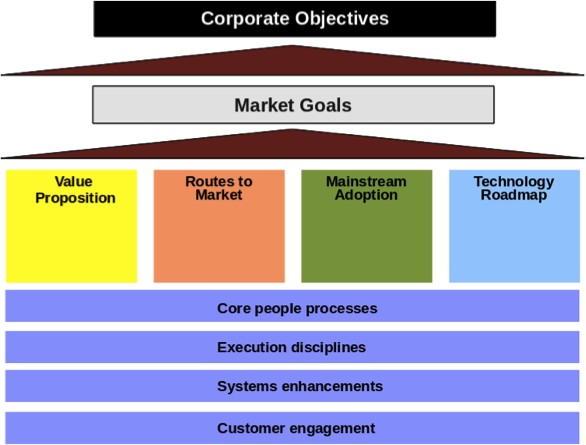
These groups took the major strategic themes and ran with them, building strategies and plans to execute on our new priorities. But where in most strategic planning projects, these teams would be asked to build strategies and plans and then bring them back to the leadership team to make decisions, we left accountability and responsibility in the hands of the people who knew the most--those who were doing the work.
This had three key effects: First, putting the responsibility for developing the details of the strategy in the hands of the people charged with implementing it--rather than handing down a fully-cooked plan--generated more creativity, accountability, and more commitment. By allowing the strategy to be developed at the same level in the organization where it would be executed, we empowered those who would have to implement the plans to control their own destiny. By giving them the freedom to develop the plans the way they saw fit, we increased their accountability for the end result.
Second, by leaving the responsibility for deciding what should be done deep within the organization rather than bubbling things up to the senior executive level for every decision, we avoided the typical 50,000-foot oversimplification of the strategy that so typically occurs in these projects. Much of the work Red Hat needed to do against these strategies was complex and nuanced. By letting people who understood this make the decisions, we were able to ensure the right plans were developed with the best information available.
Finally, by leaving it in the hands of the people who were working with these issues on a daily basis, we improved the flexibility and adaptability of the strategy. As new opportunities emerged or changes in the market occurred, the team was empowered to make changes real time rather than having to go back to the senior leadership team for approval. While the overall framework and initiatives stayed the same, each individual group had the ability to ensure their plans were current and agile. This was not simply a strategy planning team, it was the strategy execution team as well.
You won't be surprised to hear that there were times when we required that the whole company shift its thinking, and in these situations, the leadership team--and Jim in particular--stepped back in. In one instance, a strategic theme was not well articulated and was being misconstrued by many within the organization. Rather than sticking with it as originally envisioned, we renamed and repositioned it so that it so that it could be better understood and more inclusive of all of the tactics being implemented by multiple groups.
Executing the plan
In all our combined years of conducting strategy exercises Jim and I have never seen an organization follow through on its plan over a three-year period like Red Hat has done. The framework, initiatives, and themes have remained intact--with every employee understanding the strategy and how they personally fit into it. The teams have continued executing and adapting. We've monitored key metrics along they way.
Every team has made significant progress, and in some cases, people's "day jobs" have changed to give them even more time to directly work on executing against the strategy.
Since we started this process in 2008, Red Hat has been executing more efficiently on its best opportunities, and it shows. Red Hat has grown from a $400 million revenue company to an almost $1 billion company and the stock price has more than doubled.
As I write this, we are beginning to address new opportunities to compete in a quickly evolving enterprise infrastructure space that we would not have been able to address in the past. As we execute systematically against our current opportunities, we have provided ourselves with more freedom to begin thinking about exciting and different opportunities for the future.
One of the issues we noticed early on was that we were not consistent in how we communicated our value proposition around the company. Different groups had different 'translations'. So, along with re-crafting the mission, we collaborated on a clear articulation of our value proposition that explained who we are, what we deliver, and how we deliver it. This became another key element that helped ensure the individual strategies fit together into a larger story.

The sheer quantity of ideas also presented a challenge, but most of the teams did a very good job identifying and nurturing the best ideas. Our open and collaborative open source culture inherently helped us do this fairly efficiently. As with any project involving this many people, synthesis--taking all of the ideas and narrowing them down to the best ones and then putting them into context--was a key challenge simply because it took a lot of time to go through all of the data.
Many people within Red Hat had never been part of a strategy exercise before. Strategy and strategic planning can mean different things to different people. I'm sure you have a definition in your mind--and I'm sure that it's different than the one in my mind. Those involved needed to better understand Jim's definition of strategy and needed extra help understanding specifically what was being asked of them. Many frameworks can certainly work but everyone needed to understand how and why Jim had crafted the one we were using.
To make it a little more complicated, those who had indeed been involved in strategic planning processes before often didn't take the exercise seriously, believing it would probably be like lots of others they'd been through. They imagined it would end up as paper on the shelf, never to be looked at again. It was after sessions with the senior leadership team where they needed to provide robust updates and got specific feedback that they began to realize Red Hat was serious.
The sheer amount of time it took was often frustrating. When strategies are formed in smaller, more senior groups you get to 'answers' fairly quickly. Here with so much involvement, we needed to be patient. And patience is hard when your market is moving quickly. We had to keep reminding ourselves that taking longer to agree on our strategies and getting buy-in was FAR more important than writing down great answers in short order.
Teams pushed for consensus, but as we know, consensus is not always possible. And often consensus can lead to a 'watered down' answer if you aren't careful. At times some people thought ideas were too far reaching while others thought we weren't reaching far enough. When we ran into these walls we tended to go to a senior leader who could look at all the options from an unbiased perspective and help get us to an answer.
One example of this was when we tried to define what the term "renewal" meant to us. Each stakeholder had a different view of what and how we should define it, so a subset of the team took a step back to develop a definition that could work for all of the stakeholders.

And here is a comparison of the Red Hat income statement from 2008 with the one from our most recent fiscal year, 2010, showing an increase in revenue from $523 to $909 million.

Although the time upfront felt long we were actually able to execute several initiatives fairly quickly. Where most experts will tell you that it is best to only take on 2-3 strategic initiatives at one time, we were able to take on 17 under 9 themes at once--and execute on all of them.
The speed of market change has also picked up during the last three years. Because we began the process of democratizing corporate strategy in 2008, we now have the runway to dream, analyze, prioritize, and then execute against amazing future opportunities for our company today. What's more, had we not invested in the exercise three years ago we would not be as nimble and well positioned to be a key player as the technology landscape makes a strategic shift toward cloud computing.
Our employee base is eager and ready to take on new challenges and to be part of the process all over again.
The best ideas can come from anywhere. By making the strategy process transparent and collaborative, you can ensure the most powerful ideas are allowed to see the light of day. If it makes sense, consider involving members of the communities around your organization to help you develop pieces of the strategy in ways that help them benefit as well.
Involve all employees in a conversation about the organization's strategy rather than just informing them.
Where most strategic planning projects either are the work of a small group of people or solicit employee input before the actual strategy development work is done behind a curtain, our project at Red Hat allowed for transparent collaboration to happen through every stage of the project.
As much as possible, we tried to make the process a conversation that anyone who was interested in could join. We also employed strategies like blogs, wikis, and chats to stimulate conversation wherever we could.
One of the biggest challenges in running a strategic planning process involving contributions from a large number of people is ensuring that everyone has access to the information they need in order to make their best contribution. By involving the top communications people in the company at a strategic level and forming the strategic internal communications team, we were able to develop a communications plan that didn't just inform, but also deeply engaged people at all levels of the company in the process.
Drive the freedom (and accountability) for building out the strategy as deep into the organization as you can.
A crucial flaw in many strategic planning projects is that the team charged with implementing the strategy doesn't have a role in its creation. By driving the freedom to develop the strategy to the places in the organization where the strategy would actually be implemented and making those teams accountable for the results, we were able to build a strategic plan that was flexible, current, and took advantage of the knowledge of those who understood the problems and opportunities best.
What's more, because the people who were implementing were also developing the strategy, they felt more like they were in control of their own destiny, thus were more engaged in ensuring they met the goals they set for themselves. They also were empowered because they felt like management "trusted" them enough to allow them to develop the strategy.
The power of giving up centralized control over the strategy was a key takeaway from the process.
Be patient.
Running a strategy project the way I've described here won't necessarily give you the fastest answers. Keeping a large group of people communicating, informed, and involved takes a big commitment of time and energy. But the investment is a good one. The extra effort it takes to develop the strategy will pay off big dividends as you begin to implement it. Because your people were involved in the creation of the strategy, they'll be more engaged in executing against it. And because you drew from a bigger pool of ideas and involved people working directly on the specific challenges and opportunities facing your organization, you'll likely end up with better strategy as well.
Keep the drumbeat going.
The strategy process at Red Hat has been going on for three and a half years and counting. While we continue to iterate and improve the strategy along the way, many of the central themes have been driven home over a period of many years.
Regular updates on progress and regular deep dives on strategy have been a part of every Red Hat company and manager meeting for years. By continuing to keep momentum behind the strategy strong and communicating often, we've ensured that the company stays focused on executing against the strategy.
Let the strategy live and breathe.
Good strategy shouldn't change every day, but it must be flexible enough to allow implementation strategies and plans to change when they need to. By keeping accountability for strategy and execution deep in the organization, we ensure that the strategy can flex to take advantage of opportunities and challenges based on the best information available at any given time.
In particular, I'd like to thank DeLisa Alexander, Joe Anglim, Michelle Thompson, Kim Jokisch, Jeff Mackanic, Tina Kissel, Mike Paquin, LJ Brock, Jan Smith, Sue Moynihan, and Lizzie Shivers for their vision and for of their hard work that has ensured the continued drumbeat.
I'd also like the team leads and others who took key roles in the strategy process, including Mark Enzweiler, Chuck Leyrer, Iain Gray, Alex Hueblein, Gus Robertson, Dion Cornett, Mandeep Chaddha, Scott Crenshaw, Lars Herrmann, David Levine, Chris Gray, Katrinka McCallum, Craig Muzilla, Marco Bill-Peter, Essam Bahsalli, Brian Kempf, Matt Hicks, Denelle Hicks, among countless others.
I'd like to thank Jim Whitehurst and the rest of the Red Hat senior leadership team for being patient and brave enough to ask the entire company to craft Red Hat's strategy
Finally, I'd like to thank all of the employees of Red Hat, without whom this strategy effort would never have been successful.

I love Red Hat ... I will wear the Red Fedora tomorrow on a Saturday at the Venice Carnival and take a picture of Red Hatted Family on a real gondola down the Grand Canal (not the Vegas little pool). This paper is great stuff ... Great food for thoughts ... associates have ideas ... associates have too many ... i would like to learn more about reverse funneling mechanisms and tools ... would like to learn more about fuelling individuals' innovation ... would like to learn more about new coins to reward ideas and talent ... money for sure is not the engine of past present and future innovation ... I am proud and feel good to be part of this car and believe we are not even in gear 2 and would feel honored to contribute in the front line ... AnOpenMind
- Log in to post comments
Great story. However, will this work in a team comprised of people with prejudiced ideas. It will work no doubt. but only the dominant will he heard. It may be that what they want will appear as what all wanted.. Let me bring it to light here. In India we have the caste system with the forward caste having a prejudice that it is they who are superior humans. This group is protectionist, in ensuring that their "rights" are safeguarded. They won't buy the all are equal thought. Imagine if this group is within a team that also has weaker people who are less aware of their "rights".
Under the name of meritocracy the views of the dominant will become democratic.
- Log in to post comments
A brilliant story - Thank you for sharing. Not only does the process make sense, the financial results speak for themselves.Getting everyone aligned toward a clear direction is the biggest indicator of better financial performance. One element you called out is of particular importance: Patience. Leaders are often reluctant to engage and involve people simply because of the time it takes. In our work on corporate culture change, highlighted in our book Transforming Corporate Culture, we teach leaders the direct link between how they engage people and their financial results. It's much easier for a leader to commit to these types of processes when you believe that link exists.
To Priya's question: We have had success with engaging people in satellite offices through virtual mediums such as Mikogo, Maestro, and Dim Dim. facilitation programs.
Accountability, innovation, and the ability to move with greater speed are what creates competitive advantage these days. That's all about culture! Hats off to Red Hat!
- Log in to post comments
Thank you for sharing such a great story of collaboration and inclusion of all employees in the strategy process. This process makes so much sense since the people who are responsible for implementing are also the ones who are formulating the corporate strategy. Employees could link their goals to the goals of the organization and this transparent process not only resulted in improved accountability throughout the organization but also resulted in the financial success that Red hat experienced; win-win situation for all stakeholders – management, employee, and customers. Would be interesting to know if there were other challenges to ensure participation of employees located in satellite offices?
- Log in to post comments
Using the word “engaging” is a great way to avoid one-way communication, which often happen in a big organization. What you said about “people would not be fully engaged in executing unless they were included up front” is completely true. Engaging people up front can motivate employees and confirm their value and importance to the organization. Engaging people along with utilizing open source resources create a competitive edge compared to the traditional (or conservative) organizations. Since strategic planning often changes according to the market situation and the competitor’s strategies, it is very important that the organization is open-minded enough to absorb the different information from the outside world and not limited to the organization’s own world. Also, I think employees should be encouraged and recognized when contributing to the open source community since a “community” is definitely not one way. It can only grow by active contributing and participating by everyone.
- Log in to post comments
It’s interesting how the culture at Red Hat drove the decision to approach strategic planning in this way and kudus to the Red Hat executive team for recognizing that need quickly. I’m curious how this could be implemented at a mature company. Would the employees value transparency in the same way? Would the executive team be willing to relinquish control? I would love to see this a more collaborative approach to strategy at my company but wonder if we have the right culture to support it.
I’d be curious to hear more about how you managed the time issues you faced when trying to come to a consensus. As mentioned, the decision-making process takes far longer with this many people and ideas involved. Although you describe it as a long process, I’m surprised (and impressed) it didn’t take longer. Nice work!
- Log in to post comments
What a breath of fresh air! It is great to hear about a company, such as Red Hat, encouraging for innovation and collaboration from all avenues of the organization. As demonstrated with your success, by making strategies transparent and flexible, not only can a company increase their chance of success, but they can also increase employee motivation by practicing open horizontal and vertical channels of communication and employee empowerment. It definitely seems the plugged in approach taken by Red Hat will continue to prove effective and maintainable for years to come.
- Log in to post comments

Thanks Jackie. I do like your way of presentation, that you connected the creation and execution of strategy to the market performance of your stock.
- Log in to post comments
Jackie...Congratulations to you, Jim and the entire team. What an inspiring story. Your inclusive approach to strategy development and execution is fresh, sustainable and effective. I'm deeply impressed. Thank-you very much for sharing with us.
- Log in to post comments
You need to register in order to submit a comment.