


When I first heard about the web 2.0 I was not that really surprised. Our company had been working with collaboration technology such as Lotus Notes and later with Ray Ozzie's early version of Groove, so the use of internet-as-a-service for group collaboration was the next logical step. This case story describes how we had nevertheless to make a bold step and have our company sensitive information to move up into the cloud. Yet, the learning has been amazing. The most important part of the web 2.0 is not really the "second" generation of tools that it offers, but really to think about them as the .0 version implementation and then build from there. Our story is a reminder that constant evolution of technology must have us shift our focus to the collaboration processes themselves that need to be carefully and constantly designed, reviewed and improved.
groupVision specializes in group supported collaboration. The company started in the mid 90's and almost bankrupted as we were clearly ahead in the starting wave that later become the huge internet revolution that reshapes our lives today. Would you imagine to talk to a CEO or board member that does not has a laptop? Think about the pain of convincing that person to use our electronic meeting systems to kick off the next big project with her management team. People were only used to have a personal computer for individual desktop work. Internet was still in its infancy and the surprisingly easy to use Mosaic browser was just starting to shape a promising world wide web.
From the start, our company has focused on working for the big consulting firms to leverage their management consulting methodologies with our specialized groupware tools. We become quite successful working for big companies and several important government projects. Fixed or portable, large or small, our decision rooms have been used in various parts of the world. Technology for helping groups to meet has been researched under the label of Computer Supported Cooperative Work (CSCW) and early players have become very successful companies today. In the mid 90s we have acquired what has become today our most important customer - SMART Technologies - the inventors of a special class of collaborative technology - the interactive whiteboard. Our business model expanded to include marketing and distribution of this unique type of groupware technology. Our sales revenue have grown dramatically, especially when the SMART interactive whiteboard hits the classroom five years ago. Most Education systems in the world today use interactive whiteboards to improve knowledge sharing and students results. The web 2.0 has helped the adoption curve and we are now enjoying our moment of glory, celebrating market leadership in the countries where we have principal offices.
The challenge today is to keep growing on a two digit basis and adding value to a specialized distribution system we have specifically created for group collaboration technologies. The web 2.0 has been a key strategic element for the adoption of our products and for the success of our distribution methods. We are now rethinking our own management systems using the same medicine.
This is going to sound too familiar (or not) but the driver for change aroused from reading the small print on a white paper from an IT vendor company. It cried out loud to me: "In the future, the greatest competitive advantage will not come from having the most innovative products or the most skillful marketing. Instead, it will come from using employee work time in the most effective way possible". My God, I said, think about that for a moment...! Let's not only think about our company, but let's take any company with +1000 employees (which we are aiming to become). Think about the wealth of resources a company can be losing every day whenever its workforce sends to the bin precious work time that is not properly applied. Can we afford to lose such amount of money? So if our company is poised to grow then we need to excel in making our own employees work time the most effective possible. Not only we shall be more competitive but could really be confident that every bit of our collective effort would be applied in the growth of our business, the real challenge we have ahead.
This thinking triggered the internal concern on making the effective use of employee time as a company priority. We had to make sure we were not wasting money with ineffective work and instead building value to our customers and therefore making us a stronger company. It was no longer a question of having the best solutions (which we are confident to have) but how to be able to deliver them in the most effective way, without wasting employees work time. It was not any more a question of having the most skillful marketing (which we were confidently developing) but on how to develop such skills with the best possible use of employees time.
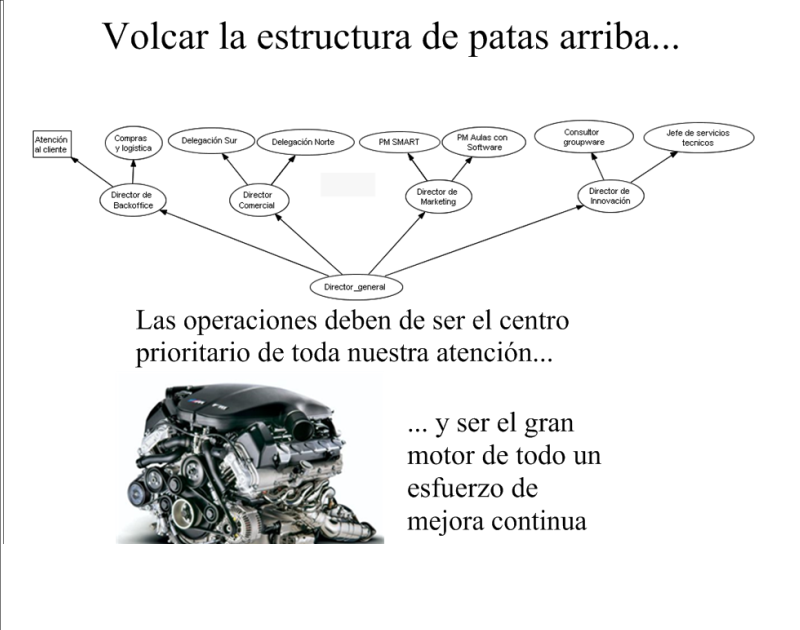
This upside-down turn in the structure was graphically represented by flipping horizontally our organizational chart and making it resembling a tree full of leaves. The lower part of the trunk was the place where I have placed myself as CEO, the trunk being the board of directors, and each department a branch in the tree. The fact that operations were now placed at the top of management attention resulted in establishing a series of structurally fixed meetings (usually Friday) where anyone can take part so long as there is any issue to be addressed. These are called the weekly operational meetings and themes range from sales & backoffice to sales & marketing. In fact "sales" are really at the core of these meetings.
It was with this new structure well in place that the thought-provoking presentation about employee work time effectiveness as a key business advantage was made later in the year. I remember it immediately sparked a wide debate about the use of "time sheets" as a management support tool, most complaining it was a pure waste of time.
Since long, we had established a "time sheet" reporting system where every employee filed a hand written piece of paper for every work week. More recently with the adoption of Google Apps, every employee submits an electronic version of the original paper form, converted in a spreadsheet. Really the problem with that "paper-based" system is that it can gives us a view of where we are spending our time but it does not guarantees that the best possible use of time is being made. Anyone knows how to trick a "time-sheet" to cover hidden unproductive time, but that is not the point at all... For instances, when I Google-searched the Netviewer's white paper in our intranet to copy-paste the quote I used above, I have found our employees have spend a total of 12 hours, assisting to on-line conferences and sales demos that were offered by that provider during the last 6 months. If we average our hourly wage cost I guess that we have spend more money finding about this tool than its actual cost for one year. This is precisely the kind of information that any time-management system can offer, and it was clearly not what we needed.
The driving quest was how to make sure every hour of our collective work time is the most effectively spend possible in order to reach organizational excellence - the smooth riding of the BMW engine... Could the new web 2.0 tools assist us in that process? The results were not at all related with technology implementation although the groupware-enabled features of our Google Apps platform were really instrumental. Yet technology must always be seen as a "means" to accomplish the goal of "group collaboration", never the end in itself. The critical factor was really the learning process that transformed the management of the company in an "upside-down" hierarchical thinking. It was surprising for me to discover the new forms my role as a CEO was taking, becoming close to those of a "meeting architect". I had to establish the foundations of how group collaboration must overcome individual-based thinking and therefore to become a key driver for the decisions that make the employees work time to be used in the best possible way.
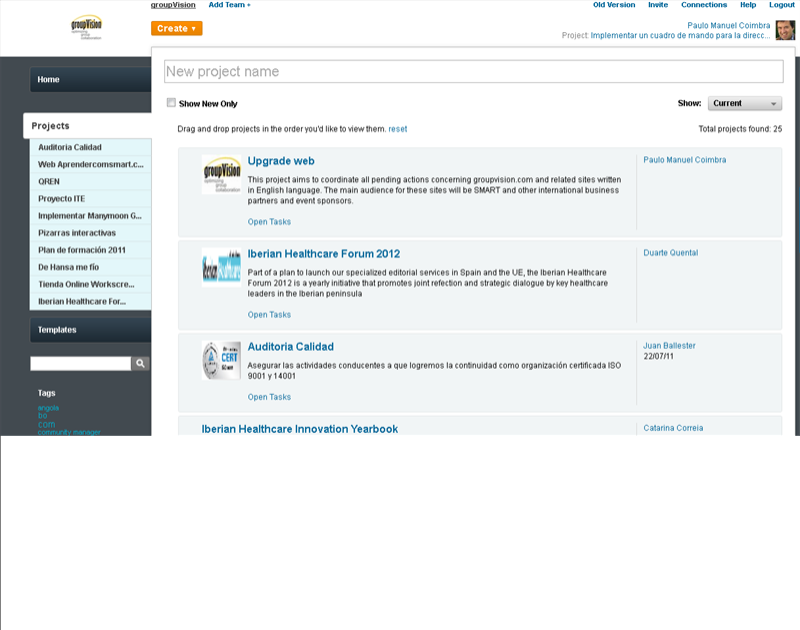
Implementing a web 2.0 project management tool is not a simple task. Be careful. I am talking here about a small organization (50 people) that has since long lived with groupware tools, from Lotus Notes to Groove and currently to Google Apps. Yet, most of our employees still resist cautiously to start using a new groupware tool. There are several reasons for this, but one was clrearly identified. E-mail was still the most powerful and time consuming communication method in our organization. The solution, or at least a part of it, was to use my own example as a CEO. I suddenly realized that if I wanted to have Manymoon fully implemented and take advantage of its built-in time reporting features I really needed to start using the tool myself, which I did, painfully adapting myself to its plain web 2.0 format. However, after the first weeks with Manymoon I found out that I could be proactive in relation to e-mail for the first time in my life. I would start my day looking at all my projects and to comment on the tasks that I have been assigned or that I have assigned to others. Manymoon has a great option which is to e-mail comments, so anyone not yet using Manymoon on a daily basis will be receiving an e-mail with selected comments or tasks that were scheduled to happen. I have started to read e-mail less often and be always attentive to Manymoon social activity, therefore making sure anyone using the tool would have his or her CEO immediate attention, which is not the case for anyone sending me plain e-mail.
Yet the real challenge was still ahead. Manymoon requires a new management attitude to be successfully deployed organization wide. The key to collaborative work is to properly address the "problem solving" process that lies behind any work project. David Strauss' book "How to make collaboration work" was really instrumental here. It explained me the 5 principles of collaborative work, and if properly applied these can be instrumental in setting up the right dynamics for great project management with Manymoon, or whatever other management tool you would be choosing to use. However, I confess, we also made it without following any of the Strauss' principles, but the results are derived from pure instinct and I wanted to have an organization relying on a sounder principle than that. As Kurt Lewin once wrote "there is nothing as practical as a good theory".
Starting from an upside-down organization with a clear focus in operational excellence, we found that work time management was a key competing advantage. So, in order to proactively manage our work time, we implemented a project management tool only to discover that the secret of success is really how to make "collaborative work" work. That led us to our final discovery - our own internal meetings architecture.
Our company specializes in groupware technology and since a long time has been the distributor of SMART Technologies – a market leader in collaboration solutions. We are so used to use the SMART Board interactive whiteboard as a productive enhancement for our internal meetings that we never thought about the importance of having an established "meeting protocol" for our own internal meetings - a protocol that implements the Strauss principles of group collaboration. This was created and has been widely explained and accepted by everybody in the company. Once this protocol was implemented our meetings’ administration dramatically improved. More recently we are trying to improve our meeting processes and started to re-use a series of "meeting heursistics" or project templates published by The Grove Consulting, SF, CA. These meeting heuristics provide the anchors for designing group processes out of which the projects and associated tasks get created in Manymoon. So we are probably on version .3 of our "Organizing 2.0" and we will probably be evolving still further. Great new web 2.0 tools are being internally researched every day. Google Apps such as Mavenlink or MindMeister can greatly complement our internal meeting protocols. But it was the .0 version that mattered the most.
The real benefit of our story - that consists of an intensive internal use of web 2.0 in support of management - was to discover that these tools are useless without a new way of thinking about management. So the implementation of web 2.0 in management really brings a great opportunity to reach the "holy grail" notion of self-management. Employees with clearly aligned goals and sufficient job clarity in terms of both responsibilities and functions, can be the best managers of themselves. When group decision making is made with key management participation, this can become a great quality control mechanism for continuously establishing the company priorities.
Self-management can be an incredible source of motivation for a varied range of jobs and web 2.0 tools can become quite useful as they expose individual accomplishments in wider contexts not only within their own organizational units but in the entire organization.
A few words about the metrics for our case story. Manymoon companywide implementation started January this year (2011). We have currently an excess of 100 projects active throughout the whole of the organization but the time-sheet scorecard filled in by Manymoon's task completion still does not account for more than 30-40% of the total work time. I understand that employees will always have to set time for "reading e-mail" or "attending departmental meetings" but hopefully those type of time records would be diluted in actual tasks within Manymoon concrete projects.
Our plans for the future include extending Manymoon to our extranet and use it as a means to manage projects with our customers. But this would be matter for another MIX story: "how to develop a collaborative sales model".
CEO is a popular acronym that can also mean "Chief Education Officer". That's also an increasingly important part of my job. To convert tacit knowledge in written norms that allow us to enhance our collaborative work, something that pertains mostly with meeting architecture. To train people on how to facilitate meetings and the way we design our internal meetings, using the right problem solving heuristics, are all critical elements for implementing web 2.0 as a management support groupware technology.
If you have a clear vision for were you are heading, do not be deterred if you do not have all the answers from the start. Engage your organization change process as if it was a 2.0 version in itself. The .0 is really just the first bold step of an entirely new vision for which you have to establish the major foundations. Go ahead and start the process, the full picture will be completed sooner than you think, provided that your are fully attentive to the collective learning that is constantly generated.
The books from David Sibbet "Team Perfomance Guides", published by The Grove Consultants International, SF, CA.
Manymoon - project management web 2.0 tool, recently acquired by Salesforce.com
You need to register in order to submit a comment.