


Story:
Boeing's Workplace Innovation Lab - Engaging 'Generation Y' as a powerful catalyst for productivity and change
Boeing has piloted a bottom-up approach to innovation in leadership, productivity and new ways of working. The Workplace Innovation Lab pairs 'Gen Y' employees with their manager and provides 90 days’ support to accelerate business priorities, focusing on leveraging personal networks, powerful conversations, and new technologies.
Boeing is the world’s leading aerospace company and the largest manufacture of commercial jetliners and military aircraft combined, providing products and tailored services to airlines and U.S. and allied armed forces around the world. Boeing leverages the talent of 158,000 people across 70 countries with a diverse range of business and technical skills.
Like many organisations, Boeing faces the demographic challenge of losing expertise as Baby Boomers move into retirement, as well as needing to engage and retain young ‘Gen Y’ talent who represent the future workforce.
- Boeing’s Strategic Workforce Planning (SWP) organization recognized the need to build a newly-engaging work environment that would enhance knowledge sharing and collaboration across 4 generations in the future workplace. But changing leadership, culture and working practices is hard. SWP were seeking innovative ways to do this.
- In 2009 the business environment was uncertain, in the face of world recession, strong competition and long-term diversification of the aircraft market. The business focus in this year was on growth, productivity, leadership and functional excellence.
- Recognising that under such pressures, the best way of growing leadership skills would be within a real business context, SWP worked with long-term partners Career Innovation (Ci) to pilot a new approach which brings together early-career ‘Gen Y’ talent and experienced managers in a Workplace Innovation Lab
- The Lab emerged from discussions between Ci and Boeing, and from the shared belief that a more decentralized, bottom-up experimental approach is needed to achieve faster organizational development and change.
The Lab was ground-breaking for Boeing in a number of ways:
- It brought together highly experienced managers with early-career employees, enabling ‘reverse mentoring’ (e.g. on new technologies) when needed
- The focus was as much on embedding new capabilities and ways of working for the future, as on generating immediate business results.
- Unlike many training programmes it was entirely voluntary, based on enthusiasm for learning and for their ideas for business improvement or innovation. It was aspirational rather than remedial learning.
- It represented, for us, an experiment in bottom-up adoption and sharing of new technologies and ways of working. Potentially: A new approach to IT, HR and the management of change.
Here is the timeline in detail:
February 2009: Boeing SWP contacted REACH members (a network for early-career Boeing employees) and their managers to seek volunteers to participate in a pilot Workplace Innovation Lab, a ‘bottom-up’ approach to building leadership skill and accelerating change. The pitch was that volunteers would commit to spending 24 hours over 3 months, including 2 face to face workshops and would receive support achieve a business goal or project of their choice. Feedback was positive and a list of volunteers was quickly put together.
March – April 2009: Working closely with SWP and members of the REACH network, the Ci team designed the Lab programme, which combines new ways of working (via conference call and using on-line tools) with more conventional face to face workshops. The aims were:
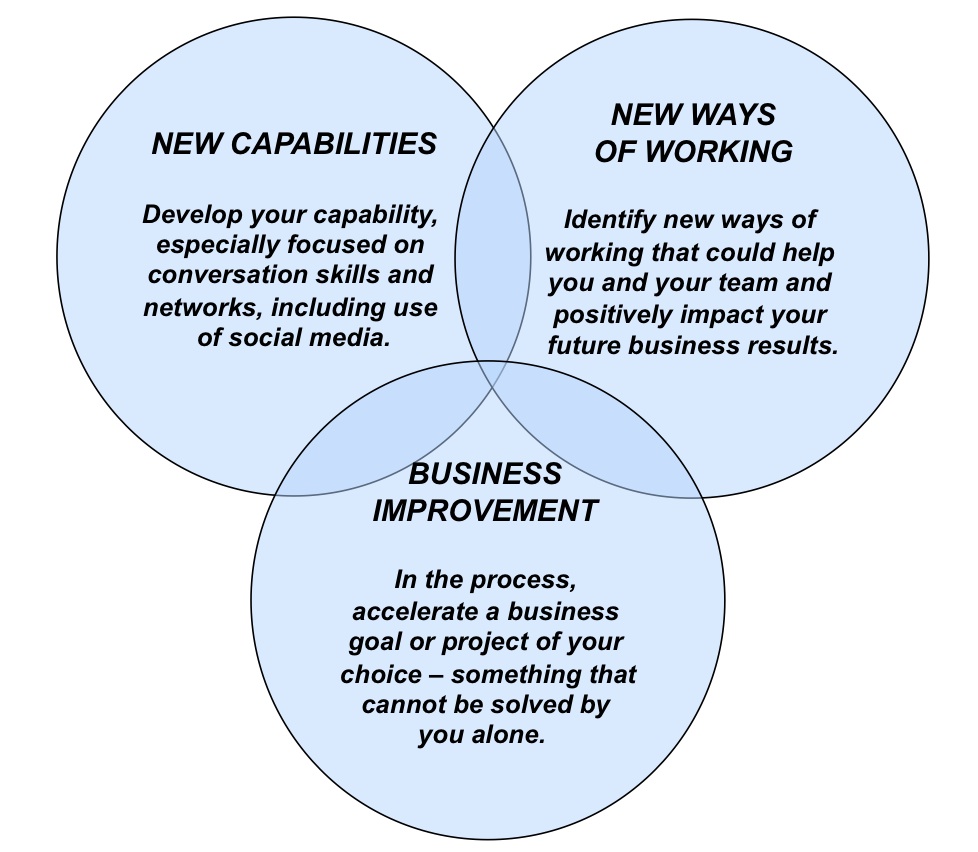
- to develop next-generation capabilities, especially focused on conversation skills and networks
- to identify new ways of working (including new technologies such as social media) which help teams positively impact on future business results
- accelerate a business goal or project for each participant
Design of the Lab drew on Ci’s ‘Conversation Gap’ research which clearly identifies the importance of dialogue in creating high performance and development, the key leadership skills which the Lab aimed to develop are 1) conversation skills and 2) understanding and mobilization of personal networks.
March 2009: A formal invitation to REACH members and their managers was sent and 13 ‘pairs’ of manager/REACH member volunteered.
April – June 2009:
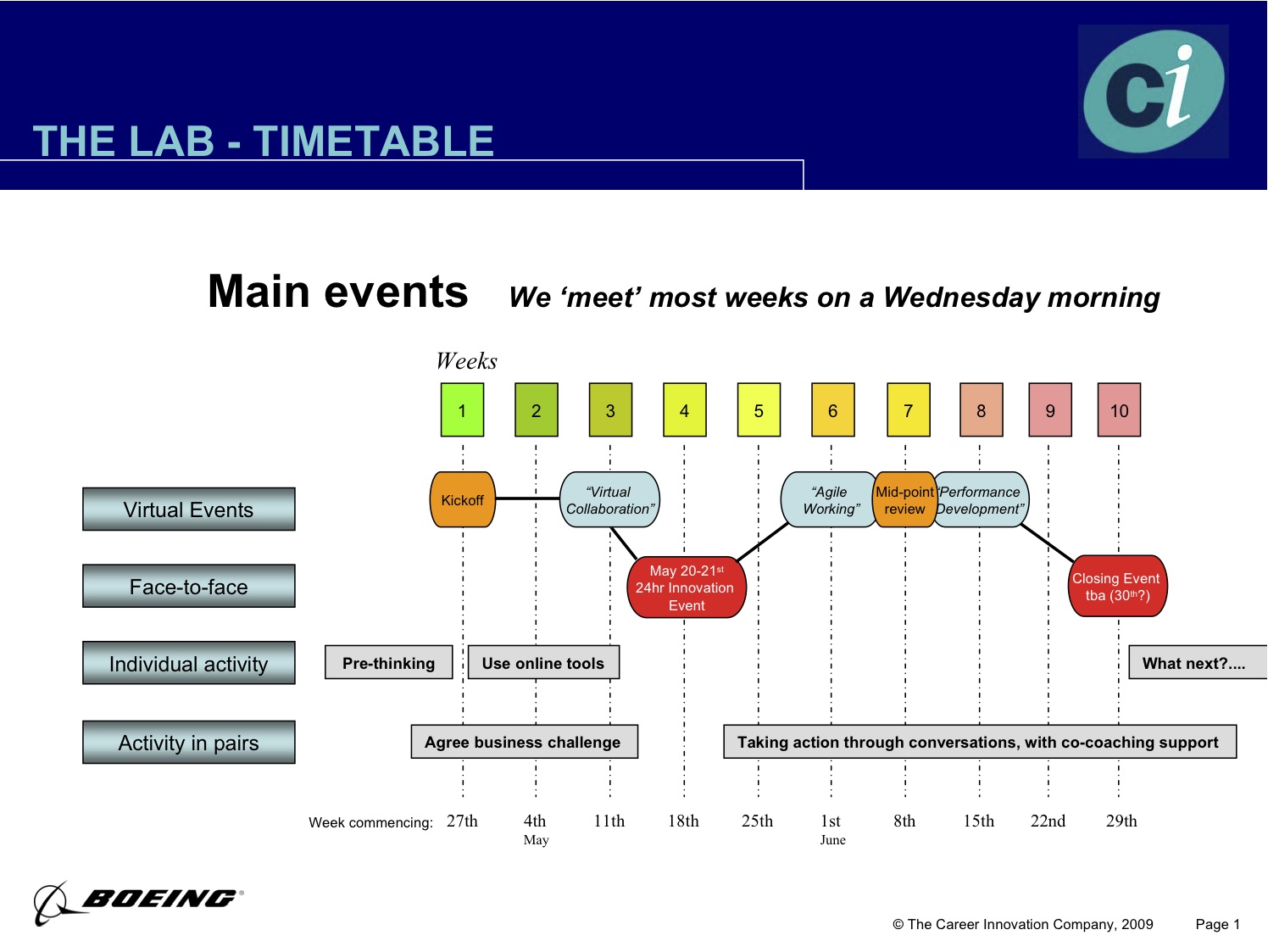
- The Lab kicked off in April with a conference call to introduce the Lab and invite participants to identify a business challenge they aimed to address with the support of the Lab.
- Participants were also invited to complete an on-line tool, in preparation for the 24-hour Innovation event: for managers, Ci’s Engaging ConversationsTM feedback tool, for REACH members Ci’s CiZone on-line career tools.
- Over the next 10 weeks, a series of conference calls (‘Virtual Roundtables’) on three areas were held, providing stimulus to new thinking:
- Virtual Collaboration: Using new technology, including social media, to support teamwork and collaboration across the generations
- Agile Working: deploying alternative employment contracts and flexible working to build responsiveness and reduce fixed costs
- Trust and Engagement: building a highly engaged, purposeful culture in which skills are developed and talent is mobilized
- Mid-way through, a 24-hour ‘Innovation Event’ was held, when participants came together for an intensive programme of theory and practice. A key outcome was each individual mapping their own networks and conversations in relation to their chosen business challenge. Over dinner, Ross Smith (a manager from Microsoft) shared his experience of building trust and improving productivity within a team, using a conversation-based approach.
September 2009: The SWP team and Ci reported back initial outcomes from the Lab pilot to the global head of HR for Boeing, showcasing the results from 3 business challenges (elected by the participants) to demonstrate tangible results from the Lab.
Challenge: Some managers were less engaged and this had the effect of de-motivating their younger colleagues.
Solution: In response, we gave them real opportunities to opt out (to emphasise the voluntary nature of the Lab). They all opted to continue.
Challenge: For an initiative about new ways of working, all participants need to be able to use basic collaboration tools like web ex, share point, global conference calling. However we stumbled with the use of these tools –we had overestimated participants familiarity with them.
Solution: In response, helpful guidelines were shared between participants, one younger participant became the group’s informal guru on the tools, and we also spent time on each conference call showcasing an existing Boeing tool or resource – not just bringing in entirely new ones. This was effective in building the essential skills for these emerging technologies.
The aims of the first pilot Lab were:
- Performance improvement through more collaborative working
- More effective ways to transfer expertise across the generations
- More productive use of investment in collaboration tools
- Helping leaders to be people-leaders as well as technical-leaders
Feedback rated very highly the focus on business challenges as a learning tool, and the chance to work in employee+manager pairs – for the REACH members, it was particularly important to work with managers as peers. Practical tools and different perspectives explored through the Lab experience encourage thinking in new ways. Progress was accelerated in many of the business challenges chosen.
|
Knowledge transfer and improving virtual collaboration |
“(By using InSite)… each person will know how to make better use of their network and the resources in it, which will save time, reduce OT, reduce overhead costs, and increase overall revenue.” |
|
Cost reduction
|
Opportunities for cost/resource saving identified eg - change to process “At minimum we anticipate the following: Improved employee morale, potential cost reduction and an increased opportunity for folks to raise environmental concerns.” - Change to team structure “We’ve restructured the team to address resource issues, moving from a geographic work structure to one that is programmatic” |
|
Improved communications between managers/employees |
Several teams reported a positive impact from direct manager-employee interaction: - results in positive two-way mentoring – both benefit - using manager-employee teams to problem solve is extremely effective Evaluation: average score 4.1(max 5) for increased awareness of other’s perspective (manager/employee) “Opened communications between the management level and the technical workforce on our project... (manager) will increase the amount of 1-on-1 interaction with team members.” “Having the manager-employee team was extremely effective… (combining) people who have the power to get things done with individuals who are seeing the problems differently…” “We will also seek to have more continual, engaging conversations so that ‘change’ doesn’t necessarily need to appear overwhelming” |
|
Increased motivation/engagement amongst participants
|
Feedback from participants: “A paradigm shift in how we viewed our problem – instead of asking why they leave, ask why they stay” “It was motivational to see Boeing willing to experiment with innovative new ways to work and involving employees in their development “ “The Lab helped me think more creatively in the area of teaming virtually and non-virtually. Before the Lab I was just operating status quo without questioning approaches or trying to think of new ways to make communication more effective, especially in virtual situations.” “This Lab is a great example of the courage needed to go out on the edge and not be afraid to experiment with new ideas.” “This Lab helped both the project manager and the new hire employee better understand each other’s issues, views, and thinking. It would not have happened without this Lab….. The increased worth felt by the employee, and the insight gained by the managers will not only benefit our current projects, but will pay dividends for life for both participants.” |
We learned that there is real power in bringing together different generational perspectives, and in using the energy and questions of early-career employees to stimulate change. In the past this has been rare.
However this needs communicating very clearly as a completely new approach. It was still surprisingly easy for some people to fall back into perceiving the Lab as a training programme outside the day-job rather than a license to experiment and learn in support of the day-job. People found it hard to see the connection between learning and immediate work performance.
The underlying “learnings” are hard to quantify---the improved relationships between participant and manager; the improved understanding of eachothers’ perspective; the impact of the manager demonstrating the importance of the project---all of these elements we believe are crucial to employee engagement and ultimately to retention. However they are rarely measurable in the short term.
In future Labs we will therefore seek to ensure a critical mass of participants from a single business area so we can generate more focused and measurable business impact. For the pilot the participant group was diverse, from across The Boeing Company. This led to a very stimulating group, opportunities to share knowledge broadly, and a fascinating mix of business projects. However it was harder to track the impact in terms of hard business metrics.
Some of the most powerful lessons learned by the participants themselves were:
- that communication tools should be varied according to the importance and urgency of the communication;
- that a less seasoned employee can bring fresh perspective and valuable insight to a long standing business problem;
- that having a manager open to innovative solutions and using young talent in innovative ways can be a powerful retention lever.
Overall, the Lab participants concluded that to be a leader or a team member in an increasingly virtual world, a single-minded focus on building trust is key both to productivity gains and to the use of new tools, technologies and ways of working.
Dianna Peterson, Maria Denzin, Tom Bartlett – Boeing
Janine Nahapiet, Rosemary McLean, Jonathan Winter - Ci
With special thanks to all the pilot Lab participants, including the three ‘showcase’ pairs who were elected by their colleagues to present their business innovations/improvements to a global board member:
Faith Norley & Kristin Rediker, Steve Cameron & Kristian Georgiev, Kelly Buchanan & Danielle Vardaro.
- The Digital Generation Initiative, a global study of young talent and their use of social networks and other new communication technologies: www.theDgeneration.com
- A study of new ways of working and their potential positive impact on organisational agility: www.CiManifesto.com (summary can be downloaded below)
- The Conversation Gap research which showed that leaders can increase engagement - sometimes quite dramatically - simply by creating an agenda-free space for open, engaging conversations: www.theCgap.com (summary can be downloaded below)


Thanks Stuart. Yes both those were vital: We felt it was important that the Lab should be entirely voluntary and self-nominated, although there were some criteria applied before people could be part of it. Also the cross-generational aspect was a real success, recognising the value of very different perspectives. Reverse mentoring works particularly well when there is something obvious that the younger generation can add, such as technology capability (including social media).
- Log in to post comments
You need to register in order to submit a comment.