


People used it in one way or another, from the gold rush to false bourgeois, from posh style to politics. Whether by force or law, the real name of the game in human attending to avoid responsibility and slow the process of decision, is bureaucracy.
Bureacracy is the modern form of the "shaped supremacy" against the core of a problem. In the wake of self-aware of bureaucracy destructive effects over economic output, market participants thought only state sectors are plagued by bureaucrats. The most pervasive consequence of bureaucracy was the common thought that it affects especially state institution, whereas private sector and free market principles are behind the strong shield of modern management knowledge. Should we have acquired earlier this fact, bureaucracy would have been less powerful. To fight properly against an enemy, you should manage to know it. What exactly is a bureaucrat and what makes him tick?
The steam of the bureaucrat's engine is started by the following characteristics: 1. The bureaucrat has a perfectly rational economic behavior. 2. The bureaucrat shows avoidance of risk-taking and of personal responsibility. 3. The bureaucrat defines his positional and job optimality through low competition. 4. The power of the law is what makes the bureaucrat to stay in the limits of his job description and does not let him to create situations in which he abuses the power that the job gives him; for this we can state that he has a law obeying behavior. 5. The bureaucrat is following the idea of shape and not of core business development, a situation similar with the European path of giving resolutions in legal and administrative businesses. Taking all these into account, seemingly that bureaucrats are rather to be encountered in state administration than on the free market, hence a hard time understanding in the bureaucratic issues in private sector. If anything at all counts for this perception, let us only think of the Wall Street' C-suites, and the brink of financial sector destruction that world faced in 2007. We can look further to sovereign debt crisis. The collapse of the system where bureaucrats live means also the collapse of them. We saw their profile, but what about the economic perspective? Bureaucrats are law obeying citizens, whereas all the other people are law abiding citizens. An action movie with this name ("Law Abiding Citizen") was across cinemas all over the world a couple of years ago. Bureaucrats should see it; perhaps they will do us a favor understanding this important difference. They defend themselves by underpinning the legitimacy of law, but their paranoid respect for law turned into a reason to live. They transformed a tool into a goal. Law should be used to regulate our lives, not the other way around. Bureaucrats face virtually no risks, and low competition. They have the law on their side, forgetting that nothing is perfect, but perfectible. Laws have been adapted through human history, better laws foresee the availability to change and to break patterns. Change is focused on the core, not on the shape, even change is sometimes reshaping. The rigidity of the bureaucrat's profile is under the shadow of the fear of change. Bureaucrats are paradoxically motivated in their pattern of stability that they are struggling to keep. Therefore the cost of change, which they evaluate as high, and the opportunity to change, which they constantly avoid, could provide a solution to reduce the extent of bureaucracy and the damage it brings to market. We should stand for the metamorphosis of the bureaucrat into an evaluator of opportunity cost. And along with this new profile, we also should pay the bureaucrats more. How this could lead to the fall of bureaucracy instead of making it looming?
The real impact on the market for bureacracy is in the used human resources that are reshaped for a better marginal productivity or a better way of using their services. For in depth awarness on the evolution of bureaucrats and bureaucracy we can see some of their transformational advantages:
I. Bureaucrats are transformed, let's say, by the human resources officers, in evaluators of opportunity costs, but a cost from the perspective of the firm, not theirs.
II. They evaluate their own jobs, and make a report about the future of the firm, without their posts.
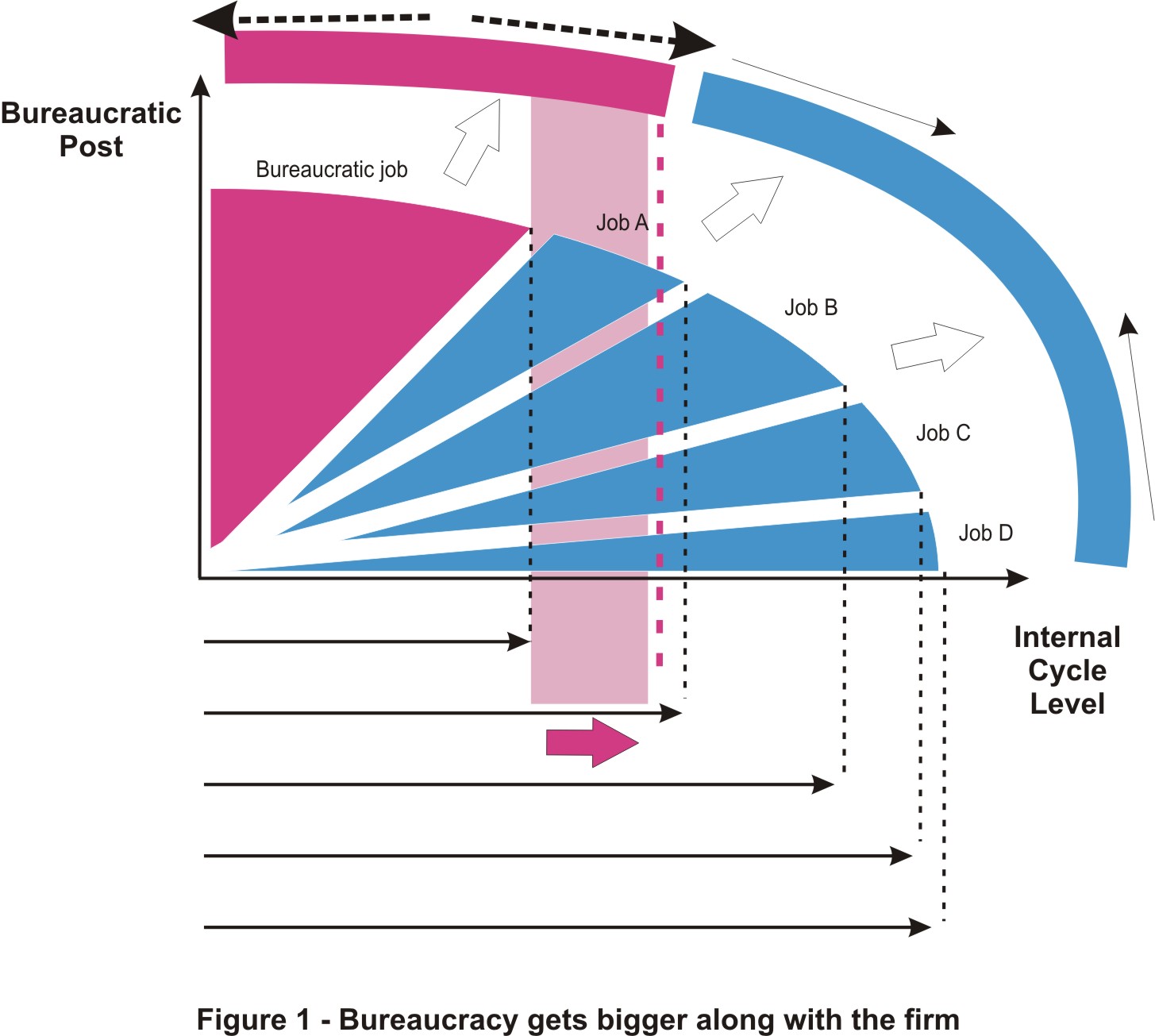
II.1. A bureaucrat discovers that his post is totally useless for the firm, and makes a sincere statement about that. Nevertheless, to be motivated to be sincere, the bureaucrat is given some assurances about his future. The firm will fire him, giving compensatory payments, but along with important savings obtained through the fact that the bureaucrat gave up his post. The more departments in the firm, the bigger the bureaucracy, as can be seen in figure 1 (see Helpful Materials section), hence the interest of the firm to reduce the number of posts.
II.2. Most probably, the bureaucrat will not be sincere. He assures the firm that his post is essential, but who says that his very own person is that most suitable for that post? Hard time for him to give a sincere answer. But competition, which he has avoided ever since, could provide a solution. What is to be done in order to raise competition?
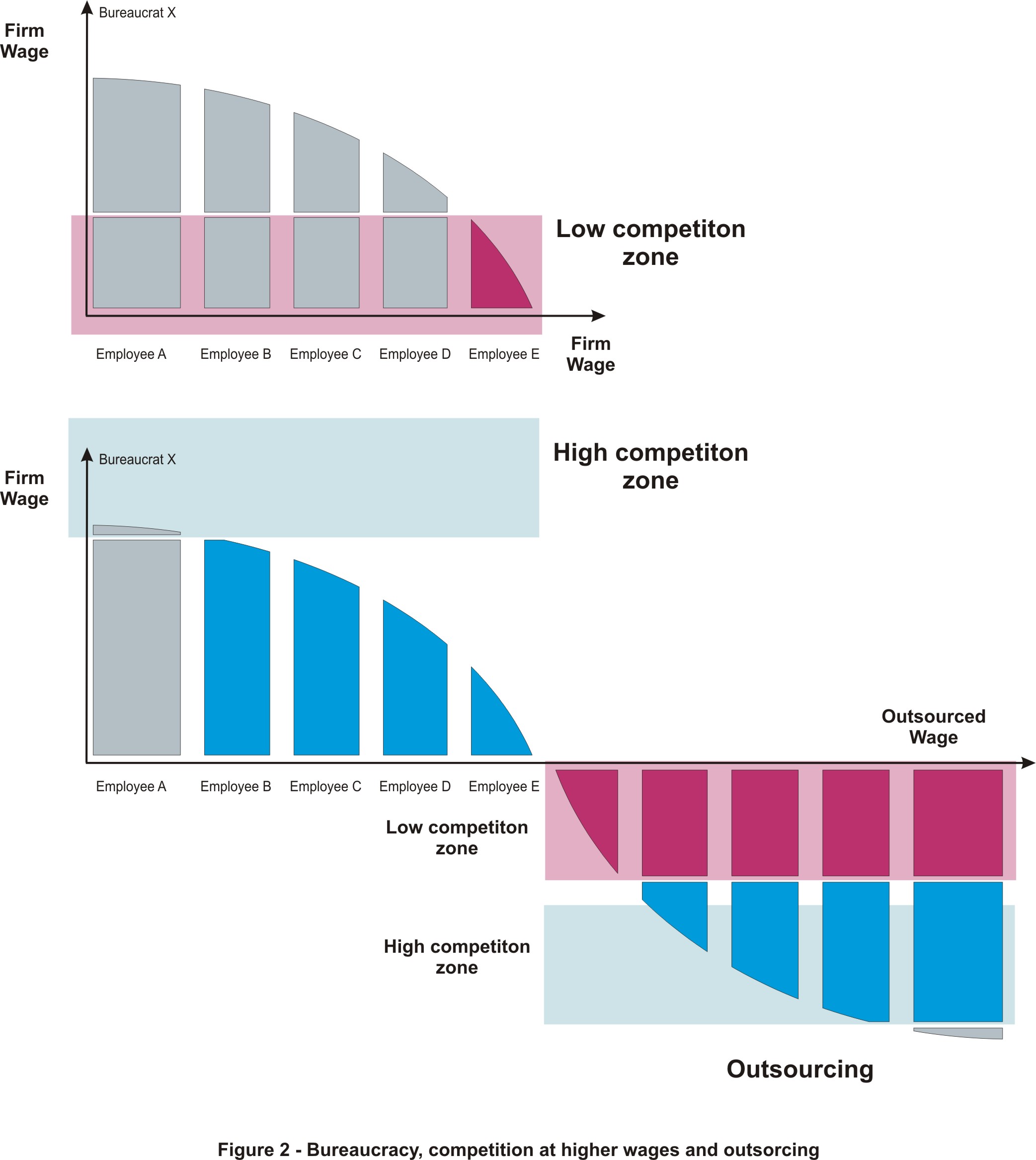
III. A rise in the remaining bureaucrat staff wages will follow and ... will make bureaucratic posts less appealing for bureaucrats and more appealing for non-bureaucrats. But will bureaucracy contract? Yes, of course, because bigger wages will come along with bigger responsibilities, the former bureaucratic posts will be bureaucratic no more. Bureaucrats will find themselves besieged by other people who targeted the same posts, very appealing because of the big wages. Along with the competition they usually avoided, bureaucrats are also under siege of brand new responsibilities. As figure 2 (see Helpful Materials section) shows, at low wages there is a low competition level, where only one person is interested about the bureaucrat's job. But at high competition level, there are several more. The bureaucratic profile of the post could implode under competition and bigger wages.
Due to the niche that this hack addresses, we need to see the breakdown structure of the decisional hierarchy and the connections or multi-links that are created between posts, be it in a vertically or horizontally deployment.
The first step is to underline the relations between decision makers, the problem' issuers and the mechanism that links the problem (the hypothesis and the conclusion) to the solution.
Another component that is important in the work process is the time gap between when the problem appears, it is noted and the moment when a solution is given. This time frame must be seen from two vantage points:
- from an abstract view: the time for one problem to appear, to be noted and to get solved.
- from a general view: the sum of the problems (issues) that are in a company, at the same level of responsibility or at other levels.
Grigore Ioan Pirosca, Ph.D. Lecturer at the Bucharest Academy of Economic Studies, Romania, is the "idea man" behind this hack and together we tried to create an external theoretical model that could be implemented on the short run in organizations all over the world and with small initial costs for implementation.
You need to register in order to submit a comment.