

Hack

Hack: Manage Your Own Performance: No One Else Can!

by Fred Nickols - Managing Partner at Distance Consulting, LLC

July 14, 2011 at 6:56am

3 Ratings:

  • Overall 4
  • Innovative 4.33
  • Detail 3.67

Contribution Summary

Summary
The so-called shift to knowledge work was actually a shift from prefigured to configured working activities.  It brought with it a shift in the locus of control over the worker's activities - from management to the worker.  Management has yet to realize that many employees must now manage their own performance instead of having it managed for them.  Nor has management figured out how to deal with self-managed employees.  Management must recognize that people are "living control systems" and deal with them as such.
Problem
When it comes to managing the performance of people, management's mindset is stuck in the industrial era.  Management is still focused on compliance and it seems oblivious to the fact that many if not most people must figure out what to do instead of simply doing what someone else has figured out.  As a consequence, management is robbing itself of the many valuable contributions that employees could make to the organization - if they were treated as agents, capable of acting on their employer's behalf and in their employer's best interests.  In a world of work where the worker must figure out what to do - and in which the worker is often the only one capable of doing so - a focus on compliance is not only counter-productive, it simply makes no sense.  Even if employees would mindlessly obey the boss' orders, the bosses can't issue the necessary orders.  For at least the last 40 years management has floundered around trying to find new and better ways of getting employees to do their bidding - and to do so happily and productively.  Management has pursued knowledge management (including efforts to extract and capture it from the people who possess it), it has tried to foster involvement and participation and, most recently, is in hot pursuit of employee engagement.  The fundamental problem is that management is still focused on controlling employee behavior and it continues to delude itself that it can "pay for performance" and get what it wants that way.  It can't.  In today's world of work, the only person who can manage, improve and engineer a particular person's performance is that person.  To effect the necessary shift in management practices related to people and their performance, management must adopt a very different view of people, their behavior, their role in organizations, their performance and the means of enabling and supporting it.
Solution
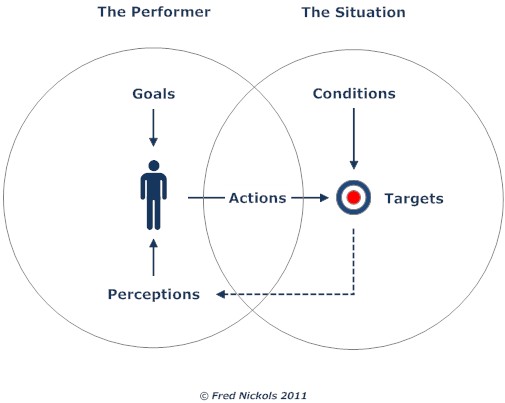
First, management needs to adopt a view of people as "living control systems."  People set and pursue individual goals and they vary their behavior as necessary to achieve and maintain those goals.  Moreover, they do so in fluid, ever-changing situations that are often marked by obstacles and barriers that must also be overcome.

Second, management needs to deal with people as self-managing agents, as people who are capable of and perfectly willing to act on their employer's behalf and in their employer's best interests.

Third, management needs to re-educate itself regarding the basic nature of human behavior and performance.  It needs to dismiss the erroneous stimulus-response-reinforcement view of human behavior and it needs also to dismiss the equally erroneous cognitive view of human behavior as programmed and programmable.  Instead, it should adopt of view of people as "living control systems" - as closed-loop, feedback-governed entities who can achieve stability in results under unstable conditions.

Fourth, with an appropriate view of people in mind, management needs to seriously re-examine and re-engineer the practice and the practices of management.  For one thing, it's not enough to listen to people; you must also act on what they tell you.  People must see that what they say makes a difference.  If not, they simply won't tell you what they think.  For another, you must devote considerable time and energy to assuring people that they can in fact operate in a more or less autonomous fashion.  For yet another, you must negotiate with employees the same way you would with any supplier.  Beyond that, you must be open to the possibility that the employee will have better ideas than management, including yourself.

Finally, despite all the changes that have occurred, the fundamental task of management has not changed: It is still a matter of concentrating and channeling organizational energy along productive lines.  What has changed is how that concentrating and channeling is accomplished - and who does it.

Practical Impact
  • Improved performance of people, management and organizations
  • Reduced costs of poor performance, loss of talent, and missed goals and objectives
  • Increased levels of participation, involvement, commitment and engagement


Challenges
The primary obstacles are management's industrial-era view of employees and its commitment to outdated and ineffective ideas practices.   For example, "pay for performance" has been shown to be ineffective and at odds with research regarding the reasons people do what they do.  It is a practice that should be discarded.

In turn, "pay for performance" drives the requirement for the universally-disliked practice of conducting performance appraisals.  A performance appraisal bestows very little in the way of carrots but it can do great damage so it is a "big stick" that quite literally makes the boss the boss.  Most important, performance appraisals actually have very little to do with performance.  Performance appraisals, too, should be discarded.

In recent years, employees have come to deeply distrust and mistrust management.  Any effort to recognize the true nature of employees and to work with them on that basis will be met with skepticism and guarded reactions.  The only organizations likely to succeed with such an endeavor will have to be led by executives who understand and appreciate the true nature of human beings as "living control systems" and who are willing to reshape the management practices of their organizations to capitalize on the contributions that employees could make to the organization.

Finally, to reengineer the practices and the practice of management and to reshape the nature of the relationship between an organization and its people is no small undertaking.  It will require a considerable investment of time and money, it will entail patience, tolerance and persistence.  It is also a long-term endeavor; the practice of management will not be engineered overnight.
First Steps
  1. Select a test bed - an organizational unit where improvements in performance would have significant payoffs.
  2. Find a manager/executive who is willing to lead, shepherd and support a year-long experiment with new and different ways of managing, improving and engineering individual and organizational performance.  If necessary, replace the current leader of the TBU.
  3. Educate the managers and the employees in this test bed unit (TBU) about the true nature of people as "living control systems."
  4. Equip the managers and the employees in this test bed unit (TBU) to approach the issues of performance from this new and different perspective.
  5. Provide ongoing support and encouragement for this experiment - from the very top of the organization.
  6. At the end of the first year, evaluate the impact. 
  7. Assuming the results in step 6 are favorable, begin the ultimate task of weaving a performance engineering capability into the fabric of the organization, equipping all employees - from the CEO to the clerks - with the ability to engineer, manage and improve their own performance.


Credits
Credit for the underlying theory of people as "living control systems" belongs to William T. Powers, the creator of the theory known as Perceptual Control Theory (PCT).

Credit for this particuar effort to apply PCT in a practical vein to human behavior and performance in the workplace belongs to me, Fred Nickols, and also to Bill Powers for the support and encouragement he's given me over a period of many years.
Tags
Performance, Management, Control, Work, Workers, Working, Autonomy
Helpful Materials
http://www.nickols.us/controltheory.html
Images:
  • Performer and Situation.jpg
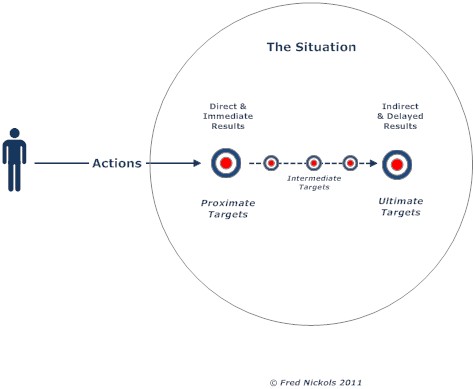
  • Target - Proximate - Ultimate.jpg
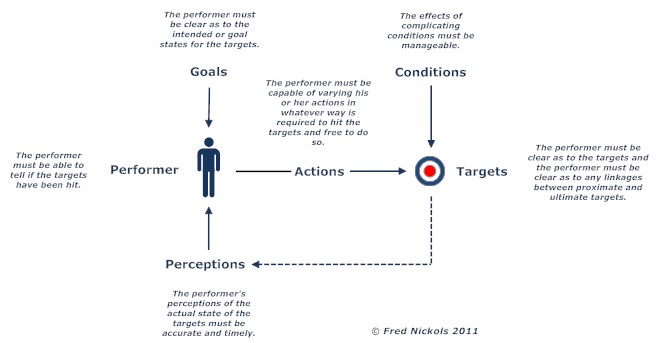
  • Target Model - Annotated.jpg
Videos:
  • No videos at this time

Input

You need to register in order to submit a comment.

Join the MIX Now

You need to register in order to rate this contribution.

Join the MIX Now

Comments

Glenn Behenna

Hi Fred, Thanks very much for your very interesting and thought provoking article. It rang a number of bells of truth for me, having been a manager and now being a team member, a member of faculty at university and a consultlant in knowledge management of all things. You touch upon so many rich areas which I hope to use as inspiration for some of my classes, at Undergraduate and particularly Masters level and even (if not especially) for my middle managers in the workplace who receive the dubious benefits of my consultancy. Once again Fred, you have brought a refreshing simplicity to an often complexly presented topic area. Thanks very much. Kind regards, Glenn