

The World of Work is changing, but who is driving the change?
Leadership in the the 'New World of Work' should focus your transition efforts on work. Not work/life balance. Not better pay and benefits. Not flextime or telecommuting. Not sabbaticals or volunteering. Not toxic bosses or bureaucracy. Not annual performance reviews. While there’s validity to each of these, and all similar issues, leadership in the NWoW is about the design of work — something that has yet to be fully pulled out of the Industrial Age.
The World of Work is changing, but what is driving the change?
Today’s business world is characterised not just by the ‘flattening’ of the world, hard globalisation, speed of technology, the changing demographics and the financial crisis, but also a shift in the priorities of employees. Employees now demand more from their employers than at any time in history. Globalisation, flatter hierarchies, sophisticated technology and strong employee values are setting the agenda for the New World of Work. Add to this the changing demographics and the financial crisis and you start to realise that organisations need to rapidly change to keep up!
The New World of Work model should focus your transition efforts on work. Not work/life balance. Not better pay and benefits. Not flextime or telecommuting. Not sabbaticals or volunteering. Not toxic bosses or bureaucracy. Not managing different generations or performance reviews. While there’s validity to each of these, and all similar issues, the NWoW is about the design of work — something that has yet to be fully pulled out of the Industrial Age.
Purely corporate-centered structures are not sustainable when compared to unleashing the brilliance of every individual within those structures. The power of optimising the skills, efficiency and productivity of individual employees in the New World of Work will increase the overall productivity more significantly than in the past with company-centric models.
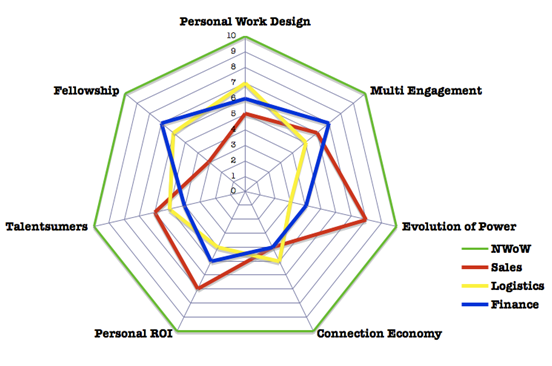
As a first step to finding out where you are on your journey to the New World of Work we conducted workshops using our ‘NWoW Transition Model’.
What’s Behind the Seven Pillars of the Transition Model?
Taken together, they define the NWoW: An environment where the workforce is finally viewed as investors in their company. Leaders use worker assets — time, attention, ideas, knowledge, passion, energy, and social networks — to make their company go. The NWoW is all about how to leverage their working capital, and how not to. Full-time employees or contract labour, salaried or hourly — doesn’t matter. Under the NWoW, on a project-by-project basis, the workforce will choose whether to invest their experience, knowledge, passion, and energy and how much to invest
The information is captured through a series of workshops using a process of semi-structured questions designed to encourage free-flow dialogue and debate with the opportunity for delegates to share real life examples and suggestions for improvement.
Fellowship – Engage and Cultivate Vs Command and Control
In the Old World of Work isolated leaders created and communicated their vision through command and control. Leadership in the 21st Century is not singular. The primary objective becomes about harnessing, embracing and unleashing the talent within the organisation. Fellowship is about understanding how effective the senior team is in creating a compelling vision and a common cause that resonates and empowers right through the organisation. FF
Personal Work Design – User Centered Vs Corporate Centered
Have you ever heard your people say they are more productive working from home than they are at work? Personal Work Design is about understanding the power of a more “user-centered” culture and the tools, processes and structures that are required to make it an effective reality.
Multi-Engagement – Personal Engagement Vs Mass Engagement
An individual who feels that their skills are not being used, that their real passions and interests are locked away , that their knowledge and difference is overlooked is a disengaged one. True engagement is about going beyond ‘the vision’ and understanding how engaged individuals are on a personal level to make the most of their resources.
Evolution of Power – Horizontal Power Vs Vertical Power
This is about moving power down and throughout the company. It means fostering a culture of trust and understanding how much power people really have over how they work, who they work with and when they work.
Connection Economy – Internal and External Collaboration Vs Internal Teams
The Connection Economy is about being able to go beyond the traditional boundaries and tap into horizontal and external sources of knowledge. Open Sourcing, Open sharing, Crowd Sourcing and Social Networking are all crucial in the New World of Work. Connection Economy is about understanding how easy it is for your people to find and access knowledge to do their job quickly and effectively.
Personal ROI – Personal Return Vs Corporate Return
PROI is a quantum leap away from viewing productivity as a ‘return’ solely from the employer’s perspective. PROI is treating both the employee and employer as investors: It’s about understanding how individual’s investments of time, attention, ideas, knowledge, passions and energy are seen and acknowledged as valuable assets that are fundamental to driving the productivity of the company.
TalentSumers - People as Consumers Vs People as Employees
The lines between people and employees have blurred and as such so has the way in which we need to engage with our talent. TalentSumers is about understanding how well the organisation can attract attention, gain loyalty and communicate in the same way marketers understand brands and how they communicate with their consumers.
We ask delegates to think of the most traditional and staid organisation on one end of the scale (0) and the most forward thinking organisation that embraces new ways of work at the other end of the scale (10) and then plot their perception of their company / division / department on that scale, 0 in the middle of the chart and 10 at the outer edge of a spidergam.

Nice post. You might be interested in my model for effective knowledge-work organisations? See: http://flowchainsensei.wordpress.com/rightshifting/the-marshall-model/
- Bob
- Log in to post comments

Absolutely brilliant article providing an "in depth" look at how 21st century corporate structure can achieve more simply by refocusing their attention on the structure within than the structure created.
I have always maintained the philosophy that a company is comprised of many unique individuals all bringing something unique and different to the table. They each have thoughts and ideas they are willing to share if listened to and each of those ideas produces an immeasurable value of contribution to the company as a whole.
- Log in to post comments
You need to register in order to submit a comment.